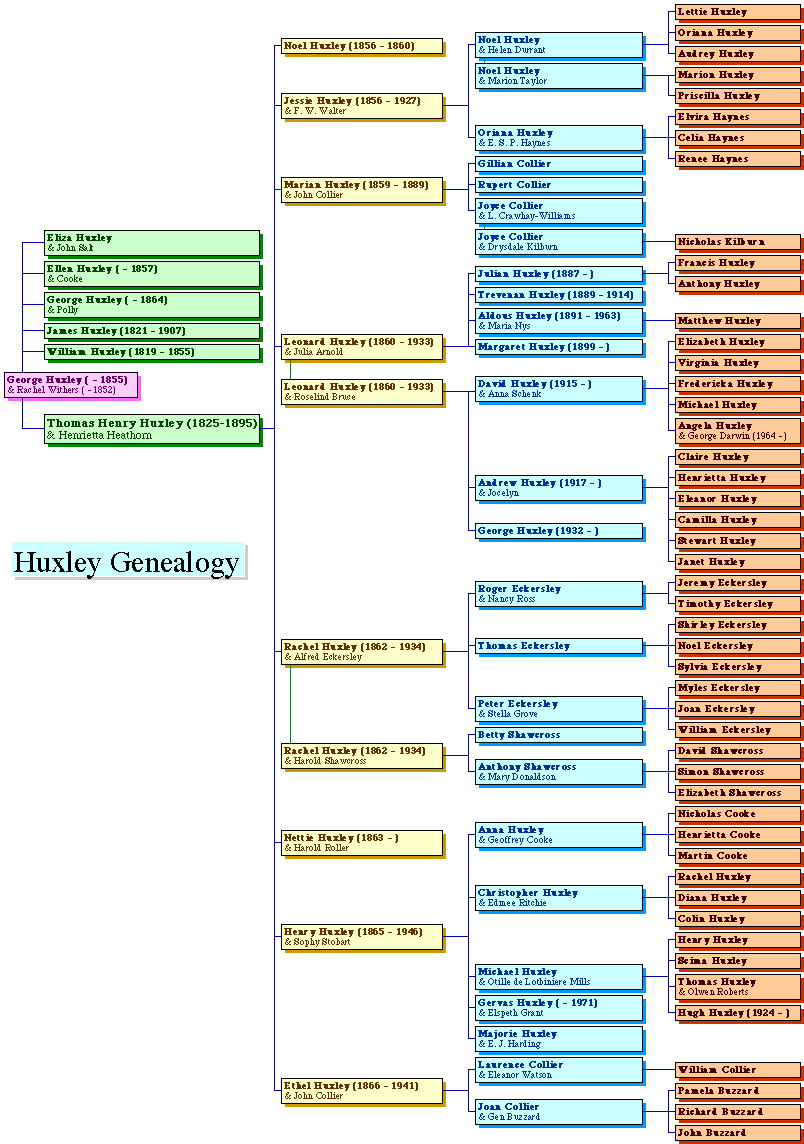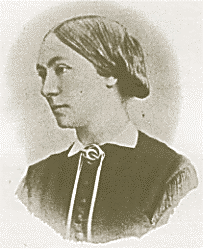
Henrietta Huxley 1857
J. Huxley, Diary of the Rattlesnake
Aphorisms and Reflections
From the Works ofT. H. HUXLEY
Selected by
Henrietta A. Huxley
MACMILLAN AND CO., LIMITED
ST. MARTIN'S STREET, LONDON
1907
PREFACE
Selected by
Henrietta A. Huxley
MACMILLAN AND CO., LIMITED
ST. MARTIN'S STREET, LONDON
1907
PREFACE
Although a man by his works and personality shall have made his mark upon the age he lives in, yet when he has passed away and his influence with him, the next generation, and still more the succeeding one, will know little of this work, of his ideals and of the goal he strove to win, although for the student his scientific work may always live.
Thomas Henry Huxley may come to be remembered by the public merely as the man who held that we were descended from the ape, or as the apostle of Darwinism, or as the man who worsted Bishop Wilberforce at Oxford.
To prevent such limitation, and to afford more intimate and valuable reasons for remembrance of this man of science and lover of his fellow-men, I have gathered together passages, on widely differing themes, from the nine volumes of his "Essays," from his "Scientific Memoirs" and his "Letters," to be published in a small volume, complete in itself and of a size that can be carried in the pocket.
Some of the passages were picked out for their philosophy, some for their moral guidances, some for their scientific exposition of natural facts, or for their insight into social questions; others for their charms of imagination or genial humour, and many not the least–for their pure beauty of lucid English writing.
In so much wealth of material it was difficult to restrict the gathering.
My great wish is that this small book, by the easy method of its contents, may attract the attention of those persons who are yet unacquainted with my husband's writings; of the men and women of leisure, who, although they may have heard of the "Essays," do not care to work their way through the nine volumes; of others who would like to read them, but who have either no time to do so or coin wherewith to buy them. More especially do I hope that these selections may attract the attention of the working man, whose cause my husband so ardently espoused, and to whom he was the first to reveal, by his free lectures, the loveliness of Nature, the many rainbow- coloured rays of science, and to show forth to his listeners how all these glorious rays unite in the one pure white light of holy truth
I am most grateful to our son Leonard Huxley for weeding out the overgrowth of my extracts, for indexing the text of the book and seeing it through the press for me.
HODESLEA, EASTBOURNE,
June 28th, 1907.
I [C.E. i. 16]
There is no alleviation for the sufferings of mankind except veracity of thought and of action, and the resolute facing of the world as it is when the garment of make-believe by which pious hands have hidden its uglier features is stripped off.
II [C.E. i 31]
Natural knowledge, seeking to satisfy natural wants, has found the ideas which can alone still spiritual cravings. I say that natural knowledge, in desiring to ascertain the laws of comfort, has been driven to discover those of conduct, and to lay the foundations of a new morality.]
III [C. E. i 40]
The improver of natural knowledge absolutely refuses to acknowledge authority, as such. For him, scepticism is the highest of duties; blind faith the one unpardonable sin.
IV [C. E. i 41]
The man of science has learned to believe in justification, not by faith, but by verification.
V [C. E. i 46]
No delusion is greater than the notion that method and industry can make up for lack of motherwit, either in science or in practical life.
VI [C.E. i 56]
Nothing great in science has ever been done by men, whatever their powers, in whom the divine afflatus of the truth-seeker was wanting.
VII [C. E. i 57]
In science, as in art, and, as I believe, in every other sphere of human activity, there may be wisdom in a multitude of counsellors, but it is only in one or two of them.
VIII [C. E. i 60]
Nothing can be more incorrect than the assumption one sometimes meets with, that physics has one method, chemistry another, and biology a third.
IX [C. E. i 62]
Anyone who is practically acquainted with scientific work is aware that those who refuse to go beyond fact, rarely get as far as fact; and anyone who has studied the history of science knows that almost every great step therein has been made by the "anticipation of Nature."
X [C. E. i 66]
There are three great problems of our time.... One of these is that doctrine concerning the constitution of matter which, for want of a better name, I'll call "molecular"; the second is the doctrine of the conservation of energy; the third is the doctrine of evolution.
XI [C. E. i 156]
M. Comte's philosophy in practice, might be compendiously described as Catholicism minus Christianity.
XII C. E. i 161]
Fact I know; and Law I know; but what is this Necessity, save an empty shadow of my own mind's throwing?
XIII [C. E. i 163]
We live in a world which is full of misery and ignorance, and the plain duty of each of us is to try to make the little corner he can influence somewhat less miserable and somewhat less ignorant than it was before he entered it.
XIV [C. E. i 165]
The man of science, who, forgetting the limits of philosophical inquiry, slides from these formulæ and symbols into what is commonly understood by materialism, seems to me to place himself on a level with the mathematician, who should mistake the x's and y's with which he works his problems for real entities–and with this further disadvantage, as compared with the mathematician, that the blunders of the latter are of no practical consequence, while the errors of systematic materialism may paralyse the energies and destroy the beauty of a life.
XV [C. E. i 167]
There are some men who are counted great because they represent the actuality of their own age, and mirror it as it is. Such an one was Voltaire, of whom it was epigrammatically said, "he expressed everybody's thoughts better than anybody." But there are others who attain greatness because they embody the potentiality of their own day, and magically reflect the future. They express the thoughts which will be everybody's two or three centuries after them. Such an one was Descartes.
XVI [C. E. i 168]
"Learn what is true, in order to do what is right," is the summing up of the whole duty of man, for all who are unable to satisfy their mental hunger with the east wind of authority.
XVII [C. E. i 170]
When I say that Descartes commemorated doubt, you must remember that it was that sort of doubt which Goethe has called "the active scepticism, whose whole aim is to conquer itself"; and not the other sort which is born of flippancy and ignorance, and whose aim is only to perpetuate itself, as an excuse for idleness and indifference.
XVIII [C. E. i 172]
What, then, is certain ? .... Why, the fact that the thought, the present consciousness, exists. Our thoughts may be delusive, but they cannot be fictitious. As thoughts, they are real and existent and the cleverest deceiver cannot make them otherwise.
XIX [C. E. i 172]
Thought is existence. More than that, so far as we are concerned, existence is thought, all our conceptions of existence being some kind or other of thought.
XX [C. E. i 178]
It is enough for all the practical purposes of human existence if we find that our trust in the representations of consciousness is verified by results; and that, by their help, we are enabled "to walk surefootedly in this life."
XXI [C. E. i 188]
It is because the body is a machine that education is possible. Education is the formation of habits, a superinducing of an artificial organisation upon the natural organisation of the body: so that acts, which at first required a conscious effort, eventually became unconscious and mechanical.
XXII [C. E. i 192]
I protest that if some great Power would agree to make me always think what is true and do what is right, on condition of being turned into a sort of clock and wound up every morning before I got out of bed, I should instantly close with the offer.
XXIII [C. E. i 193]
The only freedom I care about is the freedom to do right; the freedom to do wrong I am ready to part with on the cheapest terms to anyone who will take it of me.
XXIV [C. E. i 198]
Whatever evil voices may rage, Science, secure among the powers that are eternal, will do her work and be blessed.
XXV [C. E. i 202]
There is assuredly no more effectual method of clearing up one's own mind on any subject than by talking it over so to speak, with men of real power and grasp, who have considered it from a totally different point of view.
XXVI [C. E.i 202]
The parallax of time helps us to the true positions of a conception, as the parallax of space helps us to that of a star.
XXVII [C. E. i 242]
If animals are conscious automata with soull the soul stands related to the body as the bell of a clock to the works, and consciousness answers to the soul which the bell gives out when it is struck.
XXVIII [C. E. i 244]
Logical consequences are the scarecrows of fools and the beacons of wise men.
XXIX [C. E. i 244]
The only question which any wise man can ask himself, and which any honest man will ask himself is whether a doctrine is true or false.
XXX [C. E. i 245]
Of all the senseless babble I have ever had the occasion to read, the demonstrations of these philosophers who undertake to tell us all about the nature of God would be the worst, if they were not surpassed by the still greater absurdities of the philosophers who try to prove that there is no God.
XXXI [C. E. i 254]
That which is to be lamented, I fancy, is not that society should do its utmost to help capacity to ascend from the lower strata to the higher, but that it has no machinery by which to facilitate the descent of incapacity from the higher strata to the lower.
XXXII [C.E. i 255]
Time, whose tooth gnaws away everything else, is powerless against truth.
XXIII [C. E. i 256]
Misery is a match that never goes out.
XXXIV [C. E. i 256]
Genius as an explosive power beats gunpowder hollow; and if knowledge, which should give that power guidance, is wanting, the chances are not small that the rocket will simply run amuck among friends and foes.
XXXV [C. E. i 257]
Thoughtfulness for others, generosity, modesty, and self-respect, are the qualities which make a real gentleman
XXVI [C. E. i 261]
The higher the state of civilization, the more completely do the actions of one member of the social body influence all the rest, and the less possible is it for any one man to do a wrong thing without interfering, more or less, with the freedom of all his fellow-citizens.
XXXVII [C. E. i 281]
I take it that the good of mankind means the attainment, by every man, of all the happiness which he can enjoy without diminishing the happiness of his fellow men.
XXXVIII [C. E. 1 289]
Education promises peace by teaching men the realities of life and the obligations which are involved in the every existence of society; it promotes intellectual development, not only by training the individual intellect, but by sifting out from the masses of ordinary or inferior capacities, those who are competent to increase the general welfare by occupying higher positions; and, lastly, it promotes morality and refinement, by teaching men to discipline themselves, and by leading them to see that the highest, as it is the only permanent, content is to be attained, not by grovelling in the rank and steaming valleys of sense, but by continual striving towards those high peaks, where, resting in eternal calm, reason discerns the undefined but bright ideal of the highest Good–"a cloud by day, a pillar of fire by night."
XXXIX [C. E. i 291]
Missionaries, whether of philosophy or of religion rarely make rapid way, unless their preachings fall in with the prepossessions of the multitude of shallow thinkers, or can be made to serve as a stalking-horse for the promotion of the practical aims of the still larger multitude, who do not profess to think much, but are quite certain they want a great deal.
XL [C. E. i 309]
Proclaim human equality as loudly as you like. Witless will serve his brother.
XLI [C. E. i 313]
There is no sea more dangerous than the ocean of practical politics–none in which there is more need of good pilotage and of a single, unfaltering purpose when the waves rise high.
XLII [C. E. i 313]
The doctrine that all men are, in any sense, or have been, at any time, free and equal, is an utterly baseless fiction.
XLIII [C. E. i 319]
For the welfare of society, as for that of individual men, it is surely essential that there should be a statute of limitations in respect of the consequences of wrong- doing.
XLIV [C. E. i 319]
"Musst immer thun wie neu geboren" is the best of all maxims for the guidance of the life of States, no less than of individuals.
XLV [C. E. i 328]
The population question is the real riddle of the sphinx, to which no political Œdipus has as yet found the answer. In view of the ravages of the terrible monster, over-multiplication, all other riddles sink into insignificance.
XLVI [C. E. i 349]
The "Law of Nature" is not a command to do, or to refrain from doing, anything. It contains, in reality, nothing but a statement of that which a given being tends to do under the circumstances of its existence; and which, in the case of a living and sensitive being, it is necessitated to do, if it is to escape certain kinds of disability, pain, and ultimate dissolution.
XLVII [C. E. i 355]
Probably none of the political delusions which have sprung from the "natural rights" doctrine has been more mischievous than the assertion that all men have a natural right to freedom, and that those who willingly submit to any restriction of this freedom beyond the point determined by the deductions of a priori philosophers, deserve the title of slaves. But to my mind, this delusion is incomprehensible except as the result of the error of confounding natural with moral rights.
XLVIII [C. E. i 368]
The very existence of society depends on the fact that every member of it tacitly admits that he is not the exclusive possessor of himself, and that he admits the claim of the polity of which he forms a part, to act, to some extent, as his master.
XLIX [C. E. i 426]
Surely there is a time to submit to guidance and a time to take one's own way at all hazards.
L [C. E. i 426]
Individualism, pushed to anarchy, in the family is as ill-founded theoretically and as mischievous practically as it is in the State; while extreme regimentation is a certain means of either destroying self-reliance or of maddening to rebellion.
LI [C. E. ii 5]
A man in his development runs for a little while parallel with, though never passing through, the form of the meanest worm, then travels for a space beside the fish, then journeys along with the bird and the reptile for his fellow travellers; and only at last, after a brief companionship with the highest of the four-footed and four-handed world, rises into the dignity of pure manhood.
LII [C. E. ii 18]
Not only does every animal live at the expense of some other animal or plant, but the very plants are at war. . . . The individuals of a species are like the crew of a foundered ship, and none but good swimmers have a chance of reaching the land.
LIII [C. E. ii 13]
When we know that living things are formed of the same elements as the inorganic world, that act and react upon it, bound by a thousand ties of natural piety, is it probable, nay is it possible, that they and they alone, should have no order in their seeming disorder, no unity in their seeming multiplicity, should suffer no explanation by the discovery of some central and sublime law of mutual connection?
LIV [C. E. ii 29]
The student of Nature wonders the more and is astonished the less, the more conversant he becomes with her operations; but of all the perennial miracles she offers to his inspection, perhaps the most worthy of admiration is the development of a plant or of an animal from its embryo.
LV [C. E. ii 32]
Matter and force are the two names of the one artist who fashions the living as well as the lifeless.
LVI [C. E. ii 32]
There is not throughout Nature a law of wider application than this, that a body impelled by two forces takes the direction of their resultant.
LVII [C. E. ii 52]
Orthodoxy is the Bourbon of the world of thought. It learns not, neither can it forget.
LVIII [C. E. ii 52]
Who shall count the host of weaker men whose sense of truth has been destroyed in the effort to harmonize impossibilities–whose life has been weakened in the attempt to force the generous new wine of Science into the old bottles of Judaism, compelled by the outcry of the same strong party?
LIX [C. E. ii 58]
When Astronomy was young "the morning stars sang together for joy," and the planets were guided in their courses by celestial hands. Now, the harmony of the stars has resolved itself into gravitation according to the inverse squares of the distances, and the orbits of the planets are deducible from the laws of the forces which allow a schoolboy's stone to break a window.
LX [C. E. ii 59]
The lightning was the angel of the Lord; but it has pleased Providence, in these modern times, that science should make it the humble messenger of man, and we know that every flash that simmers about the horizon on a summer's evening is determined by ascertainable conditions, and that its direction and brightness might, if our knowledge of these were great enough, have been calculated.
LXI [C. E. ii 53]
Why should the souls [of philosophers] be deeply vexed? The majesty of Fact is on their side, and the elemental forces of Nature are working for them. Not a star comes to the meridian at its calculated time but testifies to the justice of their methods– their beliefs are "one with the falling rain and with the growing corn." By doubt they are established, and open inquiry is their bosom friend.
LXII [C. E. ii 59]
Harmonious order governing eternally continuous progress–the web and woof of matter and force interweaving by slow degrees, without a broken thread, that veil which lies between us and the Infinite–that universe which alone we know or can know; such is the picture which science draws of the world, and in proportion as any part of that picture is in unison with the rest, so may we feel sure that it is rightly painted.
LXIII [C. E. ii 76]
Mix salt and sand, and it shall puzzle the wisest of men, with his mere natural appliances, to separate all the grains of sand from all the grains of salt; but a shower of rain will effect the same object in ten minutes.
LXIV [C. E. ii 149]
Elijah's great question, "Will you serve God or Baal? Choose ye," is uttered audibly enough in the ears of every one of us as we come to manhood. Let every man who tries to answer it seriously ask himself whether he can be satisfied with the Baal of authority, and with all the good things his worshippers are promised in this world and the next. If he can, let him, if he be so inclined, amuse himself with such scientific implements as authority tells him are safe and will not cut his fingers; but let him not imagine he is, or can be, both a true son of the Church and a loyal soldier of science.
LXV [C. E. ii 149]
Ecclesiasticism in science is only unfaithfulness to truth.
LXVI [C. E. ii 150]
If the blind acceptance of authority appears to him in its true colours, as mere private judgment in excelsis, and if he have the courage to stand alone, face to face with the abyss of the eternal and unknowable, let him be content, once for all, not only to renounce the good things promised by "Infallibility," but even to bear the bad things which it prophesies; content to follow reason and fact in singleness and honesty of purpose, wherever they may lead, in the sure faith that a hell of honest men will, to him, be more endurable than a paradise full of angelic shams.
LXVII [C. E. ii 229]
History warns us that it is the customary fate of new truths to begin as heresies and to end as superstitions.
LXVIII [C. E. ii 229]
The struggle for existence holds as much in the intellectual as in the physical world. A theory is a species of thinking, and its right to exist is coextensive with its power of resisting extinction by its rivals.
LXIX [C. E. ii 229]
The scientific spirit is of more value than its products, and irrationally held truths may be more harmful than reasoned errors.
LXX [C. E. ii 230]
Every belief is the product of two factors: the first is the state of mind to which the evidence in favour of that belief is presented; and the second is the logical cogency of the evidence itself.
LXXI [C. E. ii 252]
Science commits suicide when it adopts a creed.
LXXII [C. E. ii 363]
The method of scientific investigation is nothing but the expression of the necessary mode of working of the human mind. It is simply the mode in which all phenomena are reasoned about, rendered precise and exact.
LXXIII [C.E. iii 13]
There are men (and I think Priestley was one of them) to whom the satisfaction of throwing down a triumphant fallacy is as great as that which attends the discovery of a new truth; who feel better satisfied with the government of the world, when they have been helping Providence by knocking an imposture on the head; and who care even more for freedom of thought than for mere advance of knowledge. These man are the Carnots who organise victory for truth, and they are, at least, as important as the generals who visibly fight her battles in the field.
LXXIV [C.E. iii 33]
Material advancement has its share in moral and intellectual progress. Becky Sharp's acute remark that it is not difficult to be virtuous on ten thousand a year, has its application to nations; and it is futile to expect a hungry and squalid population to be anything but violent and gross.
LXXV [C.E. iii 36]
If the twentieth century is to be better than the nineteenth, it will be because there are among us men who walk in Priestley's footsteps. But whether Priestley's lot be theirs, and a future generation, in justice and in gratitude, set up their statues; or whether their names and fame are blotted out from remembrance, their work will live as long as time endures. To all eternity, the sum of truth and right will have been increased by their means; to all eternity, falsehood and injustice will be the weaker because they have lived.
LXXVI [C.E. iii 45]
Science is, I believe, nothing but trained and organised common sense, differing from the latter only as a veteran may differ from a raw recruit: and its methods differ from those of common sense only so far as the guardsman's cut and thrust differ from the manner in which a savage wields his club.
LXXVII [C.E. iii 45]
The vast results obtained by Science are won by no mystical faculties, by no mental processes, other than those which are practiced by every one of us, in the humblest and meanest affairs of life. A detective policeman discovers a burglar from the marks made by his shoe, by a mental process identical with that by which Cuvier restored the extinct animals of Montmartre from fragments of their bones.
LXXVIII [C.E. iii 59]
There is no side of the human mind which physiological study leaves uncultivated. Connected by innumerable ties with abstract science, Physiology is yet in the most intimate relation with humanity, and by teaching us that law and order, and a definite scheme of development, regulate even the strangest and wildest manifestations of individual life, she prepares the student to look for a goal even amidst the erratic wanderings of mankind, and to believe that history offers something more than an entertaining chaos–a journal of a toilsome, tragi-comic march nowhither.
LXXIX [C.E. iii 62]
I cannot but think that he who finds a certain proportion of pain and evil inseparably woven up in the life of the very worms, will bear his own share with more courage and submission; and will, at any rate, view with suspicion those weakly amiable theories of the Divine government, which would have us believe pain to be an oversight and a mistake,–to be corrected by and by. On the other hand, the predominance of happiness among living things–their lavish beauty–the secret and wonderful harmony which pervades them all, from the highest to the lowest, are equally striking refutations of that modern Manichean doctrine, which exhibits the world as a slave-mill, worked with many tears, for mere utilitarian ends.
LXXX [C.E. iii 63]
To a person uninstructed in natural history, his country or sea-side stroll is a walk through a gallery filled with wonderful works of art, nine-tenths of which have their faces turned to the wall. Teach him something of natural history, and you place in his hands a catalogue of those which are worth turning around. Surely our innocent pleasures are not so abundant in this life that we can afford to despise this or any other source of them. We should fear being banished for our neglect to that limbo where the great Florentine tells us are those who, during this life, "wept when they might be joyful."
LXXXI [C.E. iii 67]
No slavery can be abolished without a double emancipation, and the master will benefit by freedom more than the freed man.
LXXXII [C.E. iii 78]
Compare the average artisan and the average country squire, and it may be doubted if you will find a pin to choose between the two in point of ignorance, class feeling, or prejudice. It is true that the ignorance is of a different sort–that the class feeling is in favour of a different class–and that the prejudice has a distinct savour of wrong-headedness in each case–but it is questionable if the one is either a bit better, or a bit worse, than the other. The old protectionist theory is the doctrine of trade unions as applied by the squires, and the modern trades unionism is the doctrine of the squires applied by the artisans. Why should we be worse off under one régime than under the other?
LXXXIII [C.E. iii 82]
The life, the fortune, and the happiness of every one of us, and, more or less, of those who are connected with us, do depend upon our knowing something of the rules of a game infinitely more difficult and complicated than chess. It is a game which has been played for untold ages, every man and woman of us being one of the two players in a game of his or her own. The chessboard is the world, the pieces are the phenomena of the universe, the rules of the game are what we call the laws of Nature. The player on the other side is hidden from us. We know that his play is always fair, just and patient. But also we know, to our cost, that he never overlooks a mistake, or makes the smallest allowance for ignorance. To the man who plays well, the highest stakes are paid, with that sort of overflowing generosity with which the strong shows delight in strength. And one who plays ill is checkmated–without haste, but without remorse.
LXXXIV [C.E. iii 83]
Education is the instruction of the intellect in the laws of Nature, under which name I include not merely things and their forces, but men and their ways; and the fashioning of the affections and of the will into an earnest and loving desire to move in harmony with those laws.
LXXXV [C.E. iii 84]
To every one of us the world was once as fresh and new as to Adam. And then, long before we were susceptible of any other mode of instruction, Nature took us in hand, and every minute of waking life brought its educational influence, shaping our actions into rough accordance with Nature's laws, so that we might not be ended untimely by too gross disobedience. Nor should I speak of this process of education as past for any one, be he as old as he may. For every man the world is as fresh as it was at the first day, and as full of untold novelties for him who has the eyes to see them. And Nature is still continuing her patient education of us in that great university, the universe, of which we are all members – Nature having no Test-Acts.
LXXXVI [C.E. iii 85]
Those who take honours in Nature's university, who learn the laws which govern men and things and obey them, are the really great and successful men in this world. The great mass of mankind are the "Poll," who pick up just enough to get through without much discredit. Those who won't learn at all are plucked; and then you can't come up again. Nature's pluck means extermination.
LXXXVII [C.E. iii 85]
Ignorance is visited as sharply as wilful disobedience–incapacity meets with the same punishment as crime. Nature's discipline is not even a word and a blow, and the blow first; but the blow without the word. It is left to you to find out why your ears are boxed.
LXXXVIII [C.E. iii 85]
All artificial education ought to be an anticipation of natural education.
LXXXIX [C.E. iii 86]
That man, I think, has had a liberal education who has been so trained in youth that his body is the ready servant of his will, and does with ease and pleasure all the work that, as a mechanism, it is capable of; whose intellect is a clear, cold, logic engine, with all its parts of equal strength and in smooth working order; ready, like a steam engine, to be turned to any kind of work, and spin the gossamers as well as forge the anchors of the mind; whose mind is stored with a knowledge of the great and fundamental truths of Nature and of the laws of her operations; one who, no stunted ascetic, is full of life and fire, but whose passions are trained to come to heel by a vigorous will, the servant of a tender conscience; who has learned to love all beauty, whether of Nature or of art, to hate all vileness, and to respect others as himself.
XC [C.E. iii 91]
The only medicine for suffering, crime, and all the woes of mankind, is wisdom.
XCI [C.E. iii 174]
Next to being right in this world, the best of all things is to be clearly and definitely wrong, because you will come out somewhere. If you go buzzing about between right and wrong, vibrating and fluctuating, you come out nowhere; but if you are absolutely and thoroughly and persistently wrong, you must some of these days, have the extreme good fortune of knocking your head against a fact, and that sets you all straight again.
XCII [C.E. iii 179]
No man understands Shakespeare until he is old, though the youngest may admire him, the reason being that he satisfies the artistic instinct of the youngest and harmonises with the ripest and richest experience of the oldest.
XCIII [C.E. iii 179]
It is not a question whether one order of study or another should predominate. It is a question of what topics of education you shall elect which will combine all the needful elements in such due proportion as to give the greatest amount of food, support, and encouragement to those faculties which enable us to appreciate truth, and to profit by those sources of innocent happiness which are open to us, and, at the same time, to avoid that which is bad, and coarse, and ugly, and keep clear of the multitude of pitfalls and dangers which beset those who break through the natural or moral laws.
XCIV [C.E. iii 183]
Writing is a form of drawing; therefore if you give the same attention and trouble to drawing as you do to writing, depend upon it, there is nobody who cannot be made to draw, more or less well. I do not say for one moment you would make an artistic draughtsman. Artists are not made; they grow. . .. . You can teach simple drawing, and you will find it an implement of learning of extreme value. I do not think its value can be exaggerated, because it gives you the means of training the young in attention and accuracy, which are the two things in which all mankind are more deficient than in any other mental quality whatever.
XCV [C.E. iii 185]
If a man cannot get literary culture of the highest kind out of his Bible, and Chaucer, and Shakespeare, and Milton, and Hobbes, and Bishop Berkeley, to mention only a few of our illustrious writers–I say, if he cannot get it out of those writers, he cannot get it out of anything; and I would assuredly devote a very large portion of the time of every English child to the careful study of the models of English writing of such varied and wonderful kind as we possess, and what is still more important and still more neglected, the habit of using that language with precision, with force, and with art.
XCVI [C.E. iii 185]
I fancy we are almost the only nation in the world who seem to think that composition comes by nature. The French attend to their own language, the Germans study theirs; but Englishmen do not seem to think it is worth their while.
XCVII [C.E. iii 187]
Many of the faults and mistakes of the ancient philosophers are traceable to the fact that they knew no language but their own, and were often led into confusing the symbol with the thought which it embodied.
XCVIII [C.E. iii 188]
If the time given to education permits, add Latin and German. Latin, because it is the key to nearly one-half of English and to all the Romance languages; and German, because it is the key to almost all the remainder of English, and helps you to understand a race from whom most of us have sprung, and who have a character and a literature of a fateful force in the history of the world, such as probably has been allotted to those of no other people, except the Jews, the Greeks, and ourselves.
XCIX [C.E. iii 204]
In an ideal University, . . . . the force of living example should fire the student with a noble ambition to emulate the learning of learned men, and to follow m the footsteps of the explorers of new fields of knowledge. And the very air he breathes should be charged with that enthusiasm for truth, that fanaticism of veracity, which is a greater possession than much learning; a nobler gift than the power of increasing knowledge, by so much greater and nobler than these, as the moral nature of man is greater than the intellectual; for veracity is the heart of morality.
C [C.E. iii 207]
Do what you can to do what you ought, and leave hoping and fearing alone.
CI [C.E. iii 208]
On the face of the matter, it is absurd to ask whether it is more important to know the limits of one's powers, or the ends for which they ought to be exerted, or the conditions under which they must be exerted. One may as well inquire which of the terms of a Rule of Three some one ought to know in order to get a trustworthy result. Practical life is such a sum, in which your duty multiplied into your capacity, and divided by your circumstances, gives you the fourth term in the proportion, which is your deserts, with great accuracy.
CII [C.E. iii 213]
Books are the money of Literature, but only the counters of Science.
CIII [C.E. iii 213]
Medicine was the foster-mother of Chemistry, because it has to do with the preparation of drugs and the detection of poisons; of Botany, because it enabled the physician to recognise medicinal herbs; of Comparative Anatomy and Physiology, because the man who studied Human Anatomy and Physiology for purely medical purposes was led to extend his studies to the rest of the animal world.
CIV [C.E. iii 220]
A thorough study of Human Physiology is, in itself, an education broader and more comprehensive than much that passes under that name. There is no side of the intellect which it does not call into play, no region of human knowledge into which either its roots, or its branches, do not extend; like the Atlantic between the Old and the New Worlds, its waves wash the shores of the two worlds of matter and of mind; its tributary streams flow from both; through its waters, as yet unfurrowed by the keel of any Columbus, lies the road, if such there be, from the one to the other; far away from that North-west Passage of mere speculation, in which so many brave souls have been hopelessly frozen up.
CV [C.E. iii 225]
You know that among the Bees, it depends on the kind of cell in which the egg is deposited, and the quantity and quality of food which is supplied to the grub, whether it shall turn out a busy little worker or a big idle queen. And, in the human hive, the cells of the endowed larvæ are always tending to enlarge, and their food to improve, until we get queens, beautiful to behold, but which gather no honey and build no comb.
CVI [C.E. iii 228]
Examination, like fire, is a good servant, but a bad master; and there seems to me to be some danger of its becoming our master. I by no means stand alone in this opinion. Experienced friends of mine do not hesitate to say that students whose career they watch appear to them to become deteriorated by the constant effort to pass this or that examination, just as we hear of men's brains becoming affected by the daily necessity of catching a train. They work to pass, not to know; and outraged Science takes her revenge. They do pass, and they don't know.
CVII [C.E. iii 236]
A man's worst difficulties begin when he is able to do as he likes.
CVIII [C.E. iii 236]
There is but one right, and the possibilities of wrong are infinite.
CIX [C.E. iii 254]
It is given to few to add to the store of knowledge, to strike new springs of thought, or to shape new forms of beauty. But so sure as it is that men live not by bread, but by ideas, so sure is it that the future of the world lies in the hands of those who are able to carry the interpretation of nature a step further than their predecessors.
CX [C.E. iii 260]
Size is not grandeur, and territory does not make a nation.
CXI [C.E. iii 273]
Whatever practical people may say, this world is, after all, absolutely governed by ideas, and very often by the wildest and most hypothetical ideas. It is a matter of the very greatest importance that our theories of things, and even of things that seem a long way apart from our daily lives, should be as far as possible true, and as far as possible removed from error.
CXII [C.E. iii 282]
All truth, in the long run, is only common sense clarified.
CXIII [C.E. iii 283]
You may read any quantity of books, and you may be almost as ignorant as you were at starting, if you don't have, at the back of your minds, the change for words in definite images which can only be acquired through the operation of your observing faculties on the phenomena of nature.
CXIV [C.E. iii 299]
The saying that a little knowledge is a dangerous thing is, to my mind, a very dangerous adage. If knowledge is real and genuine, I do not believe that it is other than a very valuable possession, however infinitesimal its quantity may be. Indeed, if a little knowledge is dangerous, where is the man who has so much as to be out of danger?
CXV [C.E. iii 306]
Patience and tenacity of purpose are worth more than twice their weight of cleverness.
CXVI [C.E. iii 369]
The body is a machine of the nature of an army. . . . Of this army each cell is a soldier, an organ a brigade, the central nervous system headquarters and field telegraph, the alimentary and circulatory system the commissariat. Losses are made good by recruits born in camp, and the life of the individual is a campaign, conducted successfully for a number of years, but with certain defeat in the long run.
CXVII [C.E. iii 393]
So far as the laws of conduct are determined by the intellect, I apprehend that they belong to science, and to that part of science which is called morality. But the engagement of the affections in favour of that particular kind of conduct which we call good, seems to me to be something quite beyond mere science. And I cannot but think that it, together with the awe and reverence, which have no kinship with base fear, but arise whenever one tries to pierce below the surface of things, whether they be material or spiritual, constitutes all that has any unchangeable reality in religion.
CXVIII [C.E. iii 393]
Just as I think it would be a mistake to confound the science, morality, with the affection, religion; so do I conceive it to be a most lamentable and mischievous error, that the science, theology, is so confounded in the minds of many–-indeed, I might say, of the majority of men.
CXIX [C.E. iii 394]
My belief is, that no human being, and no society composed of human beings, ever did, or ever will, come to much, unless their conduct was governed and guided by the love of some ethical ideal.
CXX [C.E. iii 414]
Perhaps the most valuable result of all education is the ability to make yourself do the thing you have to do, when it ought to be done, whether you like it or not; it is the first lesson that ought to be learned; and, however early a man's training begins, it is probably the last lesson that he learns thoroughly.
CXXI [C.E. iii 422]
The great end of life is not knowledge, but action. What men need is, as much knowledge as they can assimilate and organise into a basis for action; give them more and it may become injurious. One knows people who are as heavy and stupid from undigested learning as others are from over-fulness of meat and drink,
CXXII [C.E. iii 431]
There is no mode of exercising the faculty of observation and the faculty of accurate reproduction of that which is observed, no discipline which so readily tests error in these matters, as drawing properly taught. And by that I do not mean artistic drawing; I mean figuring natural objects. I do not wish to exaggerate, but I declare to you that, in my judgment, the child who has been taught to make an accurate elevation, plan and section of a pint pot has had an admirable training in accuracy of eye and hand.
CXXIII [C.E. iii 432]
Accuracy is the foundation of everything else.
CXXIV [C.E. iii 432]
Anybody who knows his business in science can make anything subservient to that purpose. You know it was said of Dean Swift that he could write an admirable poem upon a broomstick, and the man who has a real knowledge of science can make the commonest object in the world subservient to an introduction to the principles and greater truths of natural knowledge.
CXXV [C.E. iii 439]
My experience of the world is that things left to themselves don't get right.
CXXVI [C.E. iii 443]
I remember somewhere reading of an interview between the poet Southey and a good Quaker. Southey was a man of marvellous powers of work. He had a habit of dividing his time into little parts each of which was filled up, and he told the Quaker what he did in this hour and that, and so on through the day until far into the night. The Quaker listened, and at the close said, "Well, but, friend Southey, when dost thee think?"
CXXVII [C.E. iii 433]
The knowledge which is absolutely requisite in dealing with young children is the knowledge you possess, as you would know your own business and which you can just turn about as if you were explaining to a boy a matter of everyday life.
CXXVIII [C.E. iii 446]
You may develop the intellectual side of people as far as you like, and you may confer upon them all the skill that training and instruction can give; but, if there is not, underneath all that outside form and superficial polish, the firm fibre of healthy manhood and earnest desire to do well, your labour is absolutely in vain.
CXXIX [C.E. iii 447]
Our sole chance of succeeding in a competition, which must constantly become more and more severe, is that our people shall not only have the knowledge and the skill which are required, but that they shall have the will and the energy and the honesty, without which neither knowledge nor skill can be of any permanent avail.
CXXX [C. E. v 124]
It is a great many years since, at the outset of my career, I had to think seriously what life had to offer that was worth having. I came to the conclusion that the chief good, for me, was freedom to learn, think, and say what I pleased, when I pleased. I have acted on that conviction, and have availed myself of the "rare temporum felicitas ubi sentire quæ velis, et quæ sentias dicere licet," which is now enjoyable, to the best of my ability; and though strongly, and perhaps wisely, warned that I should probably come to grief, I am entirely satisfied with the results of the line of action I have adopted.
CXXXI [C. E. v 124]
The scientific imagination always restrains itself within the limits of probability.
CXXXII [C. E. v 136]
It is a "law of nature," verifiable by everyday experience, that our already formed convictions, our strong desires, our intent occupation with particular ideas, modify our mental operations to a most marvellous extent, and produce enduring changes in the direction and in the intensity of our intellectual and moral activities.
CXXXIII [C. E. v 136]
Men can intoxicate themselves with ideas as effectually as with alcohol or with bang, and produce, by dint of intense thinking, mental conditions hardly distinguishable from monomania.
CXXXIV [C. E. v 136]
Demoniac possession is mythical; but the faculty of being possessed, more or less completely, by an idea is probably the fundamental condition of what is called genius, whether it show itself in the saint, the artist, or the man of science. One calls it faith, another calls it inspiration, a third calls it insight; but the "intending of the mind," to borrow Newton's well-known phrase, the concentration of all the rays of intellectual energy on some one point, until it glows and colours the whole cast of thought with its peculiar light, is common to all.
CXXXV [C. E. v 143]
Whatever happens, science may bide her time in patience and in confidence.
CXXXVI [C. E. v 156]
The only people, scientific or other, who never make mistakes are those who do nothing.
CXXXVII [C. E. v 157]
The most considerable difference I note among men is not in their readiness to fall into error, but in their readiness to acknowledge these inevitable lapses.
CXXXVIII [C. E. v 182]
Quite apart from deliberate and-conscious fraud (which is a rarer thing than is often supposed), people whose mythopœic faculty is once stirred are capable of saying the thing that is not, and of acting as they should not, to an extent which is hardly imaginable by persons who are not so easily affected by the contagion of blind faith. There is no falsity so gross that honest men and, still more, virtuous women, anxious to promote a good cause, will not lend themselves to it without any clear consciousness of the moral bearings of what they are doing.
CXXXIX [C. E. v 191]
This modern reproduction of the ancient prophet, with his "Thus saith the Lord," "This is the work of the Lord," steeped in supernaturalism and glorying in blind faith, is the mental antipodes of the philosopher, founded in naturalism and a fanatic for evidence, to whom these affirmations inevitably suggest the previous question: "How do you know that the Lord saith it?" "How do you know that the Lord doeth it?" and who is compelled to demand that rational ground for belief, without which, to the man of science, assent is merely an immoral presence.
And it is this rational ground of belief which the writers of the Gospels, no less than Paul, and Eginhard, and Fox, so little dream of offering that they would regard the demand for it as a kind of blasphemy.
CXL [C. E. v 206]
To quarrel with the uncertainty that besets us in intellectual affairs would be about as reasonable as to object to live one's life, with due thought for the morrow, because no man can be sure he will be alive an hour hence.
CXLI [C. E. v 241]
I verily believe that the great good which has been effected in the world by Christianity has been largely counteracted by the pestilent doctrine on which all the Churches have insisted, that honest disbelief in their more or less astonishing creeds is a moral offence, indeed a sin of the deepest dye, deserving and involving the same future retribution as murder and robbery. If we could only see, in one view, the torrents of hypocrisy and cruelty, the lies, the slaughter, the violations of every obligation of humanity, which have flowed from this source along the course of the history of Christian nations, our worst imaginations of Hell would pale beside the vision.
CXLII [C. E. v 245]
Agnosticism, in fact, is not a creed, but a method, the essence of which lies in the rigorous application of a single principle. That principle is of great antiquity; it is as old as Socrates; as old as the writer who said, "Try all things, hold fast by that which is good"; it is the foundation of the Reformation, which simply illustrated the axiom that every man should be able to give a reason for the faith that is in him; it is the great principle of Descartes; it is the fundamental axiom of modern science. Positively the principle may be expressed: In matters of the intellect, follow your reason as far as it will take you, without regard to any other consideration. And negatively: In matters of the intellect do not pretend that conclusions are certain which are not demonstrated or demonstrable. That I take to be the agnostic faith, which if a man keep whole and undefiled, he shall not be ashamed to look the universe in the face, whatever the future may have in store for him.
CXLIII [C. E. v 257]
The best men of the best epochs are simply those who make the fewest blunders and commit the fewest sins.
CXLIV [C. E. v 257]
That one should rejoice in the good man, forgive the bad man, and pity and help all men to the best of one's ability, is surely indisputable. It is the glory of Judaism and of Christianity to have proclaimed this truth, through all their aberrations. But the worship of a God who needs forgiveness and help, and deserves pity every hour of his existence, is no better than that of any other voluntarily selected fetish. The Emperor Julian's project was hopeful in comparison with the prospects of the Comtist Anthropolatry.
CXLV [C. E. v 313]
The Cleric asserts that it is morally wrong not to believe certain propositions, whatever the results of a strict scientific investigation of the evidence of these propositions. He tells us "that religious error is, in itself, of an immoral nature." He declares that he has prejudged certain conclusions, and looks upon those who show cause for arrest of judgment as emissaries of Satan. It necessarily follows that, for him, the attainment of faith, not the ascertainment of truth, is the highest aim of mental life. And, on careful analysis of the nature of this faith, it will too often be found to be, not the mystic process of unity with the Divine, understood by the religious enthusiast; but that which the candid simplicity of a Sunday scholar once defined it to be. "Faith," said this unconscious plagiarist of Tertullian, "is the power of saying you believe things which are incredible."
CXLVI [C. E. v 315]
The science, the art, the jurisprudence, the chief political and social theories, of the modern world
have grown out of those of Greece and Rome–not by favour of, but in the teeth of, the fundamental teachings of early Christianity, to which science, art, and any serious occupation with the things of this world, were alike despicable.
CXLVII [C. E. v 315]
All that is best in the ethics of the modern world, in so far as it has not grown out of Greek thought, or Barbarian manhood, is the direct development of the ethics of old Israel. There is no code of legislation, ancient or modern, at once so just and so merciful, so tender to the weak and poor, as the Jewish law; and, if the Gospels are to be trusted, Jesus of Nazareth himself declared that he taught nothing but that which lay implicitly, or explicitly, in the religious and ethical system of his people.
CXLVIII [C. E. vi viii]
The first-recorded judicial murder of a scientific thinker was compassed and effected, not by a despot, nor by priests, but was brought about by eloquent demagogues, to whom, of all men, thorough searchings of the intellect are most dangerous and therefore most hateful.
CXLIX [C. E. vi viii]
Platonic philosophy is probably the grandest example of the unscientific use of the imagination extant; and it would be hard to estimate the amount of detriment to clear thinking effected, directly and indirectly, by the theory of ideas, on the one hand, and by the unfortunate doctrine of the baseness of matter, on the other.
CL [C. E. vi ix]
The development of exact natural knowledge in all its vast range, from physics to history and criticism, is the consequence of the working out, in this province, of the resolution to "take nothing for truth without clear knowledge that it is such"; to consider all beliefs open to criticism; to regard the value of authority as neither greater nor less than as much as it can prove itself to be worth. The modern spirit is not the spirit "which always denies," delighting only in destruction; still less is it that which builds castles in the air rather than not construct; it is that spirit which works and will work "without haste and without rest," gathering harvest after harvest of truth into its barns and devouring error with unquenchable fire.
CLI [C. E. vi 61]
In truth, the laboratory is the fore-court of the temple of philosophy; and whoso has not offered sacrifices and undergone purification there has little chance of admission into the sanctuary.
CLII [C. E. vi 65]
The memorable service rendered to the cause of sound thinking by Descartes consisted in this: that he laid the foundation of modern philosophical criticism by his inquiry into the nature of certainty.
CLIII [C. E. vi 123]
There is no question in the mind of anyone acquainted with the facts that, so far as observation and experiment can take us, the structure and the functions of the nervous system are fundamentally the same in an ape, or in a dog, and in a man. And the suggestion that we must stop at the exact point at which direct proof fails us, and refuse to believe that the similarity which extends so far stretches yet further, is no better than a quibble. Robinson Crusoe did not feel bound to conclude, from the single human footprint which he saw in the sand, that the maker of the impression had only one leg.
CLIV [C. E. vi 132]
Descartes, as we have seen, illustrates what he means by an innate idea, by the analogy of hereditary diseases or hereditary mental peculiarities, such as generosity. On the other hand, hereditary mental tendencies may justly be termed instincts; and still more appropriately might those special proclivities, which constitute what we call genius, come into the same category.
CLV [C. E. vi 132]
The child who is impelled to draw as soon as it can hold a pencil; the Mozart who breaks out into music as early; the boy Bidder who worked out the most complicated sums without learning arithmetic; the boy Pascal who evolved Euclid out of his own consciousness: all these may be said to have been impelled by instinct, as much as are the beaver and the bee. And the man of genius is distinct in kind from the man of cleverness, by reason of the working within him of strong innate tendencies–which cultivation may improve, but which it can no more create than horticulture can make thistles bear figs. The analogy between a musical instrument and the mind holds good here also. Art and industry may get much music, of a sort, out of a penny whistle; but, when all is done, it has no chance against an organ. The innate musical potentialities of the two are infinitely different.
CLVI [C. E. vi 143]
It is notorious that, to the unthinking mass of mankind, nine-tenths of the facts of life do not suggest the relation of cause and effect; and they practically deny the existence of any such relation by attributing them to chance. Few gamblers but would stare if they were told that the falling of a die on a particular face is as much the effect of a definite cause as the fact of its falling; it is a proverb that "the wind bloweth where it listeth"; and even thoughtful men usually receive with surprise the suggestion, that the form of the crest of every wave that breaks, wind-driven, on the sea-shore, and the direction of every particle of foam that flies before the gale, are the exact effects of definite causes and, as such, must be capable of being determined, deductively, from the laws of motion and the properties of air and water. So again, there are large numbers of highly intelligent persons who rather pride themselves on their fixed belief that our volitions have no cause; or that the will causes itself, which is either the same thing, or a contradiction in terms.
CLVII [C. E. vi 144]
To say that an idea is necessary is simply to affirm that we cannot conceive the contrary; and the fact that we cannot conceive the contrary of any belief may be a presumption, but is certainly no proof, of its truth.
CLVIII [C. E. vi 207]
It is remarkable that Hume does not refer to the sentimental arguments for the immortality of the soul which are so much in vogue at the present day; and which are based upon our desire for a longer conscious existence than that which nature appears to have allotted to us. Perhaps he did not think them worth notice. For indeed it is not a little strange, that our strong desire that a certain occurrence should happen should be put forward as evidence that it will happen. If my intense desire to see the friend, from whom I have parted, does not bring him from the other side of the world, or take me thither; if the mother's agonised prayer that her child should live has not prevented him from dying; experience certainly affords no presumption that the strong desire to be alive after death, which we call the aspiration after immortality is any more likely to be gratified. As Hume truly says, "All doctrines are to be suspected which are favoured by our passions"; and the doctrine that we are immortal because we should extremely like to be so, contains the quintessence of suspiciousness.
CLIX [C. E. vi 231]
If every man possessed everything he wanted, and no one had the power to interfere with such possession; or if no man desired that which could damage his fellow-man, justice would have no part to play in the universe.
CLX [C. E. vi 235]
To fail in justice, or in benevolence, is to be displeased with one's self. But happiness is impossible without inward self-approval; and, hence, every man who has any regard to his own happiness and welfare, will find his best reward in the practice of every moral duty.
CLXI [C. E. vi 237]
Virtue is undoubtedly beneficent; but the man is to be envied to whom her ways seem in anywise playful. And though she may not talk much about suffering and self- denial, her silence on that topic may be accounted for on the principle ça va sans dire.
CLXII [C. E. vi 237]
If mankind cannot be engaged in practices "full of austerity and rigour," by the love of righteousness and the fear of evil, without seeking for other compensation than that which flows from the gratification of such love and the consciousness of escape from debasement, they are in a bad case. For they will assuredly find that virtue presents no very close likeness to the sportive leader of the joyous hours in Hume's rosy picture; but that she is an awful Goddess, whose ministers are the Furies, and whose highest reward is peace.
CLXIII [C. E. vi 239]
Under its theological aspect, morality is obedience to the will of God; and the ground for such obedience is two-fold: either we ought to obey God because He will punish us if we disobey Him, which is an argument based on the utility of obedience; or our obedience ought to flow from our love towards God, which is an argument based on pure feeling and for which no reason can be given. For, if any man should say that he takes no pleasure in the contemplation of the ideal of perfect holiness, or, in other words, that he does not love God, the attempt to argue him into acquiring that pleasure would be as hopeless as the endeavour to persuade Peter Bell of the "witchery of the soft blue sky."
CLXIV [C. E. vi 239]
In whichever way we look at the matter, morality is based on feeling, not on reason; though reason alone is competent to trace out the effects of our actions and thereby dictate conduct. Justice is founded on the love of one's neighbour; and goodness is a kind of beauty. The moral law, like the laws of physical nature, rests in the long run upon instinctive intuitions, and is neither more nor less "innate" and "necessary" than they are. Some people cannot by any means be got to understand the first book of Euclid; but the truths of mathematics are no less necessary and binding on the great mass of mankind. Some there are who cannot feel the difference between the "Sonata Appassionata" and "Cherry Ripe"; or between a grave-stone-cutter's cherub and the Apollo Belvidere; but the canons of art are none the less acknowledged. While some there may be, who, devoid of sympathy, are incapable of a sense of duty; but neither does their existence affect the foundations of morality. Such pathological deviations from true manhood are merely the halt, the lame, and the blind of the world of consciousness and the anatomist of the mind leaves them aside, as the anatomist of the body would ignore abnormal specimens.
And as there are Pascals and Mozarts, Newtons and Raffaelles, in whom the innate faculty for science or art seems to need but a touch to spring into full vigour, and through whom the human race obtains new possibilities of knowledge and new conceptions of beauty: so there have been men of moral genius, to whom we owe ideals of duty and visions of moral perfection, which ordinary mankind could never have attained: though, happily for them, they can feel the beauty of a vision, which lay beyond the reach of their dull imaginations, and count life well spent in shaping some faint image of it in the actual world.
CLXV [C. E. vi 284]
The horror of "Materialism" which weighs upon the minds of so many excellent people appears to depend, in part, upon the purely accidental connexion of some forms of materialistic philosophy with ethical and religious tenets by which they are repelled; and, partly, on the survival of a very ancient superstition concerning the nature of matter.
This superstition, for the tenacious vitality of which the idealistic philosophers who are, more or less, disciples of Plato and the theologians who have been influenced by them, are responsible, assumes that matter is something, not merely inert and perishable, but essentially base and evil-natured, if not actively antagonistic to, at least a negative deadweight upon, the good.
CLXVI [C. E. vi 285]
Judging by contemporary literature, there are numbers of highly cultivated and indeed superior persons to whom the material world is altogether contemptible; who can see nothing in a handful of garden soil, or a rusty nail, but types of the passive and the corruptible.
To modern science, these assumptions are as much out of date as the equally venerable errors, that the sun goes round the earth every four-and-twenty hours, or that water is an elementary body. The handful of soil is a factory thronged with swarms of busy workers; the rusty nail is an aggregation of millions of particles, moving with inconceivable velocity in a dance of infinite complexity yet perfect measure; harmonic with like performances throughout the solar system. If there is a good ground for any conclusion, there is such for the belief that the substance of these particles has existed and will exist, that the energy which stirs them has persisted and will persist, without assignable limit, either in the past or the future. Surely, as Heracleitus said of his kitchen with its pots and pans, "Here also are the gods." Little as we have, even yet, learned of the material universe, that little makes for the belief that it is a system of unbroken order and perfect symmetry, of which the form incessantly changes, while the substance and the energy are imperishable.
CLXVII [C. E. vi 308]
Of all the dangerous mental habits, that which schoolboys call "cocksureness" is probably the most perilous; and the inestimable value of metaphysical discipline is that it furnishes an effectual counterpoise to this evil proclivity. Whoso has mastered the elements of philosophy knows that the attribute of unquestionable certainty appertains only to the existence of a state of consciousness so long as it exists; all other beliefs are mere probabilities of a higher or lower order. Sound metaphysic is an amulet which renders its possessor proof alike against the poison of superstition and the counterpoison of shallow negation; by showing that the affirmations of the former and the denials of the latter alike deal with matters about which, for lack of evidence, nothing can be either affirmed or denied.
CLVIII [C. E. vi 318]
If the question is asked, What then do we know about matter and motion? there is but one reply possible. All that we know about motion is that it is a name for certain changes in the relations of our visual, tactile, and muscular sensations; and all that we know about matter is that it is the hypothetical substance of physical phenomena, the assumption of the existence of which is as pure a piece of metaphysical speculation as is that of the existence of the substance of mind.
Our sensations, our pleasures, our pains, and the relations of these, make up the sum total of the elements of positive, unquestionable knowledge. We call a large section of these sensations and their relations matter and motion; the rest we term mind and thinking; and experience shows that there is a certain constant order of succession between some of the former and some of the latter.
This is all that just metaphysical criticism leaves of the idols set up by the spurious metaphysics of vulgar common sense. It is consistent either with pure Materialism, or with pure Idealism, but it is neither. For the Idealist, not content with declaring the truth that our knowledge is limited to facts of the consciousness, affirms the wholly unprovable proposition that nothing exists beyond these and the substance of mind. And, on the other hand, the Materialist, holding by the truth that, for anything that appears to the contrary, material phenomena are the causes of mental phenomena, asserts his unprovable dogma, that material phenomena and the substance of matter are the sole primary existences. Strike out the propositions about which neither controversialist does or can know anything, and there is nothing left for them to quarrel about. Make a desert of the Unknowable, and the divine Astræa of philosophic peace will commence her blessed reign.
CLXIX [C. E. vii ix]
"Magna est veritas et prævalebit!" Truth is great, certainly, but, considering her greatness, it is curious what a long time she is apt to take about prevailing.
CLXX [C. E. vii xi]
To my observation, human nature has not sensibly changed through the last thirty years. I doubt not that there are truths as plainly obvious and as generally denied, as those contained in "Man's Place in Nature," now awaiting enunciation. If there is a young man of the present generation, who has taken as much trouble as I did to assure himself that they are truths, let him come out with them, without troubling his head about the barking of the dogs of St. Ernulphus, "Veritas prævalebit" –some day; and, even if she does not prevail in his time, he himself will be all the better and the wiser for having tried to help her. And let him recollect that such great reward is full payment for all his labour and pains.
CLXXI [C. E. vii i]
Ancient traditions, when tested by the severe processes of modern investigations, commonly enough fade away into mere dreams: but it is singular how often the dream turns out to have been a half-waking one, presaging a reality. Ovid foreshadowed the discoveries of the geologist: the Atlantis was an imagination, but Columbus found a western world: and though the quaint forms of Centaurs and Satyrs have an existence only in the realms of art, creatures approaching man more nearly than they in essential structure, and yet as thoroughly brutal as the goat's or horse's half of the mythical compound, are now not only known, but notorious.
CLXXII [C. E. vii 81]
It is a truth of very wide, if not of universal, application, that every living creature commences its existence under a form different from, and simpler than, that which it eventually attains.
The oak is a more complex thing than the little rudimentary plant contained in the acorn; the caterpillar is more complex than the egg; the butterfly than the caterpillar; and each of these beings, in passing from its rudimentary to its perfect condition, runs through a series of changes, the sum of which is called its development. In the higher animals these changes are extremely complicated; but, within the last half century, the labours of such men as Von Baer, Rathke, Reichert, Bischoff, and Remak, have almost completely unravelled them, so that the successive stages of development which are exhibited by a dog, for example, are now as well known to the embryologist as are the steps of the metamorphosis of the silk-worm moth to the schoolboy. It will be useful to consider with attention the nature and the order of the stages of canine development, as an example of the process in the higher animals generally.
CLXXIII [C. E. vii 92]
Exactly in those respects in which the developing Man differs from the Dog, he resembles the ape, which, like man, has a spheroidal yelk-sac and a discoidal, sometimes partially lobed, placenta. So that it is only quite in the later stages of development that the young human being presents marked differences from the young ape, while the latter departs as much from the dog in its development, as the man does.
Startling as the last assertion may appear to be, it is demonstrably true, and it alone appears to me sufficient to place beyond all doubt the structural unity of man with the rest of the animal world, and more particularly and closely with the apes.
Thus, identical in the physical processes by which he originates–identical in the early stages of his formation– identical in the mode of his nutrition before and after birth, with the animals which lie immediately below him in the scale –Man, if his adult and perfect structure be compared with theirs, exhibits, as might be expected, a marvellous likeness of organisation. He resembles them as they resemble one another –he differs from them as they differ from one another.
CLXXIV [C. E. vii 138]
If a man cannot see a church, it is preposterous to take his opinion about its altar-piece or painted window.
CLXXV [C. E. vii 146]
Perhaps no order of mammals presents us with so extraordinary a series of gradations as this* –leading us insensibly from the crown and summit of the animal creation down to creatures, from which there is but a step, as it seems to the lowest, smallest, and least intelligent of the placental Mammalia. It is as if nature herself had foreseen the arrogance of man, and with Roman severity had provided that his intellect, by its very triumphs, should call into prominence the slaves, admonishing the conqueror that he is but dust.
* This alludes to a foregoing enumeration of the seven families of Primates headed by the Anthropini containing man alone.
CLXXVI [C. E. vii 146]
If man be separated by no greater structural barrier from the brutes than they are from one another –then it seems to follow that if any process of physical causation can be discovered by which the genera and families of ordinary animals have been produced, that process of causation is amply sufficient to account for the origin of Man.
CLXXVII [C. E. vii 151]
The whole analogy of natural operations furnishes so complete and crushing an argument against the intervention of any but what are termed secondary causes, in the production of all the phenomena of the universe; that, in view of the intimate relations between Man and the rest of the living world, and between the forces exerted by the latter and all other forces, I can see no excuse for doubting that all are co-ordinated terms of Nature's great progression, from the formless to the formed–from the inorganic to the organic–from blind force to conscious intellect and wit
CLXXVIII [C. E. vii 151]
Science has fulfilled her function when she has ascertained and enunciated truth.
CLXXIX [C. E. vii 154]
Thoughtful men, once escaped from the blinding influences of traditional prejudice, will find in the lowly stock whence Man has sprung the best evidence of the splendour of his capacities; and will discern in his long progress through the Past a reasonable ground of faith in his attainment of a nobler Future. . . .
And after passion and prejudice have died away, the same result will attend the teachings of the naturalist respecting that great Alps and Andes of the living world–Man. Our reverence for the nobility of manhood will not be lessened by the knowledge that Man is, in substance and structure, one with the brutes; for he alone possesses the marvellous endowment of intelligible and rational speech, whereby, in the secular period of his existence, he has slowly accumulated and organised the experience which is almost wholly lost with the cessation of every individual life in other animals; so that, now, he stands raised upon it as on a mountain top, far above the level of his humble fellows, and transfigured from his grosser nature by reflecting, here and there, a ray from the infinite source of truth.
CLXXX [C. E. vii 210]
Ethnology, as thus defined, is a branch of Anthropology, the great science which unravels the complexities of human structure; traces out the relations of man to other animals; studies all that is especially human in the mode in which man's complex functions are performed; and searches after the conditions which have determined his presence in the world. And Anthropology is a section of Zoology, which again is the animal half of Biology–the science of life and living things.
Such is the position of ethnology, such are the objects of the ethnologist. The paths or methods, by following which he may hope to reach his goal, are diverse. He may work at man from the point of view of the pure zoologist, and investigate the anatomical and physiological peculiarities of Negroes, Australians, or Mongolians, just as he would inquire into those of pointers, terriers, and turnspits.–"persistent modifications" of man's almost universal companion. Or he may seek aid from researches into the most human manifestation of humanity–Language; and assuming that what is true of speech is true of the speaker–a hypothesis as questionable in science as it is in ordinary life–he may apply to mankind themselves the conclusions drawn form a searching analysis of their words and grammatical forms.
Or, the ethnologist may turn to the study of the practical life of men; and relying upon the inherent conservatism and small inventiveness of untutored mankind, he may hope to discover in manners and customs, or in weapons, dwellings, and other handiwork, a clue to the origin of the resemblances and differences of nations. Or, he may resort to that kind of evidence which is yielded by History proper, and consists of the beliefs of men concerning past events, embodied in traditional, or in written testimony. Or, when that thread breaks, Archæology, which is the interpretation of the unrecorded remains of man's works, belonging to the epoch since the world has reached its present condition may still guide him. And, when even the dim light of archæology fades, there yet remains Palæontology, which, in these latter years; has brought to daylight once more the exuvia of ancient populations, whose world was not our world, who have been buried in river beds immemorially dry, or carried by the rush of waters into caves, inaccessible to inundation since the dawn of tradition.
CLXXXI [C. E. vii 271]
The rapid increase of natural knowledge, which is the chief characteristic of our age, is effected in various ways. The main army of science moves to the conquest of new worlds slowly and surely, nor ever cedes an inch of the territory gained. But the advance is covered and facilitated by the ceaseless activity of clouds of light troops provided with a weapon–always efficient, if not always an arm of precision–the scientific imagination. It is the business of these enfants perdus of science to make raids into the realm of ignorance wherever they see, or think they see, a chance; and cheerfully to accept defeat, or it may be annihilation, as the reward of error. Unfortunately the public, which watches the progress of the campaign, too often mistakes a dashing incursion of the Uhlans for a forward movement of the main body; fondly imagining that the strategic movement to the rear, which occasionally follows, indicates a battle lost by science. And it must be confessed that the error is too often justified by the effects of the irrepressible tendency which men of science share with all other sorts of men known to me, to be impatient of that most wholesome state of mind–suspended judgment; to assume the objective truth of speculations which, from the nature of the evidence in their favour, can have no claim to be more than working hypotheses.
The history of the "Aryan question" affords a striking illustration of these general remarks.
CLXXXII [C. E. vii 278]
Language is rooted half in the bodily and half in the mental nature of man. The vocal sounds which form the raw materials of language could not be produced without a peculiar conformation of the organs of speech; the enunciation of duly accented syllables would be impossible without the nicest co-ordination of the action of the muscles which move these organs; and such co-ordination depends on the mechanism of certain portions of the nervous system. It is therefore conceivable that the structure of this highly complex speaking apparatus should determine a man's linguistic potentiality; that is to say, should enable him to use a language of one class and not of another. It is further conceivable that a particular linguistic potentiality should be inherited and become as good a race mark as any other. As a matter of fact, it is not proven that the linguistic potentialities of all men are the same.
CLXXXIII [C. E. vii 280]
Community of language is no proof of unity of race, is not even presumptive evidence of racial
identity. All that it does prove is that, at some time or other, free and prolonged intercourse has taken place between the speakers of the same language.
CLXXXIV [C. E. vii 313]
The capacity of the population of Europe for independent progress while in the copper and early bronze stage–the "palæo-metallic" stage, as it might be called–appears to me to be demonstrated in a remarkable manner by the remains of their architecture. From the crannog to the elaborate pile-dwelling, and from the rudest enclosure to the complex fortification of the terramare, there is an advance which is obviously a native product. So with the sepulchral constructions; the stone cist, with or without a preservative or memorial cairn, grows into the chambered graves lodged in tumuli; into such megalithic edifices as the dromic vaults of Maes How and New Grange; to culminate in the finished masonry of the tombs of Mycenae constructed on exactly the same plan. Can anyone look at the varied series of forms which lie between the primitive five or six flat stones fitted together into a mere box, and such a building as Maes How, and yet imagine that the latter is the result of foreign tuition? But the men who built Maes How, without metal tools, could certainly have built the so-called "treasure-house" of Mycenæ, with them.
CLXXXV [C. E. vii 328]
Reckoned by centuries, the remoteness of the quaternary, or pleistocene, age from our own is immense, and it is difficult to form an adequate notion of its duration. Undoubtedly there is an abysmal difference between the Neanderthaloid race and the comely living specimens of the blond long heads with whom we are familiar. But the abyss of time between the period at which North Europe was first covered with ice, when savages pursued mammoths and scratched their portraits with sharp stones in central France, and the present day, ever widens as we learn more about the events which bridge it. And, if the differences between the Neanderthaloid men and ourselves could be divided into as many parts as that time contains centuries, the progress from part to part would probably be almost imperceptible.
CLXXXVI [C. E. viiii v]
I have not been one of those fortunate persons who are able to regard a popular lecture as a mere hors d'œuvre, unworthy of being ranked among the serious efforts of a philosopher; and who keep their fame as scientific hierophants unsullied by attempts–at least of the successful sort–to be understanded of the people.
On the contrary, I found that the task of putting the truths learned in the field, the laboratory and the museum, into language which, without bating a jot of scientific accuracy shall be generally intelligible, taxed such scientific and literary faculty as I possessed to the uttermost; indeed my experience has furnished me with no better corrective of the tendency to scholastic pedantry which besets all those who are absorbed in pursuits remote from the common ways of men, and become habituated to think and speak in the technical dialect of their own little world, as if there were no other.
If the popular lecture thus, as I believe, finds one moiety of its justification in the self-discipline of the lecturer, it surely finds the other half in its effect on the auditory. For though various sadly comical experiences of the results of my own efforts have led me to entertain a very moderate estimate of the purely intellectual value of lectures; though I venture to doubt if more than one in ten of an average audience carries away an accurate notion of what the speaker has been driving at; yet is that not equally true of the oratory of the hustings, of the House of Commons, and even of the pulpit?
Yet the children of this world are wise in their generation; and both the politician and the priest are justified by results. The living voice has an influence over human action altogether independent of the intellectual worth of that which it utters. Many years ago, I was a guest at a great City dinner. A famous orator, endowed with a voice of rare flexibility and power; a born actor, ranging with ease through every part, from refined comedy to tragic unction, was called upon to reply to a toast. The orator was a very busy man, a charming conversationalist and by no means despised a good dinner; and, I imagine, rose without having given a thought to what he was going to say. The rhythmic roll of sound was admirable, the gestures perfect, the earnestness impressive; nothing was lacking save sense and, occasionally, grammar. When the speaker sat down the applause was terrific and one of my neighbours was especially enthusiastic. So when he had quieted down, I asked him what the orator had said. And he could not tell me.
That sagacious person John Wesley is reported to have replied to some one who questioned the propriety of his adaptation of sacred words to extremely secular airs, that he did not see why the Devil should be left in possession of all the best tunes. And I do not see why science should not turn to account the peculiarities of human nature thus exploited by other agencies: all the more because science, by the nature of its being, cannot desire to stir the passions, or profit by the weaknesses, of human nature. The most zealous of popular lecturers can aim at nothing more than the awakening of a sympathy for abstract truth, in those who do not really follow his arguments; and of a desire to know more and better in the few who do.
At the same time it must be admitted that the popularisation of science, whether by lecture or essay, has its drawbacks. Success in this department has its perils for those who succeed. The "people who fail" take their revenge, as we have recently had occasion to observe, by ignoring all the rest of a man's work and glibly labelling him a mere populariser. If the falsehood were not too glaring, they would say the same of Faraday and Helmholtz and Kelvin.
CLXXXVII [C. E. viii viii]
Of the affliction caused by persons who think that what they have picked up from popular exposition qualifies them for discussing the great problems of science, it may be said, as the Radical toast said of the power of the Crown in bygone days, that it "has increased, is increasing, and ought to be diminished." The oddities of "English as she is spoke" might be abundantly paralleled by those of "Science as she is misunderstood" in the sermon, the novel, and the leading article; and a collection of the grotesque travesties of scientific conceptions in the shape of essays on such trifles as "the Nature of Life" and the "Origin of All Things," which reach me, from time to time, might well be bound up with them.
CLXXXVIII [C. E. viii viii]
The essay on Geological Reform unfortunately brought me, I will not say into collision, but into a position of critical remonstrance with regard to some charges of physical heterodoxy, brought by my distinguished friend Lord Kelvin, against British Geology. As President of the Geological Society of London at that time (1869), I thought I might venture to plead that we were not such heretics as we seemed to be; and that, even if we were, recantation would not affect the question of evolution.
I am glad to see that Lord Kelvin has just reprinted his reply to my plea, and I refer the reader to it. I shall not presume to question anything, that on such ripe consideration, Lord Kelvin has to say upon the physical problems involved. But I may remark that no one can have asserted more strongly than I have done, the necessity of looking to physics and mathematics, for help in regard to the earliest history of the globe.
And I take the opportunity of repeating the opinion that, whether what we call geological time, has the lower limit assigned to it by Lord Kelvin, or the higher assumed by other philosophers; whether the germs of all living things have originated in the globe itself, or whether they have been imported on, or in, meteorites from without, the problem of the origin of those successive Faunæ and Floræ of the earth, the existence of which is fully demonstrated by palæontology, remains exactly where it was.
For I think it will be admitted, that the germs brought to us by meteorites, if any, were not ova of elephants, nor of crocodiles; not cocoa-nuts nor acorns; not even eggs of shell-fish and corals; but only those of the lowest forms of animal and vegetable life. Therefore, since it is proved that, from a very remote epoch of geological time, the earth has been peopled by a continual succession of the higher forms of animals and plants, these either must have been created, or they have arisen by evolution. And in respect of certain groups of animals, the well-established facts of palæontology leave no rational doubt that they arose by the latter method.
In the second place, there are no data whatever, which justify the biologist in assigning any, even approximately definite, period of time, either long or short, to the evolution of one species from another by the process of variation and selection. In the essay on Geological Contemporaneity and Persistent Types of Life I have taken pains to prove that the change of animals has gone on at very different rates in different groups of living beings; that some types have persisted with little change from the palæozoic epoch till now, while others have changed rapidly within the limits of an epoch. In 1862 (see Coll. Ess. viii. pp. 303, 304) in 1863 (vol. ii., p. 461) and again in 1864 (ibid., pp. 89-91) I argued, not as a matter of speculation, but from palæontological facts, the bearing of which I believe, up to that time, had not been shown, that any adequate hypothesis of the causes of evolution must be consistent with progression, stationariness and retrogression, of the same type at different epochs; of different types in the same epoch; and that Darwin's hypothesis fulfilled these conditions.
According to that hypothesis, two factors are at work, variation and selection. Next to nothing is known of the causes of the former process; nothing whatever of the time required for the production of a certain amount of deviation from the existing type. And, as respects selection, which operates by extinguishing all but a small minority of variations, we have not the slightest means of estimating the rapidity with which it does its work. All that we are justified in saying is that the rate at which it takes place may vary almost indefinitely. If the famous paint-root of Florida, which kills white pigs but not black ones, were abundant and certain in its action, black pigs might be substituted for white in the course of two or three years. If, on the other hand, it was rare and uncertain in action, the white pigs might linger on for centuries.
CLXXXIX [C. E. viii 4]
A great chapter of the history of the world is written in the chalk. Few passages in the history of man can be supported by such an overwhelming mass of direct and indirect evidence as that which testifies to the truth of the fragment of the history of the globe, which I hope to enable you to read, with your own eyes, to-night. Let me add, that few chapters of human history have a more profound significance for ourselves. I weigh my words well when I assert, that the man who should know the true history of the bit of chalk which every carpenter carries about in his breeches-pocket, though ignorant of all other history, is likely, if he will think his knowledge out to its ultimate results, to have a truer, and therefore a better, conception of this wonderful universe, and of man's relation to it, than the most learned student who is deep-read in the records of humanity and ignorant of those of Nature.
CXC [C. E. viii 7]
The examination of a transparent slice gives a good notion of the manner in which the components of the chalk are arranged, and of their relative proportions. But, by rubbing up some chalk with a brush in water and then pouring off the milky fluid, so as to obtain sediments of different degrees of fineness, the granules and the minute rounded bodies may be pretty well separated from one another, and submitted to microscopic examination, either as opaque or as transparent objects. By combining the views obtained in these various methods, each of the rounded bodies may be proved to be a beautifully constructed calcareous fabric, made up of a number of chambers, communicating freely with one another. The chambered bodies are of various forms. One of the commonest is something like a badly-grown raspberry, being formed of a number of nearly globular chambers of different sizes congregated together. It is called Globigerina, and some specimens of chalk consist of little else than Globigerinæ and granules. Let us fix our attention upon the Globigerina. It is the spoor of the game we are tracking. If we can learn what it is and what are the conditions of its existence, we shall see our way to the origin and past history of the chalk.
CXCI [C. E. viii 9]
It so happens that calcareous skeletons, exactly similar to the Globigerinæ of the chalk, are being formed, at the present moment, by minute living creatures, which flourish in multitudes, literally more numerous than the sands of the sea-shore, over a large extent of that part of the earth's surface which is covered by the ocean.
The history of the discovery of these living Globigerinæ, and of the part which they play in rock building, is singular enough. It is a discovery which, like others of no less scientific importance, has arisen, incidentally, out of work devoted to very different and exceedingly practical interests. When men first took to the sea, they speedily learned to look out for shoals and rocks; and the more the burthen of their ships increased, the more imperatively necessary it became for sailors to ascertain with precision the depth of the waters they traversed. Out of this necessity grew the use of the lead and sounding line; and, ultimately, marine- surveying, which is the recording of the form of coasts and of the depth of the sea, as ascertained by the sounding-lead, upon charts.
CXCII [C. E. viii 10]
Lieut. Brooke, of the American Navy, some years ago invented a most ingenious machine, by which a considerable portion of the superficial layer of the sea-bottom can be scooped out and brought up from any depth to which the lead descends. In 1853, Lieut. Brooke obtained mud from the bottom of the North Atlantic, between Newfoundland and the Azores, at a depth of more than 10,000 feet, or two miles, by the help of this sounding apparatus. The specimens were sent for examination to Ehrenberg of Berlin, and to Bailey of West Point, and those able microscopists found that this deep-sea mud was almost entirely composed of the skeletons of living organisms–the greater proportion of these being just like the Globigerinæ already known to occur in the chalk.
Thus far, the work had been carried on simply in the interests of science but Lieut. Brooke's method of sounding acquired a high commercial value, when the enterprise of laying down the telegraph-cable between this country and the United States was undertaken. For it became a matter of immense importance to know, not only the depth of the sea over the whole line along which the cable was to be laid, but the exact nature of the bottom, so as to guard against chances of cutting or fraying the strands of that costly rope. The Admiralty consequently ordered Captain Dayman, an old friend and shipmate of mine, to ascertain the depth over the whole line of the cable, and to bring back specimens of the bottom. In former days, such a command as this might have sounded very much like one of the impossible things which the young Prince in the Fairy Tales is ordered to do before he can obtain the hand of the Princess. However, in the months of June and July, 1857, my friend performed the task assigned to him with great expedition and precision, without, so far as I know, having met with any reward of that kind. The specimens of Atlantic mud which he procured were sent to me to be examined and reported upon.
CXCIII [C. E. viii 12]
The result of all these operations is, that we know the contours and the nature of the surface-soil covered by the North Atlantic for a distance of 1,700 miles from east to west, as well as we know that of any part of the dry land. It is a prodigious plain– one of the widest and most even plains in the world. If the sea were drained off, you might drive a waggon all the way from Valentia, on the west coast of Ireland, to Trinity Bay in Newfoundland. And, except upon one sharp incline about 200 miles from Valentia, I am not quite sure that it would even be necessary to put the skid on, so gentle are the ascents and descents upon that long route. From Valentia the road would lie down-hill for about 200 miles to the point at which the bottom is now covered by 1,700 fathoms of sea-water. Then would come the central plain, more than a thousand miles wide, the inequalities of the surface of which would be hardly perceptible, though the depth of water upon it now varies from 10,000 to 15,000 feet; and there are places in which Mont Blanc might be sunk without showing its peak above water. Beyond this, the ascent on the American side commences, and gradually leads, for about 300 miles, to the Newfoundland shore.
CXCIV [C. E. viii 19]
When we consider that the remains of more than three thousand distinct species of aquatic animals have been discovered among the fossils of the chalk, that the great majority of them are of such forms as are now met with only in the sea, and that there is no reason to believe that any one of them inhabited fresh water–the collateral evidence that the chalk represents an ancient sea-bottom acquires as great force as the proof derived from the nature of the chalk itself. I think you will now allow that I did not overstate my case when I asserted that we have as strong grounds for believing that all the vast area of dry land, at present occupied by the chalk, was once at the bottom of the sea, as we have for any matter of history whatever; while there is no justification for any other belief.
No less certain it is that the time during which the countries we now call south-east England, France, Germany, Poland, Russia, Egypt, Arabia, Syria, were more or less completely covered by a deep sea, was of considerable duration. We have already seen that the chalk is, in places, more than a thousand feet thick. I think you will agree with me that it must have taken some time for the skeletons of animalcules of a hundredth of an inch in diameter to heap up such a mass as that.
If the decay of the soft parts of the sea-urchin; the attachment, growth to maturity, and decay of the Crania; and the subsequent attachment and growth of the coralline, took a year (which is a low estimate enough), the accumulation of the inch of chalk must have taken more than a year: and the deposit of a thousand feet of chalk must, consequently, have taken more than twelve thousand years.
CXCVI [C. E. viii 27]
There is a writing upon the wall of cliffs at Cromer, and whoso runs may read it. It tells us, with an authority which cannot be impeached, that the ancient sea-bed of the chalk sea was raised up, and remained dry land, until it was covered with forest, stocked with the great game the spoils of which have rejoiced your geologists. How long it remained in that condition cannot be said; but "the whirligig of time brought its revenges" in those days as in these. That dry land, with the bones and teeth of generations of long-lived elephants, hidden away among the gnarled roots and dry leaves of its ancient trees, sank gradually to the bottom of the icy sea, which covered it with huge masses of drift and boulder clay. Sea-beasts, such as the walrus, now restricted to the extreme north, paddled about where birds had twittered among the topmost twigs of the fir-trees. How long this state of things endured we know not, but at length it came to an end. The upheaved glacial mud hardened into the soil of modern Norfolk. Forests grew once more, the wolf and the beaver replaced the reindeer and the elephant; and at length what we call the history of England dawned.
CXVII [C. E. viii 34]
Direct proof may be given that some parts of the land of the northern hemisphere are at this moment insensibly rising and others insensibly sinking; and there is indirect, but perfectly satisfactory, proof, that an enormous area now covered by the Pacific has been deepened thousands of feet, since the present inhabitants of that sea came into existence. Thus there is not a shadow of a reason for believing that the physical changes of the globe, in past times, have been effected by other than natural causes.
CXCVIII [C. E. viii 36]
A small beginning has led us to a great ending. If I were to put the bit of chalk with which we started into the hot but obscure flame of burning hydrogen, it would presently shine like the sun. It seems to me that this physical metamorphosis is no false image of what has been the result of our subjecting it to a jet of fervent, though nowise brilliant, thought to-night. It has become luminous, and its clear rays, penetrating the abyss of the remote past, have brought within our ken some stages of the evolution of the earth. And in the shifting "without haste, but without rest" of the land and sea, as in the endless variation of the forms assumed by living beings, we have observed nothing but the natural product of the forces originally possessed by the substance of the universe.
CXCIX [C. E. viii 53]
In certain parts of the sea bottom in the immediate vicinity of the British Islands, as in the Clyde district, among the Hebrides, in the Moray Firth, and in the German Ocean, there are depressed areæ, forming a kind of submarine valleys, the centres of which are from 80 to 100 fathoms, or more, deep. These depressions are inhabited by assemblages of marine animals, which differ from those found over the adjacent and shallower region, and resemble those which are met with much farther north, on the Norwegian coast. Forbes called these Scandinavian detachments "Northern outliers."
How did these isolated patches of a northern population get into these deep places? To explain the mystery, Forbes called to mind the fact that, in the epoch which immediately preceded the present, the climate was much colder (whence the name of "glacial epoch" applied to it); and that the shells which are found fossil, or sub-fossil, in deposits of that age are precisely such as are now to be met with only in the Scandinavian, or still more Arctic, regions. Undoubtedly, during the glacial epoch, the general population of our seas had, universally, the northern aspect which is now presented only by the "northern outliers"; just as the vegetation of the land, down to the sea-level, had the northern character which is, at present, exhibited only by the plants which live on the tops of our mountains. But, as the glacial epoch passed away, and the present climatal conditions were developed, the northern plants were able to maintain themselves only on the bleak heights, on which southern forms could not compete with them. And, in like manner, Forbes suggested that, after the glacial epoch, the northern animals then inhabiting the sea became restricted to the deeps in which they could hold their own against invaders from the south, better fitted than they to flourish in the warmer waters of the shallows. Thus depth in the sea corresponded in its effect upon distribution to height on the land.
CC [C. E. viii 73]
Among the scientific instructions for the voyage* drawn up by a committee of the Royal Society, there is a remarkable letter from Von Humboldt to Lord Minto, then First Lord of the Admiralty, in which, among other things, he dwells upon the significance of the researches into the microscopic composition of rocks, and the discovery of the great share which microscopic organisms take in the formation of the crust of the earth at the present day, made by Ehrenberg in the years 1836-39. Ehrenberg, in fact, had shown that the extensive beds of "rotten-stone" or "Tripoli" which occur in various parts of the world, and notably at Bilin in Bohemia, consisted of accumulations of the silicious cases and skeletons of Diatomaceæ, sponges, and Radiolaria; he had proved that similar deposits were being formed by Diatomaceæ, in the pools of the Thiergarten in Berlin and elsewhere, and had pointed out that, if were commercially worth while, rotten—stone might be manufactured by a process of diatom—culture. Observations conducted at Cuxhaven, in 1839, had revealed the existence, at the surface of the waters of the Baltic, of living Diatoms and Radiolaria of the same species as those which, in a fossil state, constitute extensive rocks of tertiary age at Caltanisetta, Zante, and Oran, on the shores of the Mediterranean.
Moreover, in the fresh-water rotten-stone beds of Bilin, Ehrenberg had traced out the metamorphosis, effected apparently by the action of percolating water, of the primitively loose and friable deposit of organized particles, in which the silex exists in the hydrated or soluble condition. The silex, in fact, undergoes solution and slow redeposition, until, in ultimate result, the excessively fine-grained sand, each particle of which is a skeleton, becomes converted into a dense opaline stone, with only here and there an indication of an organism.
From the consideration of these facts, Ehrenberg, as early as the year 1839, had arrived at the conclusion that rocks, altogether similar to those which constitute a large part of the crust of the earth, must be forming, at the present day, at the bottom of the sea; and he threw out the suggestion that even where no trace of organic structure is to be found in the older rocks, it may have been lost by metamorphosis.
* Of the Challenger.
CCI [C. E. viii 114]
It is highly creditable to the ingenuity of our ancestors that the peculiar property of fermented liquids, in virtue of which they "make glad the heart of man," seems to have been known in the remotest periods of which we have any record. All savages take to alcoholic fluids as if they were to the manner born. Our Vedic forefathers intoxicated themselves with the juice of the "soma"; Noah, by a not unnatural reaction against a superfluity of water, appears to have taken the earliest practicable opportunity of qualifying that which he was obliged to drink; and the ghosts of the ancient Egyptians were solaced by pictures of banquets in which the wine-cup passes round, graven on the walls of their tombs. A knowledge of the process of fermentation, therefore, was in all probability possessed by the prehistoric populations of the globe; and it must have become a matter of great interest even to primæval wine-bibbers to study the methods by which fermented liquids could be surely manufactured. No doubt it was soon discovered that the most certain, as well as the most expeditious, way of making a sweet juice ferment was to add to it a little of the scum, or lees, of another fermenting juice. And it can hardly be questioned that this singular excitation of fermentation in one fluid, by a sort of infection, or inoculation, of a little ferment taken, from some other fluid, together with the strange swelling, foaming, and hissing of the fermented substance, must have always attracted attention from the more thoughtful. Nevertheless, the commencement of the scientific analysis of the phenomena dates from a period not earlier than the first half of the seventeenth century.
At this time, Van Helmont made a first step, by pointing out that the peculiar hissing and bubbling of a fermented liquid is due, not to the evolution of common air (which he, as the inventor of the term "gas," calls "gas ventosum"), but to that of a peculiar kind of air such as is occasionally met with in caves, mines, and wells, and which he calls "gas sylvestre."
But a century elapsed before the nature of this "gas sylvestre," or, as it was afterwards called, "fixed air," was clearly detennined, and it was found to be identical with that deadly "choke-damp" by which the lives of those who descend into old wells, or mines, or brewers' vats, are sometimes suddenly ended; and with the poisonous aeriform fluid which is produced by the combustion of charcoal, and now goes by the name of carbonic acid gas.
During the same time it gradually became evident that the presence of sugar was essential to the production of alcohol and the evolution of carbonic acid gas, which are the two great and conspicuous products of fermentation. And finally, in 1787, the Italian chemist, Fabroni, made the capital discovery that the yeast ferment, the presence of which is necessary to fermentation, is what he termed a "vegeto-animal" substance; that is, a body which gives off ammoniacal salts when it is burned, and is, in other ways, similar to the gluten of plants and the albumen and casein of animals.
CCII [C. E. viii 143]
The living club-mosses are, for the most part, insignificant and creeping herbs, which, superficially, very closely resemble true mosses, and none of them reach more than two or three feet in height. But, in their essential structure, they very closely resemble the earliest Lepidodendroid trees of the coal: their stems and leaves are similar; so are their cones; and no less like are the sporangia and spores; while even in their size, the spores of the Lepidodendron and those of the existing Lycopodium, or club-moss, very closely approach one another.
Thus, the singular conclusion is forced upon us, that the greater and the smaller sacs of the "Better-Bed" and other coals, in which the primitive structure is well preserved, are simply the sporangia and spores of certain plants, many of which were closely allied to the existing club-mosses. And if, as I believe, it can be demonstrated that ordinary coal is nothing but "saccular" coal which has undergone a certain amount of that alteration which, if continued, would convert it into anthracite; then, the conclusion is obvious, that the great mass of the coal we burn is the result of the accumulation of the spores and spore-cases of plants, other parts of which have furnished the carbonized stems and the mineral charcoal, or have left their impressions on the surfaces of the layer.
CCIII [C. E. viii 147]
The position of the beds which constitute the coal-measures is infinitely diverse. Sometimes they are tilted up vertically, sometimes they are horizontal, sometimes curved into great basins; sometimes they come to the surface, sometimes they are covered up by thousands of feet of rock. But, whatever their present position, there is abundant and conclusive evidence that every under-clay was once a surface soil. Not only do carbonized root-fibres frequently abound in these under-clays; but the stools of trees, the trunks of which are broken off and confounded with the bed of coal, have been repeatedly found passing into radiating roots, still embedded in the under-clay. On many parts of the coast of England, what are commonly known as "submarine forests" are to be seen at low water. They consist, for the most part, of short stools of oak, beech, and fir-trees, still fixed by their long roots in the bed of blue clay in which they originally grew. If one of these submarine forest beds should be gradually depressed and covered up by new deposits, it would present just the same characters as an under-clay of the coal, if the Sigillaria and Lepidodendron of the ancient world were substituted for the oak, or the beech, of our own times.
In a tropical forest, at the present day, the trunks of fallen trees, and the stools of such trees as may have been broken by the violence of storms, remain entire for but a short time. Contrary to what might be expected, the dense wood of the tree decays, and suffers from the ravages of insects, more swiftly than the bark. And the traveller, setting his foot on a prostrate trunk finds that it is a mere shell, which breaks under his weight, and lands his foot amidst the insects, or the reptiles, which have sought food or refuge within.
CCIV [C. E. viii 153]
The coal accumulated upon the area covered by one of the great forests of the carboniferous epoch would, in course of time, have been wasted away by the small, but constant, wear and tear of rain and streams, had the land which supported it remained at the same level, or been gradually raised to a greater elevation. And, no doubt, as much coal as now exists has been destroyed, after its formation, in this way.
CCV [C. E. viii 158]
Once more, an invariably-recurring lesson of geological history, at whatever point its study is taken up: the lesson of the almost infinite slowness of the modification of living forms. The lines of the pedigrees of living things break off almost before they begin to converge.
CCVI [C. E. viii 159]
Yet another curious consideration. Let us suppose that one of the stupid, salamander-like Labyrinthodonts, which pottered, with much belly and little leg, like Falstaff in his old age, among the coal-forests, could have had thinking power enough in his small brain to reflect upon the showers of spores which kept on falling through years and centuries, while perhaps not one in ten million fulfilled its apparent purpose, and reproduced the organism which gave it birth: surely he might have been excused for moralizing upon the thoughtless and wanton extravagance which Nature displayed in her operations
But we have the advantage over our shovel-headed predecessor–or possibly ancestor–and can perceive that a certain vein of thrift runs through this apparent prodigality. Nature is never in a hurry, and seems to have had always before her eyes the adage, "Keep a thing long enough, and you will find a use for it." She has kept her beds of coal many millions of years without being able to find much use for them; she has sent them down beneath the sea, and the sea-beasts could make nothing of them; she has raised them up into dry land, and laid the black veins bare, and still, for ages and ages, there was no living thing on the face of the earth that could see any sort of value in them; and it was only the other day, so to speak, that she turned a new creature out of her workshop, who by degrees acquired sufficient wits to make a fire, and then to discover that the black rock would burn.
I suppose that nineteen hundred years ago, when Julius Cæsar was good enough to deal with Britain as we have dealt with New Zealand, the primæval Briton, blue with cold and woad, may have known that the strange black stone, of which he found lumps here and there in his wanderings, would burn, and so help to warm his body and cook his food. Saxon, Dane, and Norman swarmed into the land. The English people grew into a powerful nation, and Nature still waited for a full return of the capital she had invested in the ancient club-mosses. The eighteenth century arrived, and with it James Watt. The brain of that man was the spore out of which was developed the modern steam-engine, and all the prodigious trees and branches of modern industry which have grown out of this. But coal is as much en essential condition of this growth and development as carbonic acid is for that of a club-moss. Wanting coal, we could not have smelted the iron needed to make out engines, nor have worked our engines when we had got them. But take away the engines, and the great towns of Yorkshire and Lancashire vanish like a dream. Manufactures give place to agriculture and pasture, and not ten men can live where now ten thousand are amply supported.
Thus, all this abundant wealth of money and of vivid life is Nature's interest upon her investment in club-mosses, and the like, so long ago. But what becomes of the coal which is burnt in yielding this interest? Heat comes out of it, light comes out of it; and if we could gather together all that goes up the chimney, and all that remains in the grate of a thoroughly-burnt coal-fire, we should find ourselves in possession of a quantity of carbonic acid, water, ammonia, and mineral matters, exactly equal in weight to the coal. But these are the very matters with which Nature supplied the club-mosses which made the coal. She is paid back principal and interest at the same time; and she straightway invests the carbonic acid, the water, and the ammonia. in new forms of life, feeding with them the plants that now live. Thrifty Nature! Surely no prodigal, but most notable of housekeepers!
CCVII [C. E. viii 213]
Here, then, is a capital fact. The movements of the lobster are due to muscular contractility. But why does a muscle contract at one time and not at another? Why does one whole group of muscles contract when the lobster wishes to extend his tail, and another group when he desires to bend it? What is it originates, directs, and controls the motive power?
Experiment, the great instrument for the ascertainment of truth in physical science, answers this question for us. In the head of the lobster there lies a small mass of that peculiar tissue which is known as nervous substance. Cords of similar matter connect this brain of the lobster, directly or indirectly, with the muscles. Now, if these communicating cords are cut, the brain remaining entire, the power of exerting what we call voluntary motion in the parts below the section is destroyed; and, on the other hand, if, the cords remaining entire, the brain mass be destroyed, the same voluntary mobility is equally lost. Whence the inevitable conclusion is, that the power of originating these motions resides in the brain and is propagated along the nervous cords.
In the higher animals the phenomena which attend this transmission have been investigated, and the exertion of the peculiar energy which resides in the nerves has been found to be accompanied by a disturbance of the electrical state of their molecules.
If we could exactly estimate the signification of this disturbance; if we could obtain the value of a given exertion of nerve force by determining the quantity of electricity, or of heat, of which it is the equivalent; if we could ascertain upon what arrangement, or other condition of the molecules of matter, the manifestation of the nervous and muscular energies depends (and doubtless science will some day or other ascertain these points), physiologists would have attained their ultimate goal in this direction; they would have determined the relation of the motive force of animals to the other forms of force found in nature; and if the same process had been successfully performed for all the operations which are carried on in, and by, the animal frame, physiology would be perfect, and the facts of morphology and distribution would be deducible from the laws which physiologists had established, combined with those determining the condition of the surrounding universe.
CCVIII [C. E. viii 217]
The object of lectures is, in the first place, to awaken the attention and excite the enthusiasm of the student; and this, I am sure, may be effected to a far greater extent by the oral discourse and by the personal influence of a respected teacher than in any other way. Secondly, lectures have the double use of guiding the student to the salient points of a subject, and at the same time forcing him to attend to the whole of it, and not merely to that part which takes his fancy. And lastly, lectures afford the student the opportunity of seeking explanations of those difficulties which will, and indeed ought to, arise in the course of his studies.
CCIX [C. E. viii 218]
What books shall I read? is a question constantly put by the student to the teacher. My reply usually is, "None: write your notes out carefully and fully; strive to understand them thoroughly; come to me for the explanation of anything you cannot understand; and I would rather you did not distract your mind by reading." A properly composed course of lectures ought to contain fully as much matter as a student can assimilate in the time occupied by its delivery; and the teacher should always recollect that his business is to feed and not to cram the intellect. Indeed, I believe that a student who gains from a course of lectures the simple habit of concentrating his attention upon a definitely limited series of facts, until they are thoroughly mastered, has made a step of immeasurable importance.
CCX [C. E. viii 218]
However good lectures may be, and however extensive the course of reading by which they are followed up, they are but accessories to the great instrument of scientific teaching–demonstration. If I insist unweariedly, nay fanatically, upon the importance of physical science as an educational agent, it is because the study of any branch of science, if properly conducted, appears to me to fill up a void left by all other means of education. I have the greatest respect and love for literature; nothing would grieve me more than to see literary training other than a very prominent branch of education: indeed, I wish that real literary discipline were far more attended to than it is; but I cannot shut my eyes to the fact that there is a vast difference between men who have had a purely literary, and those who have had a sound scientific, training
CCXI [C. E. viii 218]
In the world of letters, learning and knowledge are one, and books are the source of both; whereas in science, as in life, learning and knowledge are distinct, and the study of things, and not of books, is the source of the latter.
CCXII [C. E. viii 219]
All that literature has to bestow may be obtained by reading and by practical exercise in writing and in speaking; but I do not exaggerate when I say that none of the best gifts of science are to be won by these means. On the contrary, the great benefit which a scientific education bestows, whether as training or as knowledge, is dependent upon the extent to which the mind of the student is brought into immediate contact with facts– upon the degree to which he learns the habit of appealing directly to Nature, and of acquiring through his senses concrete images of those properties of things, which are, and always will be, but approximatively expressed in human language. Our way of looking at Nature, and of speaking about her, varies from year to year; but a fact once seen, a relation of cause and effect, once demonstratively apprehended, are possessions which neither change nor pass away, but, on the contrary, form fixed centres, about which other truths aggregate by natural affinity.
Therefore, the great business of the scientific teacher is, to imprint the fundamental, irrefragable facts of his science, not only by words upon the mind, but by sensible impressions upon the eye, and ear, and touch of the student, in so complete a manner, that every term used, or law enunciated, should afterwards call up vivid images of the particular structural, or other, facts which furnished the demonstration of the law, or the illustration of the term.
CCXIII [C. E. viii 224]
What is the purpose of primary intellectual education? I apprehend that its first object is to train the young in the use of those tools wherewith men extract knowledge from the ever-shifting succession of phenomena which pass before their eyes; and that its second object is to inform them of the fundamental laws which have been found by experience to govern the course of things, so that they may not be turned out into the world naked, defenceless, and a prey to the events they might control.
A boy is taught to read his own and other languages, in order that he may have access to infinitely wider stores of knowledge than could ever be opened to him by oral intercourse with his fellow men; he learns to write, that his means of communication with the rest of mankind may be indefinitely enlarged, and that he may record and store up the knowledge he acquires. He is taught elementary mathematics, that he may understand all those relations of number and form, upon which the transactions of men, associated in complicated societies, are built, and that he may have some practice in deductive reasoning.
All these operations of reading, writing, and ciphering are intellectual tools, whose use should, before all things, be learned, and learned thoroughly; so that the youth may be enabled to make his life that which it ought to be, a continual progress in learning and in wisdom.
CCXIV [C. E. viii 225]
In addition, primary education endeavours to fit a boy out with a certain equipment of positive knowledge. He is taught the great laws of morality; the religion of his sect; so much history and geography as will tell him where the great countries of the world are, what they are, and how they have become what they are.
But if I regard it closely, a curious reflection arises. I suppose that, fifteen hundred years ago, the child of any well-to-do Roman citizen was taught just these same things; reading and writing in his own, and, perhaps, the Greek tongue; the elements of mathematics; and the religion, morality, history, and geography current in his time. Furthermore, I do not think I err in affirming that, if such a Christian Roman boy, who had finished his education, could be transplanted into one of our public schools, and pass through its course of instruction, he would not meet with a single unfamiliar line of thought; amidst all the new facts he would have to learn, not one would suggest a different mode of regarding the universe from that current m his own fume.
And yet surely there is some great difference between the civilisation of the fourth century and that of the nineteenth, and still more between the intellectual habits and tone of thought of that day and this?
And what has made this difference? I answer fearlessly–The prodigious development of physical science within the last two centuries.
CCXV [C. E. viii 226]
Modern civilisation rests upon physical science; take away her gifts to our own country, and our position among the leading nations of the world is gone to-morrow; for it is physical science only that makes intelligence and moral energy stronger than brute force
CCXVI [C. E. viii 226]
The whole of modern thought is steeped in science; it has made its way into the works of our best poets, and even the mere man of letters, who affects to ignore and despise science, is unconsciously impregnated with her spirit, and indebted for his best products to her methods. I believe that the greatest intellectual revolution mankind has yet seen is now slowly taking place by her agency. She is teaching the world that the ultimate court of appeal is observation and experiment, and not authority; she is teaching it to estimate the value of evidence; she is creating a firm and living faith in the existence of immutable moral and physical laws, perfect obedience to which is the highest possible aim of an intelligent being.
But of all this your old stereotyped system of education takes no note. Physical science, its methods, its problems, and its difficulties, will meet the poorest boy at every turn, and yet we educate him in such a manner that he shall enter the world as ignorant of the existence of the methods and facts of science as the day he was born. The modern world is full of artillery; and we turn out our children to do battle in it, equipped with the shield and sword of an ancient gladiator.
CCXVII [C. E. viii 227]
Posterity will cry shame on us if we do not remedy this deplorable state of things. Nay, if we live twenty years longer, our own consciences will cry shame on us.
It is my firm conviction that the only way to remedy it is to make the elements of physical science an integral part of primary education. I have endeavoured to show you how that may be done for that branch of science which it is my business to pursue; and I can but add, that I should look upon the day when every schoolmaster throughout this land was a centre of genuine, however rudimentary, scientific knowledge as an epoch in the history of the country.
But let me entreat you to remember my last words. Addressing myself to you, as teachers, I would say, mere book learning in physical science is a sham and a delusion–what you teach, unless you wish to be impostors, that you must first know; and real knowledge in science means personal acquaintance with the facts, be they few or many.
CCXVIII [C. E. viii 233]
The first distinct enunciation of the hypothesis that all living matter has sprung from pre-existing living matter came from a contemporary, though a junior, of Harvey, a native of that country, fertile in men great in all departments of human activity, which was to intellectual Europe, in the sixteenth and seventeenth centuries, what Germany is in the nineteenth. It was in Italy, and from Italian teachers, that Harvey received the most important part of his scientific education. And it was a student trained in the same schools, Francesco Redi–a man of the widest knowledge and most versatile abilities, distinguished alike as scholar, poet, physician and, naturalist–who, just two hundred and two years ago,* published his "Esperienze intorno alla Generazione degl' Insetti," and gave to the world the idea, the growth of which it is my purpose to trace. Redi's book went through five editions in twenty years; and the extreme simplicity of his experiments, and the clearness of his arguments, gained for his views and for their consequences, almost universal acceptance.
Redi did not trouble himself much with speculative considerations, but attacked particular cases of what was supposed to be "spontageous generation" experimentally. Here are dead animals, or pieces of meat, says he; I expose them to the air in hot weather, and in a few days they swarm with maggots. You tell me that these are generated in the dead flesh; but if I put similar bodies, while quite fresh, into a jar, and tie some fine gauze over the top of the jar, not a maggot makes its appearance, while the dead substances, nevertheless, putrefy just in the same way as before. It is obvious, therefore, that the maggots are not generated by the corruption of the meat; and that the cause of their formation must be a something which is kept away by gauze. But gauze will not keep away aeriform bodies, or fluids. This something must therefore, exist in the form of solid particles too big to get through the gauze. Nor is one long left in doubt what these solid particles are; for the blow-flies, attracted by the odour of the meat, swarm round the vessel, and, urged by a powerful but in this case misleading instinct, lay eggs out of which maggots are immediately hatched, upon the gauze. The conclusion, therefore, is unavoidable; the maggots are not generated by the meat, but the eggs which give rise to them are brought through the air by the flies.
These experiments seem almost childishly simple, and one wonders how it was that no one ever thought of them before. Simple as they are, however, they are worthy of the most careful study, for every piece of experimental work since done, in regard to this subject, has been shaped upon the model furnished by the Italian philosopher. As the results of his experiments were the same, however varied the nature of the materials he used, it is not wonderful that there arose in Redi's mind a presumption that, in all such cases of the seeming production of life from dead matter, the real explanation was the introduction of living germs from without into that dead matter. And thus the hypothesis that living matter always arises by the agency of pre-existing living matter, took definite shape; and had, henceforward, a right to be considered and a claim to be refuted, in each particular case, before the production of living matter in any other way could be admitted by careful reasoners. It will be necessary for me to refer to this hypothesis so frequently, that, to save circumlocution, I shall call it the hypothesis of Biogenesis; and I shall term the contrary doctrine–that living matter may be produced by not living matter the hypothesis of Abiogenesis.
In the seventeenth century, as I have said, the latter was the dominant view, sanctioned alike by antiquity and by authority; and it is interesting to observe that Redi did not escape the customary tax upon a discoverer of having to defend himself against the charge of impugning the authority of the Scriptures; for his adversaries declared that the generation of bees from the carcase of a dead lion is affirmed, in the Book of Judges, to have been the origin of the famous riddle with which Samson perplexed the Philistines:–
"Out of the eater came forth meat,
And out of the strong came forth sweetness."
CCXIX [C. E. viii 244]
The great tragedy of Science–the slaying of a beautiful hypothesis by an ugly fact.
CCXX [C. E. viii 249]
It remains yet in the order of logic, though not of history, to show that among these solid destructible particles there really do exist germs capable of giving rise to the development of living forms in suitable menstrua. This piece of work was done by M. Pasteur in those beautiful researches which will ever render his name famous; and which, in spite of all attacks upon them, appear to me now, as they did seven years ago, to be models of accurate experimentation and logical reasoning. He strained air through cotton-wool, and found, as Schroeder and Dusch had done, that it contained nothing competent to give rise to the development of life in fluids highly fitted for that purpose. But the important further links in the chain of evidence added by Pasteur are three. In the first place he subjected to microscopic examination the cottonwool which had served as strainer, and found that sundry bodies clearly recognisable as germs were among the solid particles strained off. Secondly, he proved that these germs were competent to give rise to living forms by simply sowing them in a solution fitted for their development. And, thirdly, he showed that the incapacity of air strained through cotton-wool to give rise to life was not due to any occult change effected in the constituents of the air by the wool, by proving that the cotton-wool might be dispensed with altogether, and perfectly free access left between the exterior air and that in the experimental flask. If the neck of the flask is drawn out into a tube and bent downwards; and if, after the contained fluid has been carefully boiled, the tube is heated sufficiently to destroy any germs which may be present in the air which enters as the fluid cools, the apparatus may be left to itself for any time and no life will appear in the fluid. The reason is plain. Although there is free communication between the atmosphere laden with germs and the germless air in the flask, contact between the two takes place only in the tube; and as the germs cannot fall upwards, and there are no currents, they never reach the interior of the flask. But if the tube be broken short off where it proceeds from the flask, and free access be thus given to germs falling vertically out of the air, the fluid, which has remained clear and desert for months, becomes, in a few days, turbid and full of life.
CCXXI [C. E. viii 262]
In autumn it is not uncommon to see flies motionless upon a window-pane, with a sort of magic circle, in white, drawn round them. On microscopic examination, the magic circle is found to consist of innumerable spores, which have been thrown off in all directions by a minute fungus called Empusa muscæ, the spore-forming filaments of which stand out like a pile of velvet from the body of the fly. These spore-forming filaments are connected with others which fill the interior of the fly's body like so much fine wool, having eaten away and destroyed the creature's viscera. This is the full-grown condition of the Empusa muscæ. If traced back to its earliest stages, in flies which are still active, and to all appearance healthy, it is found to exist in the form of minute corpuscles which float in the blood of the fly. These multiply and lengthen into filaments, at the expense of the fly's substance; and when they have at last killed the patient, they grow out of its body and give off spores. Healthy flies shut up with diseased ones catch this mortal disease, and perish like the others. A most competent observer, M. Cohn, who studied the development of the Empusa very carefully, was utterly unable to discover in what manner the smallest germs of the Empusa got into the fly. The spores could not be made to give rise to such germs by cultivation; nor were such germs discoverable in the air, or in the food of the fly. It looked exceedingly like a case of Abiogenesis, or, at any rate, of Xenogenesis; and it is only quite recently that the real course of events has been made out. It has been ascertained that when one of the spores falls upon the body of a fly, it begins to germinate, and sends out a process which bores its way through the fly's skin; this, having reached the interior cavities of its body, gives off the minute floating corpuscles which are the earliest stage of the Empusa. The disease is "contagious," because a healthy fly coming in contact with a diseased one, from which the spore-bearing filaments protrude, is pretty sure to carry off a spore or two. It is "infectious" because the spores become scattered about all sorts of matter in the neighbourhood of the slain flies.
Silkworms are liable to many diseases; and, even before 1853, a peculiar epizootic, frequently accompanied by the appearance of dark spots upon the skin (whence the name of "Pébrine" which it has received), had been noted for its mortality. But in the years following 1853 this malady broke out with such extreme violence, that, in 1858, the silk-crop was reduced to a third of the amount which it had reached in 1853; and, up till within the last year or two, it has never attained half the yield of 1853. This means not only that the great number of people engaged in silk growing are some thirty millions sterling poorer than they might have been; it means not only that high prices have had to be paid for imported silkworm eggs, and that, after investing his money in them, in paying for mulberry-leaves and for attendance, the cultivator has constantly seen his silkworms perish and himself plunged in ruin; but it means that the looms of Lyons have lacked employment, and that, for years, enforced idleness and misery have been the portion of a vast population which, in former days, was industrious and well-to-do.
In reading the Report made by M. de Quatrefages in 1859, it is exceedingly interesting to observe that his elaborate study of the Pébrine forced the conviction upon his mind that, in its mode of occurrence and propagation, the disease of the silkworm is, in every respect, comparable to the cholera among mankind. But it differs from the cholera, and so far is a more formidable malady, in being hereditary, and in being, under some circumstances, contagious as well as infectious.
The Italian naturalist, Filippi, discovered in the blood of the silkworms affected by this strange disorder a multitude of cylindrical corpuscles, each about 1/6000th of an inch long. These have been carefully studied by Lebert, and named by him Panhistophyton; for the reason that in subjects in which the disease is strongly developed, the corpuscles swarm in every tissue and organ of the body, and even pass into the undeveloped eggs of the female moth. But are these corpuscles causes, or mere concomitants, of the disease? Some naturalists took one view and some another; and it was not until the French Government, alarmed by the continued ravages of the malady, and the inefficiency of the remedies which had been suggested, despatched M. Pasteur to study it, that the question received its final settlement; at a great sacrifice, not only of the time and peace of mind of that eminent philosopher, but, I regret to have to add, of his health.
But the sacrifice has not been in vain. It is now certain that this devastating, cholera-like Pébrine is the effect of the growth and multiplication of the Panhistophyto in the silkworm. It is contagious and infectious, because the corpuscles of the Panhistophyto pass away from the bodies of the diseased caterpillars, directly or indirectly, to the alimentary canal of healthy silkworms in their neighbourhood; it is hereditary because the corpuscles enter into the eggs while they are being formed, and consequently are carried within them when they are laid; and for this reason, also, it presents the very singular peculiarity of being inherited only on the mother's side. There is not a single one of all the apparently capricious and unaccountable phenomena presented by the Pébrine, but has received its explanation from the fact that the disease is the result of the presence of the microscopic organism, Panhistophyto.
CCXXII [C. E. viii 269]
I commenced this Address by asking you to follow me in an attempt to trace the path which has been followed by a scientific idea, in its long and slow progress from the position of a probable hypothesis to that of an established law of nature. Our survey has not taken us into very attractive regions; it has lain, chiefly, in a land flowing with the abominable, and peopled with mere grubs and mouldiness. And it may be imagined with what smiles and shrugs, practical and serious contemporaries of Redi and of Spallanzani may have commented on the waste of their high abilities in toiling at the solution of problems which, though curious enough in themselves, could be of no conceivable utility to mankind.
Nevertheless, you will have observed that before we had travelled very far upon our road, there appeared, on the right hand and on the left, fields laden with a harvest of golden grain, immediately convertible into those things which the most solidly practical men will admit to have value–viz., money and life.
The direct loss to France caused by the Pébrine in seventeen years cannot be estimated at less than fifty millions sterling; and if we add to this what Redi's idea, in Pasteur's hands, has done for the wine-grower and for the vinegar-maker, and try to capitalise its value, we shall find that it will go a long way towards repairing the money losses caused by the frightful and calamitous war of this autumn (1870). And as to the equivalent of Redi's thought in life, how can we overestimate the value of that knowledge of the nature of epidemic and epizootic diseases, and consequently of the means of checking, or eradicating them, the dawn of which has assuredly commenced?
Looking back no further than ten years, it is possible to select three (1863, 1864, and 1869) in which the total number of deaths from scarlet-fever alone amounted to ninety thousand. That is the return of killed, the maimed and disabled being left out of sight. Why, it is to be hoped that the list of killed in the present bloodiest of all wars will not amount to more than this! But the facts which I have placed before you must leave the least sanguine without a doubt that the nature and the causes of this scourge will, one day, be as well understood as those of the Pébrine are now; and that the long-suffered massacre of our innocents will come to an end.
And thus mankind will have one more admonition that "the people perish for lack of knowledge"; and that the alleviation of the miseries, and the promotion of the welfare, of men must be sought, by those who will not lose their pains, in that diligent, patient, loving study of all the multitudinous aspects of Nature, the results of which constitute exact knowledge, or Science.
CCXXIII [C. E. viii 306]
I find three, more or less contradictory, systems of geological thought, each of which might fairly enough claim these appellations, standing side by side 1n Britain. I shall call one of them Catastrophism, another Uniformitarianism, the third Evolutionism; and I shall try briefly to sketch the characters of each, that you may say whether the classification is, or is not, exhaustive.
By Catastrophism I mean any form of geological speculation which, in order to account for the phenomena of geology, supposes the operation of forces different in their nature, or immeasurably different in power, from those which we at present see in action in the universe.
The Mosaic cosmogony is, in this sense, catastrophic, because it assumes the operation of extranatural power. The doctrine of violent upheavals, débâcles, and cataclysms in general, is catastrophic, so far as it assumes that these were brought about by causes which have now no parallel. There was a time when catastrophism might, pre-eminently, have claimed the title of ""British popular geology"; and assuredly it has yet many adherents, and reckons among its supporters some of the most honoured members of this Society.
By Uniformitarianism I mean especially the teaching of Hutton and of Lyell.
That great though incomplete work, "The Theory of the Earth," seems to me to be one of the most remarkable contributions to geology which is recorded in the annals of the science. So far as the not-living world is concerned, uniformitarianism lies there, not only in germ, but in blossom and fruit.
If one asks how it is that Hutton was led to entertain views so far in advance of those prevalent in his time, in some respects; while, in others, they seem almost curiously limited, the answer appears to me to be plain.
Hutton was in advance of the geological speculation of his time, because, in the first place, he had amassed a vast store of knowledge of the facts of geology, gathered by personal observation in travels of considerable extent; and because, in the second place, he was thoroughly trained in the physical and chemical science of his day, and thus possessed, as much as any one in his time could possess it, the knowledge which is requisite for the just interpretation of geological phenomena, and the habit of thought which fits a man for scientific inquiry.
It is to this thorough scientific training that I ascribe Hutton's steady and persistent refusal to look to other causes than those now in operation for the explanation of geological phenomena.
The internal heat of the earth, the elevation and depression of its crust, its belchings forth of vapours, ashes, and lava, are its activities, in as strict a sense as are warmth and the movements and products of respiration the activities of an animal. The phenomena of the seasons, of the trade winds, of the Gulfstream, are as much the results of the reaction between these inner activities and outward forces as are the budding of the leaves in spring and their falling in autumn the effects of the interaction between the organisation of a plant and the solar light and heat. And, as the study of the activities of the living being is called its physiology, so are these phenomena the subject-matter of an analogous telluric physiology, to which we sometimes give the name of meteorology, sometimes that of physical geography, sometimes that of geology. Again, the earth has a place in space and in time, and relations to other bodies in both these respects, which constitute its distribution. This subject is usually left to the astronomer; but a knowledge of its broad outlines seems to me to be an essential constituent of the stock of geological ideas.
CCXIV [C. E. viii 318]
All that can be ascertained concerning the structure, succession of conditions, actions, and position in space of the earth, is the matter of fact of its natural history. But, as in biology, there remains the matter of reasoning from these facts to their causes, which is just as much science as the other, and indeed more; and this constitutes geological ætiology.
CCXXV [C. E. viii 323]
I suppose that it would be very easy to pick holes in the details of Kant's speculations, whether cosmological, or specially telluric, in their application. But for all that, he seems to me to have been the first person to frame a complete system of geological speculation by founding the doctrine of evolution.
I have said that the three schools of geological speculation which I have termed Catastrophism, Uniformitarianism, and Evolutionism, are commonly supposed to be antagonistic to one another; and I presume it will have become obvious that in my belief, the last is destined to swallow up the other two. But it is proper to remark that each of the latter has kept alive the tradition of precious truths
To my mind there appears to be no sort of necessary theoretical antagonism between Catastrophism and Uniformitarianism. On the contrary, it is very conceivable that catastrophes may be part and parcel of uniformity. Let me illustrate my case by analogy. The working of a clock is a model of uniform action; good time-keeping means uniformity of action. But the striking of the clock is essentially a catastrophe; the hammer might be made to blow up a barrel of gunpowder, or turn on a deluge of water; and, by proper arrangement, the clock, instead of marking the hours, might strike at all sorts of irregular periods, never twice alike, in the intervals, force, or number of its blows. Nevertheless, all these irregular, and apparently lawless, catastrophes would be the result of an absolutely uniformitarian action; and we might have two schools of clock-theorists, one studying the hammer and the other the pendulum.
CCXXVI [C. E. viii 333]
Mathematics may be compared to a mill of exquisite workmanship, which grinds your stuff of any degree of fineness; but, nevertheless, what you get out depends upon what you put in; and as the grandest mill in the world will not extract wheat-flour from peascods, so pages of formulæ will not get a definite result out of loose data.
CCXXVII [C. E. ix ix]
The motive of the drama of human life is the necessity, laid upon every man who comes into the world, of discovering the mean between self-assertion and self-restraint suited to his character and his circumstances. And the eternally tragic aspect of the drama lies in this: that the problem set before us is jusification for venting his sarcastic humour upon the irreparable blunders we have already made.
CCXXVIII [C. E. ix 4]
That which endures is not one or another association of living forms, but the process of which the cosmos is the product, and of which these are among the transitory expressions. And in the living world one of the most characteristic features of this cosmic process is the struggle for existence, the competition of each with all, the result of which is the selection, that is to say, the survival of those forms which, on the whole, are best adapted to the conditions which at any period obtain; and which are therefore, in that respect, and only in that respect, the fittest. The acme reached by the cosmic process in the vegetation of the downs is seen in the turf, with its weed and gorse. Under the conditions, they have come out of the struggle victorious; and, by surviving, have proved that they are the fittest to survive.
CCXXIX [C. E. ix 6]
As a natural process, of the same character as the development of a tree from its seed, or of a fowl from its egg, evolution excludes creation and all other kinds of supernatural intervention. As the expression of a fixed order, every stage of which is the effect of causes operating according to definite rules, the conception of evolution no less excludes that of chance. It is very desirable to remember that evolution is not an explanation of the cosmic process, but merely a generalized statement of the method and results of that process. And, further, that, if there is proof that the cosmic process was set going by any agent, then that agent will be the creator of it and of all its products, although, supernatural intervention may remain strictly excluded from its further course.
CCXXX [C. E. ix 7]
All plants and animals exhibit the tendency to vary, the causes of which have yet to be ascertained; it is the tendency of the conditions of life, at any given time, while favouring the existence of the variations best adapted to them, to oppose that of the rest and thus to exercise selection; and all living things tend to multiply without limit, while the means of support are limited; the obvious cause of which is the production of offspring more numerous than their progenitors, but with equal expectation of life in the actuarial sense. Without the first tendency there could be no evolution. Without the second, there would be no good reason why one variation should disappear and another take its place; that is to say, there would be no selection. Without the third, the struggle for existence, the agent of the selective process in the state of nature, would vanish.
CCXXXI [C. E. ix 8]
The faith which is born of knowledge finds its object in an eternal order, bringing forth ceaseless change, through endless time, in endless space; the manifestations of the cosmic energy alternating between phases of potentiality and phases of explication
CCXXXII [C. E. ix 27]
With all their enormous differences in natural endowment, men agree in one thing, and that is their innate desire to enjoy the pleasures and escape the pains of life; and, in short, to do nothing but that which it pleases them to do, without the least reference to the welfare of the society into which they are born. That is their inheritance (the reality at the bottom of the doctrine of original sin) from the long series of ancestors, human and semi-human and brutal, in whom the strength of this innate tendency to self-assertion was the condition of victory in the struggle for existence. That is the reason of the aviditas vitæ–the insatiable hunger for enjoyment– of all mankind, which is one of the essential conditions of success in the war with the state of nature outside; and yet the sure agent of the destruction of society if allowed free play within.
CCXXXIII [C. E. ix 28]
The check upon this free play of self-assertion, or natural liberty, which is the necessary condition for the origin of human society, is the product of organic necessities of a different kind from those upon which the constitution of the hive depends. One of these is the mutual affection of parent and offspring, intensified by the long infancy of the human species. But the most important is the tendency, so strongly developed in man, to reproduce in himself actions and feelings similar to, or correlated with, those of other men. Man is the most consummate of all mimics in the animal world; none but himself can draw or model; none comes near him in the scope, variety, and exactness of vocal imitation; none is such a master of gesture; while he seems to be impelled thus to imitate for the pure pleasure of it. And there is no such another emotional chameleon. By a purely reflex operation of the mind, we take the hue of passion of those who are about us, or, it may be, the complementary colour. It is not by any conscious "putting one's self in the place" of a joyful or a suffering person that the state of mind we call sympathy usually arises; indeed, it is often contrary to one's sense of right, and in spite of one's will, that "fellow-feeling makes us wondrous kind," or the reverse. However complete may be the indifference to public opinion, in a cool, intellectual view, of the traditional sage, it has not yet been my fortune to meet with any actual sage who took its hostile manifestations with entire equanimity. Indeed, I doubt if the philosopher lives, or ever has lived, who could know himself to be heartily despised by a street boy without some irritation. And, though one cannot justify Haman for wishing to hang Mordecai on such a very high gibbet, yet, really, the consciousness of the Vizier of Ahasuerus, as he went in and out of the gate, that this obscure Jew had no respect for him, must have been very annoying.
It is needful only to look around us, to see that the greatest restrainer of the anti-social tendencies of men is fear, not of the law, but of the opinion of their fellows. The conventions of honour bind men who break legal, moral, and religious bonds; and, while people endure the extremity of physical pain rather than part with life, shame drives the weakest to suicide.
Every forward step of social progress brings men into closer relations with their fellows, and increases the importance of the pleasures and pains derived from sympathy. We judge the acts of others by our own sympathies, and we judge our own acts by the sympathies of others, every day and all day long, from childhood upwards, until associations, as indissoluble as those of language, are formed between certain acts and the feelings of approbation or disapprobation. It becomes impossible to imagine some acts without disapprobation, or others without approbation of the actor, whether he be one's self or anyone else. We come to think in the acquired dialect of morals. An artificial personality, the "man within," as Adam Smith calls conscience, is built up beside the natural personality. He is the watchman of society, charged to restrain the antisocial tendencies of the natural man within the limits required by social welfare.
CCXXXIV [C. E. ix 30]
I have termed this evolution of the feelings out of which the primitive bonds of human society are so largely forged, into the organized and personified sympathy we call conscience, the ethical process. So far as it tends to make any human society more efficient in the struggle for existence with the state of nature, or with other societies, it works in harmonious contrast with the cosmic process. But it is none the less true that, since law and morals are restraints upon the struggle for existence between men in society, the ethical process is in opposition to the principle of the cosmic process, and tends to the suppression of the qualities best fitted for success in that struggle.
CCXXXV [C. E. ix 31]
Moralists of all ages and of all faiths, attending only to the relations of men towards one another in an ideal society, have agreed upon the "golden rule," "Do as you would be done by." In other words, let sympathy be your guide; put yourself in the place of the man towards whom your action is directed; and do to him what you would like to have done to yourself under the circumstances. However much one may admire the generosity of such a rule of conduct; however confident one may be that average men may be thoroughly depended upon not to carry it out to its full logical consequences; it is nevertheless desirable to recognise the fact that these consequences are incompatible with the existence of a civil state, under any circumstances of this world which have obtained, or, so far as one can see, are likely to come to pass.
For I imagine there can be no doubt that the great desire of every wrongdoer is to escape from the painful consequences of his actions. If I put myself in the place of the man who has robbed me, I find that I am possessed by an exceeding desire not to be fined or imprisoned; if in that of the man who has smitten me on one cheek, I contemplate with satisfaction the absence of any worse result than the turning of the other cheek for like treatment. Strictly observed, the "golden rule" involves the negation of law by the refusal to put it in motion against law-breakers; and, as regards the external relations of a polity, it is the refusal to continue the struggle for existence. It can be obeyed, even partially, only under the protection of a society which repudiates it. Without such shelter the followers of the "golden rule" may indulge in hopes of heaven, but they must reckon with the certainty that other people will be masters of the earth.
What would become of the garden if the gardener treated all the weeds and slugs and birds and trespassers as he would like to be treated if he were in their place?
CCXXXVI [C. E. ix 39]
In a large proportion of cases, crime and pauperism have nothing to do with heredity; but are the consequence, partly, of circumstances and, partly, of the possession of qualities, which, under different conditions of life, might have excited esteem and even admiration. It was a shrewd man of the world who, in discussing sewage problems, remarked that dirt is riches in the wrong place; and that sound aphorism has moral applications. The benevolence and open-handed generosity which adorn a rich man may make a pauper of a poor one; the energy and courage to which the successful soldier owes his rise, the cool and daring subtlety to which the great financier owes his fortune, may very easily, under unfavourable conditions, lead their possessors to the gallows, or to the hulks. Moreover, it is fairly probable that the children of a "failure" will receive from their other parent just that little modification of character which makes all the difference. I sometimes wonder whether people, who talk so freely about extirpating the unfit, ever dispassionately consider their own history. Surely, one must be very "fit" indeed not to know of an occasion, or perhaps two, in one's life, when it would have been only too easy to qualify for a place among the "unfit."
CCXXXVII [C. E. ix 41]
In the struggle for the means of enjoyment, the qualities which ensure success are energy, industry, intellectual capacity, tenacity of purpose, and, at least as much sympathy as is necessary to make a man understand the feelings of his fellows. Were there none of those artificial arrangements by which fools and knaves are kept at the top of society instead of sinking to their natural place at the bottom, the struggle for the means of enjoyment would ensure a constant circulation of the human units of the social compound, from the bottom to the top and from the top to the bottom. The survivors of the contest, those who continued to form the great bulk of the polity, would not be those "fittest" who got to the very top, but the great body of the moderately "fit," whose numbers and superior propagative power enable them always to swamp the exceptionally endowed minority.
I think it must be obvious to every one that, whether we consider the internal or the external interests of society, it is desirable they should be in the hands of those who are endowed with the largest share of energy, of industry, of intellectual capacity, of tenacity of purpose, while they are not devoid of sympathetic humanity; and, in so far as the struggle for the means of enjoyment tends to place such men in possession of wealth and influence, it is a process which tends to the good of society. But the process, as we have seen, has no real resemblance to that which adapts living beings to current conditions in the state of nature; nor any to the artificial selection of the horticulturist.
CCXXXVIII [C. E. ix 43]
Even should the whole human race be absorbed in one vast polity, within which "absolute political justice" reigns, the struggle for existence with the state of nature outside it, and the tendency to the return of the struggle within, in consequence of over-multiplication, will remain; and, unless men's inheritance from the ancestors who fought a good fight in the state of nature, their dose of original sin, is rooted out by some method at present unrevealed, at any rate to disbelievers in supernaturalism, every child born into the world will still bring with him the instinct of unlimited self-assertion. He will have to learn the lesson of self-restraint and renunciation. But the practice of self-restraint and renunciation is not happiness, though it may be something much better.
That man, as a "political animal," is susceptible of a vast amount of improvement, by education, by instruction, and by the application of his intelligence to the adaptation of the conditions of life to his higher needs, I entertain not the slightest doubt. But, so long as he remains liable to error, intellectual or moral; so long as he is compelled to be perpetually on guard against the cosmic forces, whose ends are not his ends, without and within himself; so long as he is haunted by inexpugnable memories and hopeless aspirations; so long as the recognition of his intellectual limitations forces him to acknowledge his incapacity to penetrate the mystery of existence; the prospect of attaining untroubled happiness, or of a state which can, even remotely, deserve the title of perfection, appears to me to be as misleading an illusion as ever was dangled before the eyes of poor humanity. And there have been many of them.
That which lies before the human race is a constant struggle to maintain and improve, in opposition to the State of Nature, the State of Art of an organized polity; in which, and by which, man may develop a worthy civilization, capable of maintaining and constantly improving itself, until the evolution of our globe shall have entered so far upon its downward course that the cosmic process resumes its sway; and, once more, the State of Nature prevails over the surface of our planet.
CCXXIX [C. E. ix 49]
From very low forms up to the highest–in the animal no less than in the vegetable kingdom– the process of life presents the same appearance of cyclical evolution. Nay, we have but to cast our eyes over the rest of the world and cyclical change presents itself on all sides. It meets us in the water that flows to the sea and returns to the springs; in the heavenly bodies that wax and wane, go and return to their places; in the inexorable sequence of the ages of man's life; in that successive rise, apogee, and fall of dynasties and of states which is the most prominent topic of civil history.
CCXL [C. E. ix 49]
As no man fording a swift stream can dip his foot twice into the same water, so no man can, with exactness, affirm of anything in the sensible world that it is. As he utters the words, nay, as he thinks them, the predicate ceases to be applicable; the present has become the past; the "is" should be "was." And the more we learn of the nature of things, the more evident it that what we call rest is only unperceived activity; that seeming peace is silent but strenuous battle. In every part, at every moment, the state of the cosmos is the expression of a transitory adjustment of contending forces; a scene of strife, in which all the combatants fall in turn. What is true of each part is true of the whole. Natural knowledge tends more and more to the conclusion that "all the choir of heaven and furniture of the earth" are the transitory forms of parcels of cosmic substance wending along the road of evolution, from nebulous potentiality, through endless growths of sun and planet and satellite; through all varieties of matter; through infinite diversities of life and thought; possibly, through modes of being of which we neither have a conception, nor are competent to form any, back to the indefinable latency from which they arose. Thus the most obvious attribute of the cosmos is its impermanence. It assumes the aspect not so much of a permanent entity or of a changeful process, in which naught endures save the flow of energy and the rational order which pervades it.
CCXLI [C. E. ix 51]
Man, the animal, in fact, has worked his way to the headship of the sentient world, and has become the superb animal which he is in virtue of his success in the struggle for existence. The conditions having been of a certain order, man's organization has adjusted itself to them better than that of his competitors in the cosmic strife. In the case of mankind, the self-assertion, the unscrupulous seizing upon all that can be grasped, the tenacious holding of all that can be kept, which constitute the essence of the struggle for existence, have answered. For his successful progress, throughout the savage state, man has been largely indebted to those qualities which he shares with the ape and the tiger; his exceptional physical organization; his cunning, his sociability, his curiosity, and his imitativeness; his ruthless and ferocious destructiveness when his anger is roused by opposition.
But, in proportion as men have passed from anarchy to social organization, and in proportion as civilization has grown in worth, these deeply ingrained serviceable qualities have become defects. After the manner of successful persons, civilized man would gladly kick down the ladder by which he has climbed. He would be only too pleased to see "the ape and tiger die." But they decline to suit his convenience; and the unwelcome intrusion of these boon companions of his hot youth into the ranged existence of civil life adds pains and griefs innumerable and immeasurably great, to those which the cosmic process necessarily brings on the mere animal. In fact, civilized man brands all these ape and tiger promptings with the name of sins; he punishes many of the acts which flow from them as crimes; and, in extreme cases, he does his best to put an end to the survival of the fittest of former days by axe and rope.
CCXLII [C. E. ix 54]
In Hindostan, as in Ionia, a period of relatively high and tolerably stable civilization had succeeded long ages of semi-barbarism and struggle. Out of wealth and security had come leisure and refinement, and, close at their heels, had followed the malady of thought. To the struggle for bare existence, which never ends, though it may be alleviated and partially disguised for a fortunate few, succeeded the struggle to make existence intelligible and to bring the order of things into harmony with the moral sense of man which also never ends, but, for the thinking few, becomes keener with every increase of knowledge and with every step towards the realization of a worthy ideal of life.
Two thousand five hundred years ago the value of civilization was as apparent as it is now; then, as now, it was obvious that only in the garden of an orderly polity can the finest fruits humanity is capable of bearing be produced. But it had also become evident that the blessings of culture were not unmixed. The garden was apt to turn into a hothouse. The stimulation of the senses, the pampering of the emotions, endlessly multiplied the sources of pleasure. The constant widening of the intellectual field indefinitely extended the range of that especially human faculty of looking before and after, which adds to the fleeting present those old and new worlds of the past and the future, wherein men dwell the more the higher their culture. But that very sharpening of the sense and that subtle refinement of emotion, which brought such a wealth of pleasures, were fatally attended by a proportional enlargement of the capacity for suffering; and the divine faculty of imagination, while it created new heavens and new earths, provided them with the corresponding hells of futile regret for the past and morbid anxiety for the future.
CCXLIII [C. E. ix 56]
One of the oldest and most important elements in such systems is the conception of justice. Society is impossible unless those who are associated agree to observe certain rules of conduct towards one another; its stability depends on the steadiness with which they abide by that agreement; and, so far as they waver, that mutual trust which is the bond of society is weakened or destroyed. Wolves could not hunt in packs except for the real though unexpressed, understanding that they should not attack one another during the chase. The most rudimentary polity is a pack of men living under the like tacit, or expressed, understanding; and having made the very important advance upon wolf society, that they agree to use the force of the whole body against individuals who violate it and in favour of those who observe it. This observance of a common understanding, with the consequent distribution of punishments and rewards according to accepted rules, received the name of justice, while the contrary was called injustice. Early ethics did not take much note of the animus of the violator of the rules. But civilization could not advance far without the establishment of a capital distinction between the case of involuntary and that of wilful misdeed; between a merely wrong action and a guilty one.
And, with increasing refinement of moral appreciation, the problem of desert, which arises out of this distinction, acquired more and more theoretical and practical importance. If life must be given for life, yet it was recognized that the unintentional slayer did not altogether deserve death; and, by a sort of compromise between the public and the private conception of justice, a sanctuary was provided in which he might take refuge from the avenger of blood.
The idea of justice thus underwent a gradual sublimation from punishment and reward according to acts, to punishment and reward according to desert; or, in other words, according to motive. Righteousness, that is, action from right motive, not only became synonymous with justice, but the positive constituent of innocence and the very heart of goodness.
CCXLIV [C. E. ix 61]
Everyday experience familiarizes us with the facts which are grouped under the name of heredity. Every one of us bears upon him obvious marks of his parentage, perhaps of remoter relationships. More particularly, the sum of tendencies to act in a certain way, which we call "character" is often to be traced through a long series of progenitors and collaterals. So we may justly say that this "character"–this moral and intellectual essence of a man–does veritably pass over from one fleshy tabernacle to another, and does really transmigrate from generation to generation. In the new-born infant the character of the stock lies latent, and the Ego is little more than a bundle of potentialities. But, very early, these become actualities ; from childhood to age they manifest themselves in dulness or brightness, weakness or strength, viciousness or uprightness; and with each feature modified by confluence with another character, if by nothing else, the character passes on to its incarnation in new bodies.
CCXLV [C. E. ix 64]
Only one rule of conduct could be based upon the remarkable theory of which I have endeavoured to give a reasoned outline. It was folly to continue to exist when an overplus of pain was certain; and the probabilities in favour of the increase of misery with the prolongation of existence, were so overwhelming. Slaying the body only made matters worse; there was nothing for it but to slay the soul by the voluntary arrest of all its activities. Property, social ties, family affections, common companionship, must be abandoned ; the most natural appetites, even that for food, must be suppressed, or at least minimized; until all that remained of a man was the impassive, extenuated, mendicant monk, self-hypnotised into cataleptic trances, which the deluded mystic took for foretastes of the final union with Brahma.
CCXLVI [C. E. ix 71]
If the cosmos is the effect of an immanent, omnipotent, and infinitely beneficent cause, the existence in it of real evil, still less of necessarily inherent evil is plainly inadmissible. Yet the universal experience of mankind testified then, as now, that, whether we look within us or without us, evil stares us in the face on all sides; that if anything is real, pain and sorrow and wrong are realities. It would be a new thing in history if a priori philosophers were daunted by the factious opposition of experience; and the Stoics were the last men to allow themselves to be beaten by mere facts. "Give me a doctrine and I will find the reasons for it," said Chrysippus. So they perfected if they did not invent, that ingenious and plausible form of pleading, the Theodicy; for the purpose of showing firstly, that there is no such thing as evil; secondly, that if there is, it is the necessary correlate of good; and, moreover, that it is either due to our own fault, or inflicted for our benefit.
CCXLVII [C. E. ix 73]
Unfortunately, it is much easier to shut one's eyes to good than to evil. Pain and sorrow knock at our doors more loudly than pleasure and happiness; and the prints of their heavy footsteps are less easily effaced.
CCXLVIII [C. E. ix 74]
In the language of the Stoa, "Nature" was a word of many meanings. There was the "Nature" of the cosmos, and the "Nature" of man. In the latter, the animal "nature," which man shares with a moiety of the living part of the cosmos, was distinguished from a higher "nature." Even in this higher nature there were grades of rank. The logical faculty is an instrument which may be turned to account for any purpose. The passions and the emotions are so closely tied to the lower nature that they may be considered to be pathological, rather than normal phenomena. The one supreme, hegemonic, faculty, which constitutes the essential "nature" of man, is most nearly represented by that which, in the language of a later philosophy, has been called the pure reason. It is this "nature" which holds up the ideal of the supreme good and demands absolute submission of the will to its behests. It is this which commands all men to love one another, to return good for evil, to regard one another as fellow-citizens of one great state. Indeed, seeing that the progress towards perfection of a civilised state, or polity, depends on the obedience of its members to these commands, the Stoics sometimes termed the pure reason the "political" nature. Unfortunately, the sense of this adjective has undergone so much modification that the application of it to that which commands the sacrifice of self to the common good would now sound almost grotesque.
CCXLIX [C. E. ix 78]
The majority of us, I apprehend, profess neither pessimism nor optimism. We hold that the world is neither so good, nor so bad, as it conceivably might be; and, as most of us have reason, now and again, to discover that it can be. Those who have failed to experience the joys that make life worth living are, probably, in as small a minority as those who have never known the griefs that rob existence of its savour and turn its richest fruits into mere dust and ashes.
CCL [C. E. ix 80]
There is another fallacy which appears to me to pervade the so-called "ethics of evolution." It is the notion that because, on the whole, animals and plants have advanced in perfection of organization by means of the struggle for existence and the consequent "survival of the fittest"; therefore men in society, men as ethical beings, must look to the same process to help them towards perfection. I suspect that this fallacy has arisen out of the unfortunate ambiguity of the phrase "survival of the fittest." "Fittest" has a connotation of "best" and about "best" there hangs a moral flavour. In cosmic nature, however, what is "fittest" depends upon the conditions. I ventured to point out that if our hemisphere were to cool again, the survival of the fittest might bring about, in the vegetable kingdom, a population of more and more stunted and humbler and humbler organisms, until the "fittest" that survived might. be nothing but lichens, diatoms, and such microscopic organisms as those which give red snow its colour; while, if it became hotter, the pleasant valleys of the Thames and Isis might be uninhabitable by any animated beings save those that flourish in a tropical jungle. They, as the fittest, the best adapted to the changed conditions, would survive.
CCLI [C. E. ix 81]
The practice of that which is ethically best–what we call goodness or virtue–involves a course of conduct which, in all respects, is opposed to that which leads to success in the cosmic struggle for existence. In place of ruthless self-assertion it demands self-restraint; in place of thrusting aside, or treading down, all competitors, it requires that the individual shall not merely respect, but shall help his fellows; its influence is directed, not so much to the survival of the fittest, as to the fitting of as many as possible to survive. It repudiates the gladiatorial theory of existence. It demands that each man who enters into the enjoyment of the advantages of a polity shall be mindful of his debt to those who have laboriously constructed it; and shall take heed that no act of his weakens the fabric in which he has been permitted to live. Laws and moral precepts are directed to the end of curbing the cosmic process and reminding the individual of his duty to the community, to the protection and influence of which he owes, if not existence itself, at least the life of something better than a brutal savage.
CCLII [C. E. ix 85]
The theory of evolution encourages no millennial anticipations. If, for millions of years, our globe has taken the upward road, yet, some time, the summit will be reached and the downward route will be commenced. The most daring imagination will hardly venture upon the suggestion that the power and the intelligence of man can ever arrest the procession of the great year.
Moreover, the cosmic nature born with us and, to a large extent, necessary for our maintenance, is the outcome of millions of years of severe training, and it would be folly to imagine that a few centuries will suffice to subdue its masterfulness to purely ethical ends. Ethical nature may count upon having to reckon with a tenacious and powerful enemy as long as the world lasts. But, on the other hand, I see no limit to the extent to which intelligence and will, guided by sound principles of investigation, and organized in common effort, may modify the conditions of existence, for a period longer than that now covered by history. And much may be done to change the nature of man himself. The intelligence which has converted the brother of the wolf into the faithful guardian of the flock ought to be able to do something towards curbing the instincts of savagery in civilized men.
But if we may permit ourselves a larger hope of abatement of the essential evil of the world than was possible to those who, in the infancy of exact knowledge, faced the problem of existence more than a score of centuries ago, I deem it an essential condition of the realization of that hope that we should cast aside the notion that the escape from pain and sorrow is the proper object of life.
CCLIII [C. E. ix 86]
We have long since emerged from the heroic childhood of our race, when good and evil could be met with the same "frolic welcome"; the attempts to escape from evil, whether Indian or Greek, have ended in flight from the battle-field; it remains to us to throw aside the youthful overconfidence and the no less youthful discouragement of nonage. We are grown men and must play the man
strong in will
To strive, to seek, to find, and not to yield,
cherishing the good that falls in our way, and bearing the evil, in and around us, with stout hearts set on diminishing it. So far, we all may strive in one faith towards one hope:
It may be that the gulfs will wash us down,
It may be we shall touch the Happy Isles,
. . . . but something ere the end,
Some work of noble note may yet be done.
CCLIV [C. E. ix 123]
I do not suppose that I am exceptionally endowed because l have all my life enjoyed a keen perception of the beauty offered us by nature and by art. Now physical science may and probably will, some day, enable our posterity to set forth the exact physical concomitants and conditions of the strange rapture of beauty. But if ever that day arrives, the rapture will remain, just as it is now, outside and beyond the physical world; and, even in the mental world, something superadded to mere sensation. I do not wish to crow unduly over my humble cousin the orang, but in the æsthetic province, as in that of the intellect, I am afraid he is nowhere. I doubt not he would detect a fruit amidst a wilderness of leaves where I could see nothing; but I am tolerably confident that he has never been awestruck, as I have been, by the dim religious gloom, as of a temple devoted to the earthgods, of the tropical forests which he inhabits. Yet I doubt not that our poor long-armed and short-legged friend, as he sits meditatively munching his durian fruit, has something behind that sad Socratic face of his which is utterly "beyond the bounds of physical science." Physical science may know all about his clutching the fruit and munching it and digesting it, and how the physical titillation of his palate is transmitted to some microscopic cells of the gray matter of his brain. But the feelings of sweetness and of satisfaction which, for a moment, hang out their signal lights in his melancholy eyes, are as utterly outside the bounds of physics as is the "fine frenzy" of a human rhapsodist.
CCLV [C. E. ix 130]
When I was a mere boy, with a perverse tendency to think when I ought to have been playing, my mind was greatly exercised by this formidable problem, What would become of things if they lost their qualities? As the qualities had no objective existence, and the thing without qualities was nothing, the solid world seemed whittled away–to my great horror. As I grew older, and learned to use the terms "matter" and "force," the boyish problem was revived, mutato nomine. On the one hand, the notion of matter without force seemed to resolve the world into a set of geometrical ghosts, too dead even to jabber. On the other hand, Boscovich's hypothesis, by which matter was resolved into centres of force, was very attractive. But when one tried to think it out, what in the world became of force considered as an objective entity? Force, even the most materialistic of philosophers will agree with the most idealistic, is nothing but a name for the cause of motion. And if, with Boscovich, I resolved things into centres of force, then matter vanished altogether and left immaterial entities in its place. One might as well frankly accept Idealism and have done with it.
CCLVI [C. E. ix 134]
Tolerably early in life I discovered that one of the unpardonable sins, in the eyes of most people, is for a man to presume to go about unlabelled. The world regards such a person as the police do an unmuzzled dog, not under proper control. I could find no label that would suit me, so, in my desire to range myself and be respectable, I invented one; and, as the chief thing I was sure of was that I did not know a great many things that the -ists and the -ites about me professed to be familiar with, I called myself an Agnostic. Surely no denomination could be more modest or more appropriate; and I cannot imagine why I should be every now and then haled out of my refuge and declared sometimes to be a Materialist, sometimes an Atheist, sometimes a Positivist, and sometimes, alas and alack, a cowardly or reactionary Obscurantist.
CCLVII [C. E. ix 141]
Lastly, with respect to the old riddle of the freedom of the will. In the only sense in which the word freedom is intelligible to me–that is to say the absence of any restraint upon doing what one likes within certain limits–physical science certainly gives no more ground for doubting it than the common sense of mankind does. And if physical science, in strengthening our belief in the universality of causation and abolishing chance as an absurdity, leads to the conclusion of determinism, it does no more than follow the track of consistent and logical thinkers in philosophy and in theology, before it existed or was thought of. Whoever accepts the universality of the law of causation as a dogma of philosophy, denies the existence of uncaused phenomena. And the essence of that which is improperly called the freewill doctrine is that occasionally, at any rate, human volition is self-caused, that is to say not caused at all; for to cause oneself one must have anteceded oneself–which is, to say the least of it, difficult to imagine.
CCLVIII [C. E. ix 145]
If the diseases of society consist in the weakness of its faith in the existence of the God of the theologians, in a future state, and in uncaused volitions, the indication, as the doctors say, is to suppress Theology and Philosophy, whose bickerings about things of which they know nothing have been the prime cause and continual sustenance of that evil scepticism which is the Nemesis of meddling with the unknowable.
Cinderella is modestly conscious of her ignorance of these high matters. She lights the fire, sweeps the house, and provides the dinner; and is rewarded by being told that she is a base creature, devoted to low and material interests. But in her garret she has fairy visions out of the ken of the pair of shrews who are quarrelling downstairs. She sees the order which pervades the seeming disorder of the world; the great drama of evolution, with its full share of pity and terror, but also with abundant goodness and beauty, unrolls itself before her eyes; and she learns, in her heart of hearts, the lesson, that the foundation of morality is to have done, once and for all, with lying; to give up pretending to believe that for which there is no evidence, and repeating unintelligible propositions about things beyond the possibilities of knowledge.
She knows that the safety of morality lies neither in the adoption of this or that philosophical speculation, or this or that theological creed, but in a real and living belief in that fixed order of nature which sends social disorganisation upon the track of immorality, as surely as it sends physical disease after physical trespasses. And of that firm and lively faith it is her high mission to be the priestess.
CCLIX [C. E. ix 147]
The first act of a new born child is to draw a deep breath. In fact, it will never draw a deeper, inasmuch as the passages and chambers of the lungs, once distended with air, do not empty themselves again; it is only a fraction of their contents which passes in and out with the flow and the ebb of the respiratory tide. Mechanically, this act of drawing breath, or inspiration, is of the same nature as that by which the handles of a bellows are separated in order to fill the bellows with air; and, in like manner, it involves that expenditure of energy which we call exertion, or work, or labour. It is, therefore, no mere metaphor to say that man is destined to a life of toil: the work of respiration which began with his first breath ends only with his last; nor does one born in the purple get off with a lighter task than the child who first sees light under a hedge.
How is it that the new-born infant is enabled to perform this first instalment of the sentence of lifelong labour which no man may escape? Whatever else a child may be, in respect of this particular question, it is a complicated piece of mechanism, built up out of materials supplied by its mother; and in the course of such building-up, provided with a set of motors–the muscles. Each of these muscles contains a stock of substance capable of yielding energy under certain conditions, one of which is a change of state in the nerve-fibres connected with it. The powder in a loaded gun is such another stock of substance capable of yielding energy in consequence of a change of state in the mechanism of the lock, which intervenes between the finger of the man who pulls the trigger and the cartridge. If that change is brought about, the potential energy of the powder passes suddenly into actual energy, and does the work of propelling the bullet. The powder, therefore, may be appropriately called work-stuff not only because it is stuff which is easily made to yield work in the physical sense, but because a good deal of work in the economical sense has contributed to its production. Labour was necessary to collect, transport, and purify the raw sulphur and saltpetre, to cut wood and convert it into powdered charcoal; to mix these ingredients in the right proportions; to give the mixture the proper grain, and so on. The powder once formed part of the stock, or capital, of a powder-maker: and it is not only certain natural bodies which are collected and stored in the gunpowder, but the labour bestowed on the operations mentioned may be figuratively said to be incorporated in it.
CCLX [C. E. ix 149]
In principle, the work-stuff stored in the muscles of the new-born child is comparable to that stored in the gun-barrel. The infant is launched into altogether new surroundings; and these operate through the mechanism of the nervous machinery, with the result that the potential energy of some of the work-stuff in the muscles which bring about inspiration is suddenly converted into actual energy; and this, operating through the mechanism of the respiratory apparatus, gives rise to an act of inspiration. As the bullet is propelled by the "going off" of the powder, as it might be said that the ribs are raised and the midriff depressed by the "going off" of certain portions of muscular work-stuff. This work-stuff is part of a stock or capital of that commodity stored up in the child's organism before birth, at the expense of the mother; and the mother has made good her expenditure by drawing upon the capital of food-stuffs which furnished her daily maintenance.
Under these circumstances, it does not appear to me to be open to doubt that the primary act of outward labour in the series which necessarily accompany the life of man is dependent upon the pre-existence of a stock of material which is not only of use to him, but which is disposed in such a manner as to be utilisable with facility. And I further imagine that the propriety of the application of the term "capital" to this stock of useful substance cannot be justly called in question; inasmuch as it is easy to prove that the essential constituents of the work-stuff accumulated in the child's muscles have merely been transferred from the store of food-stuffs, which everybody admits to be capital, by means of the maternal organism to that of the child, in which they are again deposited to await use. Every subsequent act of labour, in like manner, involves an equivalent consumption of the child's store of work-stuff–its vital capital; and one of the main objects of the process of breathing is to get rid of some of the effects of that consumption. It follows, then, that, even if no other than the respiratory work were going on in the organism, the capital of work-stuff, which the child brought with it into the world, must sooner or later be used up, and the movements of breathing must come to an end; just as the see-saw of the piston of a steam-engine stops when the coal in the fireplace has burnt away.
Milk, however, is a stock of materials which essentially consists of savings from the food-stuffs supplied to the mother. And these savings are in such a physical and chemical condition that the organism of the child can easily convert them into work-stuff. That is to say, by borrowing directly from the vital capital of the mother, indirectly from the store in the natural bodies accessible to her, it can make good the loss of its own. The operation of borrowing, however, involves further work; that is, the labour of sucking, which is a mechanical operation of much the same nature as breathing. The child thus pays for the capital it borrows in labour; but as the value in work-stuff of the milk obtained is very far greater than the value of that labour, estimated by the consumption of work-stuff it involves, the operation yields a large profit to the infant. The overplus of food-stuff suffices to increase the child's capital of work-stuff; and to supply not only the materials for the enlargement of the "buildings and machinery" which is expressed by the child's growth, but also the energy required to put all these materials together, and to carry them to their proper places. Thus, throughout the years of infancy, and so long thereafter as the youth or man is not thrown upon his own resources, he lives by consuming the vital capital provided by others.
CCLXI [C. E. ix 152]
Let us now suppose the child come to man's estate in the condition of a wandering savage, dependent for his food upon what he can pick up or catch, after the fashion of the Australian aborigines. It is plain that the place of mother, as the supplier of vital capital, is now taken by the fruits, seeds, and roots of plants and by various kinds of animals. . . . The savage, like the child, borrows the capital he needs, and, at any rate, intentionally, does nothing towards repayment; it would plainly be an improper use of the word "produce" to say that his labour in hunting for the roots, or the fruits, or the eggs, or the grubs and snakes, which he finds and eats, "produces" or contributes to "produce" them. The same thing is true of more advanced tribes, who are still merely hunters, such as the Esquimaux. They may expend more labour and skill; but it is spent in destruction.
CCLXII [C. E. ix 158]
When we find set forth as an "absolute" truth the statement that the essential factors in economic production are land, capital and labour–when this is offered as an axiom whence all sorts of other important truths may be deduced–it is needful to remember that the assertion is true only with a qualification. Undoubtedly "vital capital" is essential; for, as we have seen, no human work can be done unless it exists, not even that internal work of the body which is necessary to passive life. But, with respect to labour (that is, human labour) I hope to have left no doubt on the reader's mind that, in regard to production, the importance of human labour may be so small as to be almost a vanishing quantity.
CCLXIII [C. E. ix 159]
The one thing needful for economic production is the green plant, as the sole producer of vital capital from natural inorganic bodies. Men might exist without labour (in the ordinary sense) and without land; without plants they must inevitably perish.
CCLXIV [C. E. ix 162]
Since no amount of labour can produce an ounce of food-stuff beyond the maximum producible by a limited number of plants, under the most favourable circumstances in regard to those conditions which are not affected by labour, it follows that, if the number of men to be fed increases indefinitely, a time must come when some will have to starve. That is the essence of the so-called Malthusian doctrine; and it is a truth which, to my mind, is as plain as the general proposition that a quantity which constantly increases will, some time or other, exceed any greater quantity the amount of which is fixed.
CCLXV [C. E. ix 168]
"Virtually" is apt to cover more intellectual sins than "charity" does moral delicts.
CCLXVI [C. E. ix 171]
The notion that the value of a thing bears any necessary relation to the amount of labour (average or otherwise) bestowed upon it, is a fallacy which needs no further refutation than it has already received. The average amount of labour bestowed upon warming-pans confers no value upon them in the eyes of a Gold-Coast negro; nor would an Esquimaux give a slice of blubber for the most elaborate of ice-machines.
CCLXVII [C. E. ix 182]
Who has ever imagined that wealth which, in the hands of an employer, is capital, ceases to be capital if it is in the hands of a labourer? Suppose a workman to be paid thirty shillings on Saturday evening for six days' labour, that thirty shillings comes out of the employer's capital, and receives the name of "wages" simply because it is exchanged for labour. In the workman's pocket, as he goes home, it is a part of his capital, in exactly the same sense as, half an hour before, it was part of the employer's capital; he is a capitalist just as much as if he were a Rothschild.
CCLXVllI [C. E. ix 186]
I think it may be not too much to say that, of all the political delusions which are current in this queer world, the very stupidest are those which assume that labour and capital are necessarily antagonistic; that all capital is produced by labour and therefore, by natural right, is the property of the labourer; that the possessor of capital is a robber who preys on the workman and appropriates to himself that which he has had no share in producing.
On the contrary, capital and labour are necessarily, close allies; capital is never a product of human labour alone; it exists apart from human labour; it is the necessary antecedent of labour; and it furnishes the materials on which labour is employed. The only indispensable form of capital–vital capital– cannot be produced by human labour. All that man can do is to favour its formation by the real producers. There is no intrinsic relation between the amount of labour bestowed on an article and its value in exchange. The claim of labour to the total result of operations which are rendered possible only by capital is simply an a priori iniquity.
CCLXIX [C. E. ix 195]
The vast and varied procession of events, which we call Nature, affords a sublime spectacle and an inexhaustible wealth of attractive problems to the speculative observer. If we confine our attention to that aspect which engages the attention of the intellect, nature appears a beautiful and harmonious whole, the incarnation of a faultless logical process, from certain premisses in the past to an inevitable conclusion in the future. But if it be regarded from a less elevated, though more human point of view; if our moral sympathies are allowed to influence our judgment, and we permit ourselves to criticize our great mother as we criticize one another; then our verdict, at least so far as sentient nature is concerned, can hardly be so favourable.
In sober truth, to those who have made a study of the phenomena of life as they are exhibited by the higher forms of the animal world, the optimistic dogma, that this is the best of all possible worlds, will seem little better than a libel upon possibility. It is really only another instance to be added to the many extant, of the audacity of a priori speculators who, having created God in their own image, find no difficulty in assuming that the Almighty must have been actuated by the same motives as themselves. They are quite sure that, had any other course been practicable, He would no more have made infinite suffering a necessary ingredient of His handiwork than a respectable philosopher would have done the like.
But even the modified optimism of the time-honoured thesis of physico-theology, that the sentient world is, on the whole, regulated by principles of benevolence, does but ill stand the test of impartial confrontation with the facts of the case. No doubt it is quite true that sentient nature affords hosts of examples of subtle contrivances directed towards the production of pleasure or the avoidance of pain; and it may be proper to say that these are evidenses of benevolence. But if so, why is it not equally proper to say of the equally numerous arrangements, the no less necessary result of which is the production of pain, that they are evidences of malevolence?
If a vast amount of that which, in a piece of human workmanship, we should call skill, is visible in those parts of the organization of a deer to which it owes its ability to escape from beasts of prey, there is at least equal skill displayed in that bodily mechanism of the wolf which enables him to track, and sooner or later to bring down, the deer. Viewed under the dry light of science, deer and wolf are alike admirable; and, if both were non-sentient automata, there would be nothing to qualify our admiration of the action of the one on the other. But the fact that the deer suffers, while the wolf inflicts suffering, engages our moral sympathies. We should call men like the deer innocent and good, men such as the wolf malignant and bad; we should call those who defended the deer and aided him to escape brave and compassionate, and those who helped the wolf in his bloody work base and cruel. Surely, if we transfer these judgments to nature outside the world of man at all, we must do so impartially. In that case, the goodness of the right hand which helps the deer, and wickedness of the left hand which eggs on the wolf, will neutralize one another: and the course of nature will appear to be neither moral nor immoral, but non-moral.
This conclusion is thrust upon us by analogous facts in every part of the sentient world; yet, inasmuch as it not only jars upon prevalent prejudices, but arouses the natural dislike to that which is painful, much ingenuity has been exercised in devising an escape from it.
CCLXX [C. E. ix 199]
From the point of view of the moralist the animal world is on about the same level as a gladiator's show. The creatures are fairly well treated, and set to fight–whereby the strongest, the swiftest, and the cunningest live to fight another day. The spectator has no need to turn his thumbs down, as no quarter is given. He must admit that the skill and training displayed are wonderful. But he must shut his eyes if he would not see that more or less enduring suffering is the meed of both vanquished and victor. And since the great game is going on in every corner of the world, thousands of times a minute; since, were our ears sharp enough, we need not descend to the gates of hell to hear–
sospiri, pianti, ed alti guai.
. . . . . .
Voci alte e fioche, e suon di man con elle
–it seems to follow that, if this world is governed by benevolence, it must be a different sort of benevolence from that of John Howard.
CCLXXI [C. E. ix 201]
This may not be the best of all possible worlds, but to say that it is the worst is mere petulant nonsense. A worn-out voluptuary may find nothing good under the sun, or a vain and inexperienced youth, who cannot get the moon he cries for, may vent his irritation in pessimistic moanings; but there can be no doubt in the mind of any reasonable person that mankind could, would, and in fact do, get on fairly well with vastly less happiness and far more misery than find their way into the lives of nine people out of ten. If each and all of us had been visited by an attack of neuralgia, or of extreme mental depression, for one hour in every twenty-four–a supposition which many tolerably vigorous people know, to their cost, is not extravagant–the burden of life would have been immensely increased without much practical hindrance to its general course. Men with any manhood in them find life quite worth living under worse conditions than these.
CCLXXII [C. E. ix 201]
There is another sufficiently obvious fact, which renders the hypothesis that the course of sentient nature is dictated by malevolence quite untenable. A vast multitude of pleasures, and these among the purest and the best, are superfluities, bits of good which are to all appearance unnecessary as inducements to live, and are, so to speak, thrown into the bargain of life. To those who experience them, few delights can be more entrancing than such as are afforded by natural beauty, or by the arts, and especially by music; but they are products of, rather than factors in, evolution, and it is probable that they are known, in any considerable degree, to but a very small proportion of mankind.
CCLXXIII [C. E. ix 202]
The conclusion of the whole matter seems to be that, if Ormuzd has not had his way in this world, neither has Ahriman. Pessimism is as little consonant with the facts of sentient existence as optimism. If we desire to represent the course of nature in terms of human thought, and assume that it was intended to be that which it is, we must say that its governing principle is intellectual and not moral; that it is a materialized logical process, accompanied by pleasures and pains, the incidence of which, in the majority of cases, has not the slightest reference to moral desert. That the rain falls alike upon the just and the unjust, and that those upon whom the Tower of Siloam fell were no worse than their neighbours, seem to be Oriental modes of expressing the same conclusion.
CCLXXIV [C. E. ix 202]
In the strict sense of the word "nature," it denotes the sum of the phenomenal world, of that which has been, and is, and will be; and society, like art, is therefore a part of nature. But it is convenient to distinguish those parts of nature in which man plays the part of immediate cause, as something apart; and therefore, society, like art, is usefully to be considered as distinct from nature. It is the more desirable, and even necessary, to make this distinction, since society differs from nature in having a definite moral object; whence it comes about that the course shaped by the ethical man–the member of society or citizen–necessarily runs counter to that which the non-ethical man–the primitive savage, or man as a mere member of the animal kingdom tends to adopt. The latter fights out the struggle for existence to the bitter end, like any other animal; the former devotes his best energies to the object of setting limits to the struggle.
CCLXXV [C. E. ix 204]
The first men who substituted the state of mutual peace for that of mutual war, whatever the motive which impelled them to take that step, created society. But, in establishing peace, they obviously put a limit upon the struggle for existence. Between the members of that society, at any rate, it was not to be pursued à outrance. And of all the successive shapes which society has taken, that most nearly approaches perfection in which the war of individual against individual is most strictly limited. The primitive savage, tutored by Istar, appropriated whatever took his fancy, and killed whosoever opposed him, if he could. On the contrary, the ideal of the ethical man is to limit his freedom of action to a sphere in which he does not interfere with the freedom of others; he seeks the common weal as much as his own; and, indeed, as an essential part of his own welfare. Peace is both end and means with him; and he founds his life on a more or less complete self-restraint, which is the negation of the unlimited struggle for existence. He tries to escape from his place in the animal kingdom, founded on the free development of the principle of non-moral evolution, and to establish a kingdom of Man, governed upon the principle of moral evolution. For society not only has a moral end, but in its perfection, social life, is embodied morality.
CCLXXVI [C. E. ix 207]
I was once talking with a very eminent physician* about the vis medicatrix naturæ "Stuff!" said he; "nine times out of ten nature does not want to cure the man; she wants to put him in his coffin."
* The late Sir W. Gull.
CCLXXVII [C. E. ix 209]
Let us look at home. For seventy years peace and industry have had their way among us with less interruption and under more favourable conditions than in any other country on the face of the earth. The wealth of Crœsus was nothing to that which we have accumulated, and our prosperity has filled the world with envy. But Nemesis did not forget Crœsus: has she forgotten us?
CCLXXVIII [C. E. ix 211]
Judged by an ethical standard, nothing can be less satisfactory than the position in which we find ourselves. In a real, though incomplete, degree we have attained the condition of peace which is the main object of social organization; and, for argument's sake, it may be assumed that we desire nothing but that which is in itself innocent and praiseworthy–namely, the enjoyment of the fruits of honest industry. And lo! in spite of ourselves, we are in reality engaged in an internecine struggle for existence with our presumably no less peaceful and well-meaning neighbours. We seek peace and we do not ensue it. The moral nature in us asks for no more than is compatible with the general good; tne non-moral nature proclaims and acts upon that fine old Scottish family motto, "Thou shalt starve ere I want." Let us be under no illusions; then. So long as unlimited multiplication goes on, no social organization which has ever been devised, or is likely to be devised, no fiddle-faddling with the distribution of wealth, will deliver society from the tendency to be destroyed by the reproduction within itself, in its intensest form, of that struggle for existence the limitation of which is the object of society. And however shocking to the moral sense this eternal competition of man against man and of nation against nation may be; however revolting may be the accumulation of misery at the negative pole of society, in contrast with that of monstrous wealth at the positive pole; this state of things must abide, and grow continually worse, so long as Istar holds her way unchecked. It is the true riddle of the Sphinx; and every nation which does not solve it will sooner or later be devoured by the monster itself has generated.
CCLXXIX [C. E. ix 212]
It would be folly to entertain any ill-feeling towards those neighbours and rivals who, like ourselves, are slaves of Istar; but if somebody is to be starved, the modern world has no Oracle of Delphi to which the nations can appeal for an indication of the victim. It is open to us to try our fortune; and, if we avoid impending fate, there will be a certain ground for believing that we are the right people to escape. Securus judicat orbis.
To this end, it is well to look into the necessary conditions of our salvation by works. They are two, one plain to all the world and hardly needing insistence; the other seemingly not so plain, since too often it has been theoretically and practically left out of sight. The obvious condition is that our produce shall be better than that of others. Tl1ere is only one reason why our goods should be preferred to those of our rivals–our customers must find them better at the price. That means that we must use more knowledge, skill, and industry in producing them, without a proportionate increase in the cost of production; and, as the price of labour constitutes a large element in that cost, the rate of wages must be restricted within certain limits. It is perfectly true that cheap production and cheap labour are by no means synonymous; but it is also true that wages cannot increase beyond a certain proportion without destroying cheapness. Cheapness, then, with, as part and parcel of cheapness, a moderate price of labour, is essential to our success as competitors in the markets of the world.
The second condition is really quite as plainly indispensable as the first, if one thinks seriously about the matter. It is social stability. Society is stable when the wants of its members obtain as much satisfaction as, life being what it is, common sense and experience show may be reasonably expected. Mankind, in general, care very little for forms of government or ideal considerations of any sort; and nothing really stirs the great multitude to break with custom and incur the manifest perils of revolt except the belief that misery in this world, or damnation in the next, or both, are threatened by the continuance of the state of things in which they have been brought up. But when they do attain that conviction, society becomes as unstable as a package of dynamite, and a very small matter will produce the explosion which sends it back to the chaos of savagery.
CCLXXX [C. E. ix 216]
Intelligence, knowledge, and skill are undoubtedly conditions of success; but of what avail are they likely to be unless they are backed up by honesty, energy, goodwill, and all the physical and moral faculties that go to the making of manhood, and unless they are stimulated by hope of such reward as men may fairly look to? And what dweller in the slough of want, dwarfed in body and soul, demoralized, hopeless, can reasonably be expected to possess these qualities?
CCLXXXI [C. E. ix 227]
I am as strongly convinced as the most pronounced individualist can be, that it is desirable that every man should be free to act in every way which does not limit the corresponding freedom of his fellowman. But I fail to connect that great induction of political science with the practical corollary which is frequently drawn from it: that the State–that is, the people in their corporate capacity–has no business to meddle with anything but the administration of justice and external defence. It appears to me that the amount of freedom which incorporate society may fitly leave to its members is not a fixed quantity, to be determined a priori by deduction from the fiction called "natural rights"; but that it must be determined by, and vary with, circumstances. I conceive it to be demonstrable that the higher and the more complex the organization of the social body, the more closely is the life of each member bound up with that of the whole; and the larger becomes the category of acts which cease to be merely sell-regarding, and which interfere with the freedom of others more or less seriously.
If a squatter, living ten miles away from any neighbour, chooses to burn his house down to get rid of vermin, there may be no necessity (in the absence of insurance offices) that the law should interfere with his freedom of action; his act can hurt nobody but himself. But, if the dweller in a street chooses to do the same thing, the State very properly makes such a proceeding a crime, and punishes it as such. He does meddle with his neighbour's freedom, and that seriously. So it might, perhaps, be a tenable doctrine, that it would be needless, and even tyrannous, to make education compulsory in a sparse agricultural population, living in abundance on the produce of its own soil; but, in a densely populated manufacturing country, struggling for existence with competitors, every ignorant person tends to become a burden upon, and, so far, an infringer of the liberty of, his fellows, and an obstacle to their success. Under such circumstances an education rate is, in fact, a war tax, levied for purposes of defence.
CCXXXII [C. E. ix 229]
That State action always has been more or less misdirected, and always will be so, is, I believe, perfectly true. But I am not aware that it is more true of the action of men in their corporate capacity than it is of the doings of individuals. The wisest and most dispassionate man in existence, merely wishing to go from one stile in a field to the opposite, will not walk quite straight–he is always going a little wrong, and always correcting himself; and I can only congratulate the individualist who is able to say that his general course of life has been of a less undulatory character. To abolish State action, because its direction is never more than approximately correct, appears to me to be much the same thing as abolishing the man at the wheel altogether, because, do what he will, the ship yaws more or less. "Why should I be robbed of my property to pay for teaching another man's children?" is an individualist question, which is not unfrequently put as if it settled the whole business. Perhaps it does, but I find difficulties in seeing why it should. The parish in which I live makes me pay my share for the paving and lighting of a great many streets that I never pass through; and I might plead that I am robbed to smooth the way and lighten the darkness of other people. But I am afraid the parochial authorities would not let me off on this plea; and I must confess I do not see why they should.
CCLXXXIII [C. E. ix 230]
I cannot speak of my own knowledge, but I have every reason to believe that I came into this world a small reddish person, certainly without a gold spoon in my mouth, and in fact with no discernible abstract or concrete "rights" or property of any description. If a foot was not set upon me at once, as a squalling nuisance, it was either the natural affection of those about me, which I certainly had done nothing to deserve, or the fear of the law which, ages before my birth, was painfully built up by the society into which I intruded, that prevented that catastrophe. If I was nourished, cared for, taught, saved from the vagabondage of a wastrel, I certainly am not aware that I did anything to deserve those advantages. And, if I possess anything now, it strikes me that, though I may have fairly earned my day's wages for my day's work, and may justly call them my property–yet, without that organization of society, created out of the toil and blood of long generations before my time, I should probably have had nothing but a flint axe and an indifferent hut to call my own; and even those would be mine only so long as no stranger savage came my way.
So that if society, having, quite gratuitously, done all these things for me, asks me in turn to do something towards its preservation–even if that something is to contribute to the teaching of other men's children–I really, in spite of all my individualist learnings, feel rather ashamed to say no. And, if I were not ashamed, I cannot say that I think that society would be dealing unjustly with me in converting the moral obligation into a legal one. There is a manifest unfairness in letting all the burden be borne by the willing horse.
CCLXXXIV [C. E. ix 233]
It is impossible to insist too strongly upon the fact that efficient teachers of science and of technology are not to be made by the processes in vogue at ordinary training colleges. The memory loaded with mere bookwork is not the thing wanted–is, in fact, rather worse than useless–in the teacher of scientific subjects. It is absolutely essential that his mind should be full of knowledge and not of mere learning, and that what he knows should have been learned in the laboratory rather than in the library.
CCLXXXV [S. M. iv 658]
The attempt to form a just conception of the value of work done in any department of human knowledge, and of its significance as an indication of the intellectual and moral qualities of which it was the product, is an undertaking which must always be beset with difficulties, and may easily end in making the limitations of the appraiser more obvious than the true worth of that which he appraises. For the judgment of a contemporary is liable to be obscured by intellectual incompatibilities and warped by personal antagonisms; while the critic of a later generation, though he may escape the influence of these sources of error, is often ignorant, or forgetful, of the conditions under which the labours of his predecessors have been carried on. He is prone to lose sight of the fact that without their clearing of the ground and rough-hewing of the foundation- stones, the stately edifice of later builders could not have been erected.
CCLXXXVI [S. M. iv 663]
The vulgar antithesis of fact and theory is founded on a misconception of the nature of scientific theory, which is, or ought to be, no more than the expression of fact in a general form. Whatever goes beyond such expression is hypothesis; and hypotheses are not ends, but means. They should be regarded as instruments by which new lines of inquiry are indicated; or by the aid of which a provisional coherency and intelligibility may be given to seemingly disconnected groups of phenomena. The most useful of servants to the man of science, they are the worst of masters. And when the establishment of the hypothesis becomes the end, and fact is alluded to only so far as it suits the "Idee," science has no longer anything to do with the business.
CCLXXXVII [S. M. iv 664]
Scientific observation tell us that living birds form a group or class of animals, through which a certain form of skeleton runs; and that this kind of skeleton differs in certain well-defined characters from that of mammals. On the other hand, if anyone utterly ignorant of osteology, but endowed with the artistic sense of form, were set before a bird skeleton and a mammalian skeleton, he would at once see that the two were similar and yet different. Very likely he would be unable to give clear expression to his just sense of the differences and resemblances; perhaps he would make great mistakes in detail if he tried. Nevertheless, he would be able to draw from memory a couple of sketches, in which all the salient points of likeness and unlikeliess would be reproduced with sufficient accuracy. The mere osteologist, however accurately he might put the resemblances and differences into words, if he lacked the artistic visualising faculty, might be hopelessly incompetent to perform any such feat; lost in details, it might not even occur to him that it was possible; or, still more probably, the habit of looking for differences might impair the perception of resemblances.
Under these circumstances, the artist might be led to higher and broader views, and thus be more useful to the progress of science than the osteological expert. Not that the former attains the higher truth by a different method; for the way of reaching truth is one and indivisible. Whether he knows it or not, the artist has made a generalization from two sets of facts, which is perfectly scientific m form; and trustworthy so far as it rests upon the direct perception of similarities and dissimilarities. The only peculiarity of the artistic application of scientific method lies in the artist's power of visualizing the result of his mental processes, of embodying the facts of resemblance in a visible "type," and of showing the manner in which the differences may be represented as modifications of that type; he does, in fact, instinctively, what an architect, who desires to demonstrate the community of plan in certain ancient temples, does by the methodical construction of plans, sections, and elevations, the comparison of which will furnish him with the "type" of such temples.
Thus, what I may term the artistic fashion of dealing with anatomy is not only perfectly legitimate, but has been of great utility. The harm of it does not begin until the attempt is made to get more out of this visual projection of thought than it contains; until the origin of the notion of "type" is forgotten and the speculative philosopher deludes himself with the supposition that the generalization suggested by fact is an "Idea" of the Pure Reason, with which fact must, somehow or other, be made to agree.
CCLXXXVIII [S. M. iv 666]
Flowers are the primers of the morphologist; those who run may read in them uniformity of type amidst endless diversity, singleness of plan with complex multiplicity of detail. As a musician might say, every natural group of flowering plants is a sort of visible fugue, wandering about a central theme which is never forsaken, however it may, momentarily, cease to be apparent.
CCLXXXIX [S. M. iv 666]
Like all the really great men of literature, Goethe added some of the qualities of the man of science to those of the artist, especially the habit of careful and patient observation of Nature. The great poet was no mere book-learned speculator. His acquaintance with mineralogy, geology, botany and osteology, the fruit of long and wide studies, would have sufficed to satisfy the requirements of a professoriate in those days, if only he could have pleaded ignorance of everything else. Unfortunately for Goethe's credit with his scientific contemporaries, and, consequently, for the attention attracted by his work, he did not come forward as a man of science until the public had ranged him among the men of literature. And when the little men have thus classified a big man, they consider that the last word has been said about him; it appears to the thought hardly decent on his part if he venture to stray beyond the specialty they have assigned to him. It does not seem to occur to them that a clear intellect is an engine capable of supplying power to all sorts of mental factories; nor to admit that, as Goethe somewhere pathetically remarks, a man may have a right to live for himself as well as for the public; to follow the line of work that happens to interest him, rather than that which interests them.
On the face of the matter it is not obvious that the brilliant poet has less chance of doing good service in natural science than the dullest of dissectors and nomenclators. Indeed, as I have endeavoured to indicate, there was considerable reason, a hundred years ago, for thinking than an infusion of the artistic way of looking at things might tend to revivify the somewhat mummified body of technical zoology and botany. Great ideas were floating about; the artistic apprehension was needed to give these airy nothings a local habitation and a name; to convert vague suppositions into definite hypotheses. And I apprehend that it was just this service which Goethe rendered by writing his essays on the inter-maxillary bone, on osteology generally, and on the metamorphoses of plants.
CCXC [S. M. iv 668]
All this is mere justice to Goethe; but, as it is the unpleasant duty of the historian to do justice upon, as well as to, great men, it behoves me to add that the germs of the worst faults of later speculative morphologists are no less visible in his writings than their great merits. In the artist-philosopher there was, at best, a good deal more artist than philosopher; and when Goethe ventured into the regions which belong to pure science, this excess of a virtue had all the consequences of a vice. "Trennen und zahlen lag nicht in meiner Natur," says he; but the mental operations of which "analysis and numeration" are partial expressions are indispensable for every step of progress beyond happy glimpses, even in morphology; while, in physiology and in physics, failure in the most exact performance of these operations involves sheer disaster, as indeed Goethe was afforded abundant opportunity of learning. Yet he never understood the sharp lessons he received, and put down to malice, or prejudice, the ill-reception of his unfortunate attempts to deal with purely physical problems.
CCXCI [S. M. iv 669]
There was never any lack of the scientific imagination about the great anatomist; and the charge of indifference to general ideas, sometimes brought against him, is stupidly unjust. But Cuvier was one of those happily endowed persons in whom genius never parts company with common-sense; and whose perception of the importance of sound method is so great that they look at even a truth hit upon by those who pursue an essentially vicious method, with the sort of feeling with which an honest trader regards the winnings of a gambler. They hold it better to remain poor than obtain riches by the road that, as a rule, leads to ruin.
CCVCII [S. M. iv 670]
The irony of history is nowhere more apparent than in science. Here we see the men, over whose minds the coming events of the world of biology cast their shadows, doing their best to spoil their case in stating it; while the man who represented sound scientific method is doing his best to stay the inevitable progress of thought and bolster up antiquated traditions. The progress of knowledge during the last seventy years enables us to see that neither Geoffroy, nor Cuvier, was altogether right nor altogether wrong; and that they were meant to hunt in couples instead of pulling against one another. Science has need of servants of very different qualifications; of artistic constructors no less than of men of business; of people to design her palaces and of others to see that the materials are sound and well-fitted together; of some to spur investigators, and of others to keep their heads cool The only would-be servants, who are entirely unprofitable, are those who do not take the trouble to interrogate Nature, but imagine vain things about her; and spin, from their inner consciousness, webs, as exquisitely symmetrical as those of the most geometrical of spiders, but alas \! as easily torn to pieces by some inconsidered bluebottle of a fact.
CCXCIII [L .L. i 171]
There is always a Cape Horn in one's life that one either weathers or wrecks one's self on.
CCXCIV [L. L. i 196]
A Local Museum should be exactly what its name. implies, viz., "Local"–illustrating local Geology, local Botany, local Zoology, and local Archæology.
Such a museum, if residents who are interested in these sciences take proper pains, may be brought to a great degree of perfection and be unique of its kind. It will tell both natives and strangers exactly what they want to know, and possess great scientific interest and importance. Whereas the ordinary lumber-room of clubs from New Zealand, Hindoo idols, sharks' teeth, mangy monkeys, scorpions, and conch shells–who shall describe the weary inutility of it? It is really worse than nothing, because it leads the unwary to look for the objects of science elsewhere than under their noses. What they want to know is that their "America is here," as Wilhelm Meister has it.
CCXCV [L. L. i 285]
A man who speaks out honestly and fearlessly that which he knows, and that which he believes, will always enlist the good-will and the respect, however much he may fail in winning the assent, of his fellow men
CCVCV I [L .L. i 310]
Science and literature are not two things, but two sides of one thing.
CCXCVII [L .L. i 314]
I neither deny nor affirm the immortality of man. I see no reason for believing in it, but, on the other hand, I have no means of disproving it.
I have no a priori objections to the doctrine. No man who has to deal daily and hourly with nature can trouble himself about a priori difficulties. Give me such evidence as would justify me in believing anything else, and I will believe that. Why should I not? It is not half so wonderful as the conservation of force, or the indestructibility of matter.
Whoso clearly appreciates all that is implied in the falling of a stone can have no difficulty about any doctrine simply on account of its marvellousness. But the longer I live, the more obvious it is to me that the most sacred act of a man's life is to say and to feel, "I believe such and such to be true." All the greatest rewards and all the heaviest penalties of existence cling about that act. The universe is one and the same throughout; and if the condition of my success in unravelling some little difficulty of anatomy or physiology is that I shall rigorously refuse to put faith in that which does not rest on aufficient evidence, I cannot believe that the great mysteries of existence will be laid open to me on other terms.
CCXCVIII [L .L. i 315]
I cannot conceive of my personality as a thing apart from the phenomena of my life. When I try to form such a conception I discover that, as Coleridge would have said, I only hypostatize a word, and it alters nothing if, with Fichte, I suppose the universe to be nothing but a manifestation of' my personality. I am neither more nor less eternal than I was before.
CCXCIX [L. L. i 315]
I do not know whether the animals persist after they disappear or not. I do not even know whether the infinite difference between us and them may not be compensated by their persistence and our cessation after apparent death, just as the humble bulb of an annual lives, whilst the glorious flowers it has put forth die away.
CCC [L .L. i 316]
My business is to teach my aspirations to confirm themselves to fact, not to try and make facts harmonize with my aspirations.
CCCI [L .L. i 316]
Science seems to me to teach in the highest and strongest manner the great truth which is embodied in the Christian conception of entire surrender to the will of God. Sit down before fact as a little child, be prepared to give up every preconceived notion, follow humbly wherever and to whatever abysses nature leads, or you shall learn nothing. I have only begun to learn content and peace of mind since I have resolved at all risks to do this.
CCCII [L. L. i 316]
There are, however, other arguments commonly brought forward in favour of the immortality of man, which are to my mind not only delusive but mischievous. The one is the notion that the moral government of the world is imperfect without a system of future rewards and punishments. The other is: that such a system is indispensable to practical morality. I believe that both these dogmas are very mischievous lies.
With respect to the first, I am no optimist, but I have the firmest belief that the Divine Government (if we may use such a phrase to express the sum of the "customs of matter") is wholly just. The more I know intimately of the lives of other men (to say nothing of my own), the more obvious it is to me that the wicked does not flourish nor is the righteous punished. But for this to be clear we must bear in mind what almost all forget, that the rewards of life are contingent upon obedience to the whole law– physical as well as moral–and that moral obedience will not atone for physical sin, or vice versa.
CCCIII [L .L. i 317]
The ledger of the Almighty is strictly kept, and every one of us has the balance of his operations paid over to him at the end of every minute of his existence.
Life cannot exist without a certain conformity to the surrounding universe–that conformity involves a certain amount of happiness in excess of pain. In short, as we live we are paid for living.
CCCIV [L. L. i 317]
It is to be recollected in view of the apparent discrepancy between men's acts and their rewards that Nature is juster than we. She takes into account what a man brings with him into the world, which human justice cannot do. If I, born a bloodthirsty and savage brute, inheriting these qualities from others, kill you, my fellow-men will very justly hang me, but I shall not be visited with the horrible remorse which would be my real punishment if, my nature being higher, I had done the same thing.
CCCV [L. L. i 317]
The absolute justice of the system of things is as clear to me as any scientific fact. The gravitation of sin to sorrow is as certain as that of the earth to the sun, and more so–for experimental proof of the fact is within reach of us all–nay, is before us all in our own lives, if we had but the eyes to see it.
CCCVI [L. L. i 317]
Not only do I disbelieve in the need for compensation, but 1 believe that the seeking for rewards and punishments out of this life leads men to a ruinous 1gnorance of the fact that their inevitable rewards and punishments are here.
CCCVII [L. L. i 317]
If the expectation of hell hereafter can keep me from evil-doing, surely a fortiori he certainty of hell now will do so? If a man could be firmly impressed with the belief that stealing damaged him as much as swallowing arsenic would do (and it does), would not the dissuasive force of that belief be greater than that of any based on mere future expectations?
CCCVIII [L. L. i 316]
As I stood behind the coffin of my little son the other day, with my mind bent on anything but disputation, the officiating minister read, as a part of his duty, the words, "If the dead rise not again, let us eat and drink, for to-morrow we die." I cannot tell you how inexpressibly they shocked me. Paul had neither wife nor child, or he must have known that his alternative involved a blasphemy against all that was best and noblest in human nature. I could have laughed with scorn. What ! because I am [ace to face with irreparable loss, because I have given back to the source from whence it came, the cause of a great happiness, still retaining through all my life the blessings which have sprung and will spring from that cause, I am to renounce my manhood, and, howling, grovel in bestiality? Why, the very apes know better, and if you shoot their young the poor brutes grieve their grief out and do not immediately seek distraction in a gorge.
CCCVIX [L .L. i 326]
He had intellect to comprehend his highest duty distinctly, and force of character to do it; which of us dare ask for a higher summary of his life than that? For such a man there can be no fear in facing the great unknown, his life has been one long experience of the substantial justice of the laws by which this world is governed, and he will calmly trust to them still as he lays his head down for his long sleep.
CCCX [L. L. i 345]
Whether astronomy and geology can or cannot be made to agree with the statements as to the matters of fact laid down in Genesis–whether the Gospels are historically true or not–are matters of comparatively small moment in the face of the impassable gulf between the anthropomorphism (however refined) of theology and the passionless impersonality of the unknown and unknowable which science shows everywhere underlying the thin veil of phenomena.
CCCXI [L. L. i 347]
I am too much a believer in Butler and in the great principle of the "Analogy" that "there is no absurdity in theology so great that you cannot parallel it by a greater absurdity of Nature" (it is not
commonly stated in this way), to have any difficulties about miracles. I have never had the least sympathy with the a priori reasons against orthodoxy, and I have by nature and disposition the greatest possible antipathy to all the atheistic and infidel school.
CCCXII [L. L. i 350]
This universe is, I conceive, like to a great game being played out, and we poor mortals are allowed to take a hand. By great good fortune the wiser among us have made out some few of the rules of the game, as at present played. We call them "Laws of Nature," and honour them because we find that if we obey them we win something for our pains. The cards are our theories and hypotheses, the tricks our experimental verifications. But what sane man would endeavour to solve this problem: given the rules of a game and the winnings, to find whether the cards are made of pasteboard or gold-leaf? Yet the problem of the metaphysicians is to my mind no saner.
CCCXIII [L. L. i 363]
I have not the smallest sentimental sympathy with the negro; don't believe in him at all, in short. But it is clear to me that slavery means, for the white man, bad political economy; bad social morality; bad internal political organisation, and a bad influence upon free labour and freedom all over the world.
CCCXIV [L. L. i 400]
At the present time the important question for England is not the duration of her coal, but the due comprehension of the truths of science, and the labours of her scientific men.
CCCXV [L L. i 408]
It is better for a man to go wrong in freedom than to go right in chains.
CCCXVI [L. L. i 433]
A good book is comparable to a piece of meat, and fools are as flies who swarm to it, each for the purpose of depositing and hatching his own particular maggot of an idea.
CCCXVII [L. L. i 441]
Children work a greater metamorphosis in men than any other condition of life. They ripen one wonderfully and make life ten times better worth having than it was.
CCCXVIII [L. L. ii 32]
Teach a child what is wise, that is morality. Teach him what is wise and beautiful, that is religion.
CCCXIX [L .L. ii 42]
People may talk about intellectual teaching, but what we principally want is the moral teaching.
CCCXX [L. L. ii 111]
We are in the midst of a gigantic movement greater than that which preceded and produced the Reformation, and really only the continuation of that movement. But there is nothing new in the ideas which lie at the bottom of the movement, nor is any reconcilement possible between free thought and traditional authority. One or other will have to succumb after a struggle of unknown duration, which will have as side issues vast political and social troubles. I have no more doubt that free thought will win in the long run than I have that I sit here writing to you, or that this free thought will organize itself into a coherent system, embracing human life and the world as one harmonious whole. But this organization will be the work of generations of men, and those who further it most will be those who teach men to rest in no lie, and to rest in no verbal delusions.
CCCXXI [L L. ii 116]
Make up your mind to act decidedly and take the consequences. No good is ever done in this world by hesitation.
CCCXXII [L. L. ii 128]
The world is neither wise nor just, but it makes up for all its folly and injustice by being damnably sentimental.
CCCXXIII [L L. ii 140]
Without seeing any reason to believe that women are, on the average, so strong physically, intellectually, or morally, as men, I cannot shut my eyes to the fact that many women are much better endowed in all these respects than many men, and I am at a loss to understand on what grounds of justice or public policy a career which is open to the weakest and most foolish of the male sex should be forcibly closed to women of vigour and capacity.
CCCXXIV [L L.ii 140]
We have heard a great deal lately about the physical disabilities of women. Some of these alleged impediments, no doubt, are really inherent in their organization, but nine-tenths of them are artificial–the products of their modes of life. I believe that nothing would tend so effectually to get rid of these creations of idleness, weariness, and that "over stimulation of the emotions" which, in plainer-spoken days, used to be called wantonness, than a fair share of healthy work, directed towards a definite object, combined with an equally fair share of healthy play, during the years of adolescence; and those who are best acquainted with the acquirements of an average medical practitioner will find it hardest to believe that the attempt to reach that standard is like to prove exhausting to an ordinarily intelligent and well-educated young woman.
CCCXXV [L L.ii 144]
The only good that I can see in the demonstration of the truth of "Spiritualism" is to furnish an additional argument against suicide. Better live a crossing-sweeper than die and be made to talk twaddle by a "medium" hired at a guinea a séance.
CCCXXVI [L. L.ii 166]
I ask myself–suppose you knew that by inflicting prolonged pain on 100 rabbits you could discover a way to the extirpation of leprosy, or consumption, or locomotor ataxy, or of suicidal melancholia among human beings, dare you refuse to inflict that pain? Now I am quite unable to say that I dare. That sort of daring would seem to me to be extreme moral cowardice, to involve gross inconsistency.
For the advantage and protection of society, we all agree to inflict pain upon man–pain of the most prolonged and acute character–in our prisons, and on our battlefields. If England were invaded, we should have no hesitation about inflicting the maximum of suffering upon our invaders for no other object than our own good.
But if the good of society and of a nation is a sufficient plea for inflicting pain on men, I think it may suffice us for experimenting on rabbits or dogs.
At the same time, I think that a heavy moral responsibility rests on those who perform experiments of the second kind.
The wanton infliction of pain on man or beast is a crime; pity is that so many of those who (as I think rightly) hold this view, seem to forget that the criminality lies in the wantonness and not in the act of inflicting pain per se.
CCCXXVII [L L. ii 209]
The one condition of success, your sole safeguard, is the moral worth and intellectual clearness of the individual citizen. Education cannot give these, but it can cherish them and bring them to the front in whatever station of society they are to be found, and the universities ought to be and may be, the fortresses of the higher life of the nation.
CCCXXVIII [L L. ii 215]
As a matter of fact, men sin, and the consequences of their sins affect endless generations of their progeny. Men are tempted, men are punished for the sins of others without merit or demerit of their own; and they are tormented for their evil deeds as long as their consciousness lasts.
CCCXXIX [L L. ii 216]
I find that as a matter of experience, erroneous beliefs are punished, and right beliefs are rewarded–though very often the erroneous belief is based upon a more conscientious study of the facts than the right belief.
CCCXXX [L. L. ii 216]
If we are to assume that anybody has designedly set this wonderful universe going, it is perfectly clear to me that he is no more entirely benevolent and just in any intelligible sense of the words, than that he is malevolent and unjust. Infinite benevolence need not have invented pain and sorrow at all– infinite malevolence would very easily have deprived us of the large measure of content and happiness that falls to our lot. After all, Butler's "Analogy" is unassailable, and there is nothing in theological dogmas more contradictory to our moral sense, than is to be found in the facts of nature. From which, however, the Bishop's conclusion that the dogmas are true doesn't follow.
CCCXXXI [L L. ii 219]
It appears to me that if every person who is engaged in an industry had access to instruction in the scientific principles on which that industry is based; in the mode of applying these principles in practice; in the actual use of the means and appliances employed; in the language of the people who know as much about the matter as we do ourselves; and lastly, in the art of keeping accounts, Technical Education would have done all that can be required of it.
CCCXXXII [L L.ii 220]
Though under-instruction is a bad thing, it is not impossible that over-instruction may be worse.
CCCXXXIII [L L. ii 222]
There are two things I really care about–one is the progress of scientific thought, and the other is the bettering of the condition of the masses of the people by bettering them in the way of lifting themselves out of the misery which has hitherto been the lot of the majority of them. Posthumous fame is not particularly attractive to me, but, if I am to be remembered at all, I would rather it should be as "a man who did his best to help the people" than by other title.
CCCXXXIV [L L. ii 242]
I am of opinion that our Indian Empire is a curse to us. But so long as we make up our minds to hold it, we must also make up our minds to do those things which are needful to hold it effectually, and in the long-run it will be found that so doing is real justice both for ourselves, our subject population, and the Afghans themselves.
CCCXXXV [L L. ii 261]
The great thing in the world is not so much to seek happiness as to earn peace and self-respect.
CCCXXXVI [L. L. ii 266]
The more rapidly truth is spread among mankind the better it will be for them. Only let us be sure that it is truth.
CCCXXXVII [L L. ii 275]
Your astonishment at the tenacity of life of fallacies, permit me to say, is shockingly unphysiological. They, like other low organisms, are independent of brains, and only wriggle the more, the more they are smitten on the place where the brains ought to be.
CCCXXXVIII [L. L. iii 283]
I don't know what you think about anniversaries. I like them, being always minded to drink my cup of life to the bottom, and take my chance of the sweets and bitters.
CCCXXXIX [L L.ii 193]
Of the few innocent pleasures left to men past middle life–the jamming common-sense down the throats of fools is perhaps the keenest.
CCCXL [L L. ii 305]
Life is like walking along a crowded street–there always seem to be fewer obstacles to getting along on the opposite pavement–and yet, if one crosses over, matters are rarely mended.
CCCXLI [L L .ii 351]
The great thing one has to wish for as time goes on is vigour as long as one lives, and death as soon as vigour flags.
CCCXLII [L. L. ii 358]
Whether motion disintegrates or integrates is, I apprehend, a question of conditions. A whirlpool in a stream may remain in the same spot for any imaginable time. Yet it is the effect of the motion of the particles of the water in that spot which continually integrate themselves into the whirlpool and disintegrate themselves from it. The whirlpool is permanent while the conditions last, though its constituents incessantly change. Living bodies are just such whirlpools. Matter sets into them in the shape of food,–sets out of them in the shape of waste products. Their individuality lies in the constant maintenance of a characteristic form, not in the preservation of material identity.
CCCXLIII [L L. ii 358]
Most of us are idolators, and ascribe divine powers to the abstractions "Force," "Gravity," "Vitality," which our own brains have created. I do not know anything about "inert" things in nature. If we reduce the world to matter and motion, the matter is not "inert," inasmuch as the same amount of motion affects different kinds of matter in different ways. To go back to my own illustration. The fabric of the watch is not inert, every particle of it is in violent and rapid motion, and the winding-up simply perturbs the whole infinitely complicated system in a particular fashion. Equilibrium means death, because life is a succession of changes, while a changing equilibrium is a contradiction in terms. I am not at all clear that a living being is comparable to a machine running down. On this side of the question the whirlpool affords a better parallel than the watch. If you dam the stream above or below, the whirlpool dies; just as the living being does if you cut off its food, or choke it with its own waste products. And if you alter the sides or bottom of the stream you may kill the whirlpool, just as you kill the animal by interfering with its structure. Heat and oxidation as a source of heat appear to supply energy to the living machine, the molecular structure of the germ furnishing the "sides and bottom of the stream " that is, determining the results which the energy supplied shall produce.
CCCXLIV [L. L. ii 401]
I believe that history might be, and ought to be, taught in a new fashion so as to make the meaning of it as a process of evolution–intelligible to the young.
CCCXLV [L. L. ii 440]
Government by average opinion is merely a circuitous method of go1ng to the devil; those who profess to lead but in fact slavishly follow this average opinion are simply the fastest runners and the loudest squeakers of the herd which is rushing blindly down to its destruction.
CCCXLVI [L.L. ii 444]
It's very sad to lose your child just when he ;vas beginning to bind himself to you, and I don't know that it is much consolation to reflect that the longer he had wound himself up in your heart-strings the worse the tear would have been, which seems to have been inevitable sooner or later. One does not weigh and measure these things while grief is fresh, and in my experience a deep plunge into the waters of sorrow is the hopefullest way of getting through them on to one's daily road of life again. No one can help another very much in these crises of life; but love and sympathy count for something.
CCCXLVII [L L. ii 453]
There is amazingly little evidence of "reverential care for unoffending creation" in the arrangements of nature, that I can discover. If our ears were sharp enough to hear all the cries of pain that are uttered in the earth by men and beasts, we should be deafened by one continuous scream!
And yet the wealth of superfluous loveliness in the world condemns pessim1sm. It is a hopeless riddle.
CCCXLVIII [L. L. iii 4]
A man who has only half as much food as he needs is indubitably starved, even though his short rations consist of ortolans and are served upon gold plate.
CCCXLIX [L. L. iii 7]
Economy does not lie in sparing money, but in spending it wisely.
CCCL [L. L. iii 18]
We men of science, at any rate, hold ourselves morally bound to "try all things and hold fast to that which is good"; and among public benefactors we reckon him who explodes old error, as next in rank to him who discovers new truth.
CCCLI [L. L. iii 45]
Whatever Linnceus may say, man is not a rational animal–especially in his parental capacity.
CCCLII [L. L. iii 92]
The inquiry into the truth or falsehood of a matter of history is just as much a question of pure science as the inquiry into the truth or falsehood of a matter of geology, and the value of evidence in the two cases must be tested in the same way. If anyone tells me that the evidence of the existence of man in the miocene epoch is as good as that upon which I frequently act every day of my life, I reply that this is quite true, but that it is no sort of reason for believing in the existence of miocene man.
Surely no one but a born fool can fail to be aware that we constantly, and in very grave conjunctions, are obliged to act upon extremely bad evidence, and that very often we suffer all sorts of penalties in consequence. And surely one must be something worse than a born fool to pretend that such decision under the pressure of the enigmas of life ought to have the smallest influence in those judgments which are made with due and sufficient deliberation.
CCCLIII [L. L. iii 115]
I. The Church founded by Jesus has not made its way; has not permeated the world–but did become extinct in the country of its birth–as Nazarenism and Ebionism.
2. The Church that did make its way and coalesced with the State in the 4th century had no more to do with the Church founded by Jesus than Ultramontanism has with Quakerism. It is Alexandrian Judaism and Neoplatonistic mystagogy, and as much of the old idolatry and demonology as could be got in under new or old names.
3. Paul has said that the Law was schoolmaster to Christ with more truth than he knew. Throughout the Empire the synagogues had their cloud of Gentile hangers-on–those who "feared God"–and who were fully prepared to accept a Christianity, which was merely an expurgated Judaism and the belief in Jesus as the Messiah.
4. The Christian "Sodalitia" were not merely religious bodies, but friendly societies, burial societies, and guilds. They hung together for all purposes–the mob hated them as it now hates the Jews in Eastern Europe, because they were more frugal, more industrious, and lived better lives than their neighbours, while they stuck together like Scotchmen.
If these things are so–and I appeal to your knowledge of history that they are so–what has the success of Christianity to do with the truth or falsehood of the story of Jesus ?
CCCLIV [L. L. iii 118]
It is Baur's great merit to have seen that the key the problem of Christianity lies in the Epistle to
Galatians. No doubt he and his followers rather overdid the thing, but that is always the way with those who take up a new idea.
CCCLV [L. L. iii 121]
If a man cannot do brain work without stimulants of any kind, he had better turn to hand work–it is an indication on Nature's part that she did not mean him to be a head worker.
CCCLVI [L. L. iii 142]
It is not to be forgotten that what we call rational rounds for our beliefs are often extremely irrational attempts to justify our instincts.
CCCLVII [L. L. iii 145]
Even the best of modern civilisations appears to me to exhibit a condition of mankind which neither embodies any worthy ideal nor even possesses the merit of stability. I do not hesitate to express my opinion that, if there is no hope of a large improvement of the condition of the greater part of the human family; if it is true that the increase of knowledge, the winning of a greater dominion over Nature which is its consequence, and the wealth which follows upon that dominion, are to make no difference in the extent and the intensity of Want, with its concomitant physical and moral degradation, among the masses of the people, I should hail the advent of some kindly comet, which would sweep the whole affair away, as a desirable consummation.
What profits it to the human Prometheus that he has stolen the fire of heaven to be his servant, and that the spirits of the earth and of the air obey him, if the vulture of pauperism is eternally to tear his very vitals and keep him on the brink of destruction?
CCCLVIII [L. L. iii 162]
No induction, however broad its basis, can confer certainty–in the strict sense of the word. The experience of the whole human race through innumerable years has shown that stones unsupported fall to the ground, but that does not make it certain that any day next week unsupported stones will not move the other way. All that it does justify is the very strong expectation, which hitherto has been invariably verified, that they will do just the contrary.
Only one absolute certainty is possible to man– namely, that at any given moment the feeling which he has exists.
All other so-called certainties are beliefs of greater or less intensity.
CCCLIX [L. L. iii 172]
Of moral purpose I see no trace in Nature. That is an article of exclusively human manufacture–and very much to our credit.
CCCLX [L. L. iii 172[
There is nothing of permanent value (putting aside a few human affections), nothing that satisfies quiet reflection–except the sense of having worked according to one's capacity and light, to make things clear and get rid of cant and shams of all sorts. That was the lesson I learned from Carlyle's books when I was a boy, and it has stuck by me all my life.
You may make more of failing to get money, and of succeeding in getting abuse–until such time in your life (if you are teachable) you have ceased to care much about either.
CCCLXI [L. L. iii 191]
The doctrine of the conservation of energy tells neither one way nor the other [on the doctrine of immortality]. Energy is the cause of movement of body, i.e. things having mass. States of consciousness have no mass, even if they can be conceded to be movable. Therefore even if they are caused by molecular movements, they would not in any way affect the store of energy.
Physical causation need not be the only kind of causation, and when Cabanis said that thought was a function of the brain, in the same way as bile secretion is a function of the liver, he blundered philosophically. Bile is a product of the transformation of material energy. But in the mathematical sense of the word "function," thought may be a function of the brain. That is to say, it may arise only when certain physical particles take on a certain order.
By way of a coarse analogy, consider a parallel-sided piece of glass through which light passes. It forms no picture. Shape it so as to be a bi-convex, and a picture appears in its focus.
Is not the formation of the picture a "function" of the piece of glass thus shaped?
So, from your own point of view, suppose a mind-stuff–logos–a noumenal cosmic light such as is shadowed in the fourth gospel. The brain of a dog will convert it into one set of phenomenal pictures, and the brain of a man into another. But in both cases the result is the consequence of the way in which the respective brains perform their " function."
CCCLXII [L. L. iii 192]
The actions we call sinful are as much the consequence of the order of nature as those we call virtuous. They are part and parcel of the struggle for existence through which all living things have passed, and they have become sins because man alone seeks a higher life in voluntary association.
Therefore the instrument has never been marred; on the contrary, we are trying to get music out of harps, sacbuts, and psalteries, which never were in tune and seemingly never will be.
CCCLXIII [L. L. iii 216]
I have always been, am, and propose to remain a mere scholar. All that I have ever proposed to myself is to say, this and this I have learned; thus and thus have I learned it: go thou and learn better; but do not thrust on my shoulders the responsibility for your own laziness if you elect to take, on my authority, conclusions, the value of which you ought to have tested for yourself.
CCCLXIV [L. L. iii 217]
There is endless backwoodsman's work yet to be done. If "those also serve who only stand and wait," still more do those who sweep and cleanse; and if any man elect to give his strength to the weeder's and scavenger's occupation, I remain of the opinion that his service should be counted acceptable, and that no one has a right to ask more of him than faithful performance of the duties he has undertaken. I venture to count it an improbable suggestion that any such person–a man, let us say, who has well-nigh reached his threescore years and ten, and has graduated in all the faculties of human relationships; who has taken his share in all the deep joys and deeper anxieties which cling about them; who has felt the burden of young lives entrusted to his care, and has stood alone with his dead before the abyss of the eternal–has never had a thought beyond negative criticism. It seems to me incredible that such an one can have done his day's work, always with a light heart, with no sense of responsibility, no terror of that which may appear when the factitious veil of Isis–the thick web of fiction man has woven round nature–is stripped off.
CCCLXV [L. L. iii 218]
If the doctrine of a Providence is to be taken as the expression, in a way "to be understanded of the people," of the total exclusion of chance from a place even in the most insignificant corner of Nature, if it means the strong conviction that the cosmic process is rational, and the faith that, throughout all duration, unbroken order has reigned in the universe, I not only accept it, but I am disposed to think it the most important of all truths. As it is of more consequence for a citizen to know the law than to be personally acquainted with the features of those who will surely carry it into effect, so this very positive doctrine of Providence, in the sense defined, seems to me far more important than all the theorems of speculative theology. If, further, the doctrine is held to imply that, in some indefinitely remote past aeon, the cosmic process was set going by some entity possessed of intelligence and foresight, similar to our own in kind, however superior in degree, if, consequently, it is held that every event, not merely in our planetary speck, but in untold millions of other worlds, was foreknown before these worlds were, scientific thought, so far as I know anything about it, has nothing to say about that hypothesis. It is, in fact, an anthropomorphic rendering of the doctrine of evolution.
It may be so, but the evidence accessible to us is, to my mind, wholly insufficient to warrant either a positive or a negative conclusion.
CCCLXVI [L. L. iii 221]
It may be well to remember that the highest level of moral aspiration recorded in history was reached by a few ancient Jews–Micah, Isaiah, and the rest–who took no count whatever of what might or what might not happen to them after death. It is not obvious to me why the same point should not by and by be reached by the Gentiles.
CCCLXVII [L. L. iii 222]
Belief in majorities is not rooted in my breast, and if all the world were against me the fact might warn me to revise and criticise my opinions, but would not in itself supply a ghost of a reason for forsaking them. For myself I say deliberately, it is better to have a millstone tied round the neck and be thrown into the sea than to share the enterprises of those to whom the world has turned, and will turn, because they minister to its weaknesses and cover up the awful realities which it shudders to look at.
CCCLXVIII [L. L. iii 223]
Moral duty consists in the observance of those rules of conduct which contribute to the welfare of society, and by implication, of the individuals who compose it.
The end of society is peace and mutual protection, so that the individual may reach the fullest and highest life attainable by man. The rules of conduct by which this end is to be attained are discoverable –like the other so-called laws of Nature–by observation and experiment, and only in that way.
Some thousands of years of such experience have led to the generalisations, that stealing and murder, for example, are inconsistent with the ends of society. There is no more doubt that they are so than that unsupported stones tend to fall. The man who steals or murders, breaks his implied contract with society, and forfeits all protection. He becomes an outlaw, to be dealt with as any other feral creature. Criminal law indicates the ways which have proved most convenient for dealing with him.
All this would be true if men had no "moral sense" at all, just as there are rules of perspective which must be strictly observed by a draughtsman, and are quite independent of his having any artistic sense.
CCCLXIX [L. L. iii 223]
The moral sense is a very complex affair–dependent in part upon associations of pleasure and pain, approbation and disapprobation formed by education in early youth, but in part also on an innate sense of moral beauty and ugliness (how originated need not be discussed), which is possessed by some people in great strength, while some are totally devoid of it–just as some children draw, or are enchanted by music while mere infants, while others do not know "Cherry Ripe" from "Rule Britannia," nor can represent the form of the simplest thing to the end of their lives.
Now for this last sort of people there is no reason why they should discharge any moral duty, except from fear of punishment m all its grades, from mere disapprobation to hanging, and the duty of society is to see that they live under wholesome fear of such punishment short, sharp, and decisive.
For the people with a keen innate sense of moral beauty there is no need of any other motive. What they want is knowledge of the things they may do and must leave undone, if the welfare of society is to be attained. Good people so often forget this that some of them occasionally require hanging almost as much as the bad.
If you ask me why the moral inner sense is to be (under due limitations) obeyed; why the few who are steered by it move the mass in whom it is weak? I can only reply by putting another question–Why do the few in whom the sense of beauty if strong–Shakespeare, Raffaele, Beethoven, carry the less endowed multitude away? But they do, and always will. People who overlook that fact attend neither to history nor to what goes on about them.
Benjamin Franklin was a shrewd, excellent, kindly man. I have great respect for him. The force of genial common-sense respectability could no further go. George Fox was the very antipodes of all this, and yet one understands how he came to move the world of his day, and Franklin did not.
CCCLXX [L. L. iii 224]
As to whether we can fulfil the moral law, I should say hardly any of us. Some of us are utterly incapable of fulfilling its plainest dictates. As there are men born physically cripples, and intellectually idiots, so there are some who are moral cripples and idiots, and can be kept straight not even by punishment. For these people there is nothing but shutting up, or extirpation.
CCCLXXI [L. L. iii 230]
The cardinal fact in the University questions appears to me to be this: that the student to whose wants the mediæval University was adjusted, looked to the past and sought book-learning, while the modern looks to the future and seeks the knowledge of things.
The mediæval view was that all knowledge worth having was explicitly or implicitly contained in various ancient writings; in the Scriptures, in the writings of the greater Greeks, and those of the Christian Fathers. Whatever apparent novelty they put forward, was professedly obtained by deduction from ancient data.
The modern knows that the only source of real knowledge lies in the application of scientific methods of enquiry to the ascertainment of the facts of existence; that the ascertainable is infinitely greater than the ascertained, and that the chief business of the teacher is not so much to make scholars as to train pioneers.
From this point of view, the University occupies a position altogether independent of that of the coping-stone of schools for general education, combined with technical schools of Theology, Law, and Medicine. It is not primarily an institution for testing the work of schoolmasters, or for ascertaining the fitness of young men to be curates, lawyers, or doctors.
It is an institution in which a man who claims to devote himself to Science or Art, should be able to find some one who can teach him what is already known, and train him in the methods of knowing more.
CCCLXXII [L. L. iii 238]
The besetting sin of able men is impatience of contradiction and of criticism. Even those who do their best to resist the temptation, yield to it almost unconsciously and become the tools of toadies and flatterers. "Authorities," "disciples," and "schools" are the curse of science; and do more to interfere with the work of the scientific spirit than all its enemies.
CCCLXXIII [L. L. iii 243]
People never will recollect, that mere learning and mere cleverness are of next to no value in life, while energy and intellectual grip, the things that are inborn and cannot be taught, are everything.
CCCLXXIV [L. L. iii 245]
In my opinion a man's first duty is to find a way of supporting himself, thereby relieving other people of the necessity of supporting him. Moreover, the learning to do work of practical value in the world, in an exact and careful manner, is of itself a very important education, the effects of which make themselves felt in all other pursuits. The habit of doing that which you do not care about when you would much rather be doing something else, is invaluable.
CCCLXXV [L. L. iii 245]
Success in any scientific career requires an unusual equipment of capacity, industry and energy. If you possess that equipment you will find leisure enough after your daily commercial work is over, to make an opening in the scientific ranks for yourself. If you do not, you had better stick to commerce.
Nothing is less to be desired than the fate of a young man, who, as the Scotch proverb says, in 'trying to make a spoon spoils a horn,' and becomes a mere hanger-on in literature or in science, when he might have been a useful and a valuable member of Society in other occupations.
CCLXXVI [L. L. iii 311]
Playing Providence is a game at which one is very apt to burn one's fingers.
CCCLXXVII [L. L. iii 322]
I conceive that the leading characteristic of the nineteenth century has been the rapid growth of the scientific spirit, the consequent application of scientific methods of investigation to all the problems with which the human mind is occupied, and the correlative rejection of traditional beliefs which have proved their incompetence to bear such investigation.
CCCLXXVIII [L. L. iii 332]
Science reckons many prophets, but there is not even a promise of a Messiah.
CCCLXXIX [L. L. iii 323]
I have not the slightest doubt about the magnitude of the evils which accrue from the steady increase of European armaments; but I think that this regrettable fact is merely the superficial expression of social forces, the operation of which cannot be sensibly affected by agreements between Governments.
In my opinion it is a delusion to attribute the growth of armaments to the "exactions of militarism." The "exactions of industrialism," generated by international commercial competition may, I believe, claim a much larger share in prompting that growth. Add to this the French thirst for revenge, the most just determination of the German and Italian peoples to assert their national unity; the Russian Panslavonic fanaticism and desire for free access to the western seas; the Papacy steadily fishing in the troubled waters for the means of recovering its lost (I hope for ever lost) temporal possessions and spiritual supremacy; the "sick man," kept alive only because each of the doctors is afraid of the other becoming his heir.
When I think of the intensity of the perturbing agencies which arise out of these and other conditions of modern European society, I confess that the attempt to counteract them by asking Governments to agree to a maximum military expenditure, does not appear to me to be worth making; indeed I think it might do harm by leading people to suppose that the desires of Governments are the chief agents in determining whether peace or war shall obtain in Europe.
CCCLXXX [L. L. iii 330]
I am not afraid of the priests in the long-run. Scientific method is the white ant which will slowly but surely destroy their fortifications. And the importance of scientific methods in modern practical life–always growing and increasing–is the guarantee for the gradual emancipation of the ignorant upper and lower classes, the former of whom especially are the strength of the priests.
CCCLXXXI [L. L. iii 337]
There is such a thing as a science of social life, for which, if the term had not been so helplessly degraded, Politics is the proper name.
Men are beings of a certain constitution, who, under certain conditions, will as surely tend to act in certain ways as stones will tend to fall if you leave them unsupported. The laws of their nature are as invariable as the laws of gravitation, only the applications to particular cases offer worse problems than the case of the three bodies.
The Political Economists have gone the right way to work–the way that the physical philosopher follows in all complex affairs–by tracing out the effects of one great cause of human action, the desire of wealth, supposing it to be unchecked.
If they, or other people have forgotten that there are other potent causes of action which may interfere with this, it is no fault of scientific method but only their own stupidity.
Hydrostatics is not a "dismal science," because water does not always seek the lowest level–e.g., from a bottle turned upside down, if there is a cork in the neck!
There is much need that somebody should do for what is vaguely called "Ethics" just what the Political Economists have done. Settle the question of what will be done under the unchecked action of certain motives, and leave the problem of "ought" for subsequent consideration.
For, whatever they ought to do, it is quite certain the majority of men will act as if the attainment of certain positive and negative pleasures were the end of action.
We want a science of "Eubiotics" to tell us exactly what will happen if human beings are exclusively activated by the desire of well-being in the ordinary sense. Of course the utilitarians have laid the foundations of such a science, with the result that the nicknamer of genius called this branch of science "pig philosophy," making just the same blunder as when he called political economy "dismal science."
"Moderate sell-being" may be no more the worthiest end of life than wealth. But if it is the best to be had in this queer world–it may be worth trying for.
CCCLXXXII [L. L. iii 345]
Those who wish to attain to some clear and definite solution of the great problems which Mr. Darwin was the first person to set before us in later times must base themselves upon the facts which are stated in his great work, and, still more, must pursue their inquiries by the methods of which he was so brilliant an exemplar throughout the whole of his life. You must have his sagacity, his untiring search after the knowledge of fact, his readiness always to give up a preconceived opinion to that which was demonstrably true, before you can hope to carry his doctrines to their ultimate issue; and whether the particular form in which he has put them before us may be such as is finally destined to survive or not is more, I venture to think, than anybody is capable at this present moment of saying. But this one thing is perfectly certain–that it is only by pursuing his methods, by that wonderful single-mindedness, devotion to truth, readiness to sacrifice all things for the advance of definite knowledge, that we can hope to come any nearer than we are at present to the truths which he struggled to attain.
CCCLXXXIII [L. L. iii 346]
Dean Stanley told me he thought being made a bishop destroyed a man's moral courage. I am inclined to think that the practice of the methods of political leaders destroys their intellect for all serious purposes.
CCCLXXXIV [L. L. iii 395]
It is one of the most saddening things in life that, try as we may, we can never be certain of making people happy, whereas we can almost always be certain of making them unhappy.
CCCLXXXV [L. L. iii 401]
Men, my dear, are very queer animals, a mixture of horse-nervousness, ass-stubbornness and camel-malice–with an angel bobbing about unexpectedly like the apple in the posset, and when they can do exactly as they please, they are very hard to drive.
INDEX I
REFERENCES OF QUOTATIONS TO THEIR SOURCES
Collected Essays. I. Method and Results. II . Darwiniana. III. Science and Education. IV. Science and Hebrew Tradition. V. Science and Christian Tradition. VI. Hume, with Helps to the Study of Berkeley. VII. Man's Place in Nature. VIII. Discourses, Biological and Geological. IX. Evolution and Ethics, and other Essays.S. M. = Scientific Memoirs.
L. L. = Life and Letters, three volume edition.[Index I No. in Text CE page No. in Text these sources now attached to item number]]
Index II Subject Index
Backwoodsman's work in science is acceptable, CCCLXIV
Baur, merits of as a critic, CCCLIV
Beauty, the sense of, CCLIV
Becky Sharp, LXXIV
Bees, comparison with, CV
Being, impermanence of, CCXL
– the ultimate, CCLV
Belief , the bases of, LXX
– and morality, CLXI, CXLV, CCXCVII
– and rational grounds for, CXXXIX; cf. CCCLVI
– consequences of right and wrong, CCCXXIX
Benevolence in nature, CCLXIX, CCCXXX
Best men, the, CXLIII
Biblical criticism, the key to, CCCLIV
Biogenesis, defined, CCXVIII, CCXX, CCXXI
Bishops and moral courage, CCCLXXXIII
Body, compared to an Army, CXVI
– to a loaded gun, CCLIX
Book-learning, CXIII, CCXVII
– sought by the ancient University, CCCLXXI
Books, CII
– good, and fools, CCCXVI
Brahma and the rule of life, CCXLV
Brain work and stimulants, CCCLV
Brutes, mental analogies with, CLIII
Butler's Analogy, CCCXI, CCCXXX
Cabanis, CCCLXI
Cant and shams, CCCLX
Capacity and incapacity, XXXI
Cape Horn of life, the, CCXCIII
Capital, vital, CCLIX, CCLXII
– lately wages, CCLXVII
– supposed antagonism to labour, CCLXVIII
Capitalist nature, CCVI
Carlyle, the lesson of, CCCLX
Catholicism minus Christianity, XI
Causation, its universality, CLVI
Causes, natural, vast effects of, CXCVII
– secondary, CLXXXVII
Certainty lies in thought, XVIII, XIX, CLII
– absolute, the only, CCCLVIII; not given by induction, CCCLVIII
– limits of, CLXVII
Chalk, the significance of, CLXXXIX
– antiquity of, CXCVI
– deep sea origin of, CXCIV
– parentage of, CXC, cf., CXCI
– present day formation of, CXCI
– rate of formation, CXCV
– the lesson of, CXCVIII
Chance, CLVI
Character and heredity, CCXLIV
Chessplayer, the hidden, LXXXIII; cf. Game
Child, death of a, CCCXLVI; cf. CCCLXIV
Children, influence of, CCCXVII, CCCLI
Christianity and Creeds, CXLI, CXLIV
– and the intellectual world, CXLVI
– its success alleged as proof of the story of Jesus, CCCLIII
– primitive and later, CCCLIII
Church, the primitive and later, CCCLIII
Cinderella, the role of science, CCLVIII
Civilisation and suffering, CCXLII, CCCLVII
Class-feeling, high and low, LXXXII
Classical education, CCXIV
Clearness of thought, XXV
Clericalism and science, LVIII
Cleverness, CXV
– is of small intrinsic value, CCCLXXIII
Coal and clubmosses, CCII
– less important than education, CCCXIV
– the preservation of, CCIV, CCVI
Cocksureness, CLXVII
Comet, a kindly, CCCLVII
Commerce and science, CLXXIII
Common facts and great principles, CXXIV
Common sense and science, LXXVI, and truth, CXII
Comte, XL, CXLIV
Conduct, laws of, how discoverable, CCCLXVIII
Conscience and sympathy, CCXXXIII
Consequences, logical, XXVIII
Conservation of energy and immortality, CCCLXI
Cosmic process and ethical process, CCLI
Creation and evolution, CCXXIX
Creeds, LXXI
– disbelief in as a sin, CXLI, CXLV
Crime and heredity, CCXXXVI
Crowded street, life is like a, CCCXL
Culture and English literature, XCV
Cultured idleness, CV
Cuvier and common sense, CCXCI
Cyclical evolution, CCXXXIX
Dante, LXXX
Darwin, his work and methods, CCCLXXXII
Death of a child, CCCXLVI; cf. CCCLXIV
Deep sea soundings, CXCII
– glacial survivors in. CXCIX
Demagogues caused Socrates' death, CXLVIII
Demonstration, the essence of modern teaching, CCIX
Descartes, XV, XVII
Descartes, his chief service, CLII, CLIV
Determinants of mental and moral activities, CXXXII
Development, CLXXII
Disciples not sought for, CCCLXIII
– the curse of science, CCCLXXII
Dismal science, the, CCCLXXXI
Do as you would be done by, CCXXXV
Dogmatism, the nemesis of, CCLVIII
Doubt (cf. scepticisrn), XVII; cf. Unbelief and Creeds
Drawing, the teaching of, XCIV
– as a discipline, CXXII
Duty, XIII, XVI
– and happiness, CLX, CLXI
– a man's first, CCCLXXIV
Economical problem, in physiological terms, CCLIX
Economy, true, CCCXLIX
Education, mechanical basis of, XXI
– a liberal, LXXXIX
– ancient and modern, CCXV (cf. CCCXII)
– and conflict of studies, XCIII
– and examinations, CVI
– and fine buildings, L
– by nature, LXXXV, LXXXVI, compared with artificial education, LXXXVIII
– classical, the same for ancient Rome and modern England, CCXIV
– defined, LXXXIV
– effects of, XXXVIII
– English, and culture, XCV
– English untaught, XCVI
– foreign languages in, XCVII
– Latin and German in, XCVIII
– more important than coal, CCCXIII
– of the young, knowledge requisite for, CXXVI
– technical, CCCXXXI
– the, of practical work, CCCLXXIV
– the purpose of primary, CCXIII
Eginhard, CXXXIX
Emotional chameleon (man), CCXXXIII
Empusa museac, CCXXL
End of life, the great, CXXI, CCCXXXV
English literature and culture, XCV
– untaught, XCVL
Equality, XL, XLII
Error (cf. Mistakes), CXXXVI
– advantage of consistent, XCI
– acknowledgment of, CXXXVII
– and faith, CXXXVIII
– old, the explosion of, CCCL
– religious, CXLI, CXLV
Eternal order, the, CCXXXI
Ethical ideals necessary, CXIX
Ethical process, the, CCXXXIV
– and cosmic process, CCLI
– and the survival of the fittest, CCL
Ethics, modern, and old Israel, CXLVII
Ethnology, methods and results of, CLXXX
Eubiotics, CCCLXXXI
Evidence, judgment, and action, CCCLII
Evil, the existence of, CCXLVI
– - the insistence of, CCXLVII
Evolution and man, CLXXVI
– and the millennium, CCLII
– cyclical, CCXXXIX
– described, CCXXIX
– formulated by Kant, CCXXV
– in history, CCCXLIV
– slowness of, CCV
– variation and selection are the bases of, CCXXX
Examinations, CVI
Existence and thought, XVIII, XIX
Expectation and verification, CCCLVIII
Fact and hypothesis, IX, CCXIX
– and aspiration, CCC
– and theory, CCLXXXVI
Faith, blind, effects of, CXXXVIII, CXXXIX
– moral aspect of, CXLI, CXLV
– which is born of knowledge, CCXXXI
Fall, doctrine of the, baseless, CCCLXII
Fallacies, the destruction of, LXXIII
– their tenacity of life, CCCXXXVII
Fame, posthumous CCCXXXIII, cf. CCCLXIII
Feeling and morality, CLXIII, CLXIV
Ferments, the first knowledge of, CCI
Florida paint-root, CLXXXVIII
Fly and silkworm disease, CCXXI
Fools and common-sense, CCCXXXIX
Force, CCCXLIII
Foreign languages, value of, XCVII
Forests, records of ancient, CCIII
Forms, the permanence of, CCXXVIII
Fox, George, CXXXIX
Frankness, reception of honest, CCXCV
Fraud, unconscious, CXXXVIII
Freedom, XXIII
– dangers of, CVII
– its struggle with tradition, CCCXX
– of the will, CCLVII
– of thought, CXXX
– to go wrong in, CCCXV
Fugue, Nature's great, CCLXXXVIII
Function of the brain, thought as a, CCCLXI
Future of the world, CIX
– retribution, CCCII, CCCIII, CCCIV, CCCV
– dangers of the doctrine, CCCVI, CCCVII
Galatians, Epistle to, the key to Christianity, CCCLIV
Game, life compared to a, LXXXIII; cf. CCCXII
Genius, XXXIV, CLIV, CLV
– a faculty for "possession," CXXXIV
– as motherwit, V
Gentleman, qualities of a, XXXV
Geological theories, CCXXIII; reconciliation of, CCXXV
– fact and theory, CCXXIV
– time, CLXXXVIII
Glacial survivors in the deep sea, CLXXVII
God and no God, XXX
– the love of, CLXIII
Goethe and science, CCLXXXIX
– defects of his scientific qualities, CCXC
Golden rule, the, CCXXXV
Good of mankind, XXXVII
Graduates in all the faculties of human relationships have thoughts beyond negative criticism, CCCLXIV
Greatness, XV
– national, CX
Guide to life, XX
Habit, an invaluable, CCCLXXIV
Haman and Mordecai, CCXXXIII
Happilless and moral duty, CLX
– is in excess of pain, CCCIII
– we are never certain of conferring it on others, CCCLXXXIV
Henslow, character of, CCCIX
Heredity and crime, CCXXXVI
– and character, CCXLIV
Heresies (cf. Authority), LXVII
Hesitation, no good done by, CCCXXI
Historical truth a matter of science, CCCLII
History and physiology, LXXVIII
– possible new teaching of, CCCXLIV
Human nature, no recent change in, CLXX
Humanity, religion of, CXLIV
Hume, CLVIII
Hutton, CCXXIII
Hypothesis and fact, IX, CCXIX
Ideal, necessity of ethical, CXIX
Idealism and materialism, CLXVIII
Ideas, men live by, CIX, CXI
– innate, CLIV
– necessary, CLVII
– struggle for existence among, LXVIII
Idleness, cultured, in society, CV
Idolatry, intellectual, CCCXLIII
Ignorance, how treated by nature, LXXXVII
Imagination, scientific, CXXXI, CLXXXI
– unscientific, CXLIX
Immortality, aspirations after, CLVIII
– and conservation of energy, CCCLXI
– and grief, CCCVIII
– and probability, CCXCVII
– animal, CCXCIX
– disregarded by the highest ancient moral aspiration, CCCLXVI
Impermanence of being, CCXL
Incapacity, XXXI, LXXXVII
Indian Empire, a curse, CCCXXXIV
– how to hold it, ib.
Individual and society, XLVIII, LII
– his debt to society, CCLXXXIII
– not infallible, CCLXXXII
– worth, the safeguarcl of society, CCCXXVII
Individualism, XLIX, L
– limits of, CCLXXXI
Induction, does not confer absolute certainty, CCCLVIII
Industrialism and militarism, CCCLXXIX
Inert matter, CCCLXIII
Innate ideas, CLIV, CLV
Innocent pleasure of advancing years, CCCXXXIX
Instinct, CLIV, CLV
Intellectual instruction, merely, CXXVIII; less needful than moral, CCCXIX
– matters, reason the guide in, CXLII
– uncertainty, CXL
– world and Christianity, CXLVI
Intoxication, mental, CXXXIII
Irony of history in science, CCXCII
Israel and modern ethics, CXLVII
Italy, intellectual position of, CCXVIII
Jesus, the story of; its truth or falsehood as based on the success of Christianity, CCCLIII
Jews, persecution of, in Eastern Europe, compared to that of early Christians, CCCLIII
Judaism, old and modern ethics of, CXLVII
Julian, the Emperor, CXLIV
Justice satisfied, CLIX
– and desert, CCXLIII
– of nature, CCCII, CCCIV, CCCV
Kant and evolution, CCXXV
Kelvin, Lord, CLXXXVIII
Knowledge, a little, CXIV
– and faith, CCXXXI
– of teachers, CXXVII
– the people perish for want of, CCXXII
Laboratory, the forecourt to the temple of philosophy, CLl
Labour, vital, dependent on vital capital, CCLIX
– and value, CCLXVI
– savage, CCLXI
– supposed antagonism to capital, CCLXVIII
Language and racemarks, CLXXXII, CLXXXIII
Latin, XCVIII
Law of nature, XLVI, LIII, LVI, CCCXII
– the, as schoolmaster to Christ, CCCLIII
Learning inferior to character, CCCLXXIII
Leaving things to themselves, CXXV
Lectures, value of, CCVIII, CCIX, CCX
– dangers of, CLXXXVII
– popular, CLXXXVI
Ledger of the Almighty, CCCIII
Lessons, the first and last of, CXX
"Let us eat and drink for to-morrow we die," CCCVIII
Life guided by verification, XX
– a rule of, C
– as a game of chess, LXXXIII; cf. CCCXII
– as a rule of three sum, CI
– is worth living, even on hard terms, CCLXXI
– its great end, CXXI, CCCXXXV
– its uncertainty, CXL
– like a crowded street, CCCXL
– like a whirlpool, CCCXLII, CCCXLIII: less like a machine running down, ib.
– the best thing it offers, CXXX, CCCLX
– the Cape Horn of, CCXCIII
– the cup of, CCCXXXVIII
– the mother of the rocks, CC
– the tragic thread of, CCXXVII
– one of the most saddening things in, CCCLXXXIV
Literature and science, CCXCVI; hangers on in, CCCLXXV
– the money of, CII
Literatures, the four great, XCVIII
Lobster, CCVII
Logical consequences, XXVIII
Majorities and opinion, CCCLXVII
Malevolence in nature, CCLXIX, CCCXXX
Malthusian doctrine, the, CCLXIV
Man, structural unity of, with animals, CLXXIII
Man, a queer animal, CCCLXXXV
– antiquity of, CLXXXV
– ascent of, LI, CLXXIX
– not a rational animal, CCCLI
– the mimic, CCXXXIII
– and the common process of evolution, CLXXVI
Man's arrogance, a check to, CLXXV
Mankind, the good of, XXXVII
Material prosperity, value of, LXXIV
– world, dignity of, CLXV, CLXVI
Materialism, XIV
– and idealism, CLXVIII
– the horror of, CLXV
Mathematical mill, the, CCXXVI
Matter and force, LV
– dignity of, CLXV, CLXVI
– inert, CCCXLIII
– its existence a metaphysical assumption, CXLVIII
Means and ends, political, CCCXXXIV
Mechanism and education, XXI
Medicine the foster-mother of the sciences, CIII
Mental and moral activities, determinants of, CXXXII
– analogies with the brutes, CLIII
– intoxication, CXXXIII
Messiah, science has none, CCCLXXVIII
Metaphysics and matter, CLXVIII
– and the limits of certainty, CLXVII
– the problem of, CCCXII
Method of science, VIII
– spread of, CCCLXXVII
Middle-age, chief pleasure of, CCCXXXIX
Militarism and industrialism, CCCLXXIX
Millennium, the, and evolution, CCLII
Ministers to the world's weaknesses, CCCLXVII
Miracle of nature, LIV
Miracles, no a priori objection to, CCCXI
Misery, XXXIII
Missionaries, XXXIX
Mistakes, CXXXVI; cf. Error
– and acknowledgment of them, CXXXVII, CXLI
Modern teaching, essence of, CCIX
Moral activities, determinants of, CXXXII
– aspects of faith, CXXXVIII, CXXXIX, CXLI, CXLV
– cripples and idiots, CCCLXX
– conditions of success, CCLXXX
– duty defined, CCCLXVIII
– law, how far it can be fulfilled, CCCLXX
– laws true, even if moral sense non-existent, CCCLXVIII
– purpose, no sign of, in nature, CCCLIX; of human origin, ib.
– sanction, how far based on pure feeling, CLXIII, CLXIV
– sense, CCCLXIX
– teaching more needful than intellectual, CCCXIX
Morality and religion, CXVII; cf. CLXIII, CLXIV; distinguished, CCCXVIII
– is embodied in society, CCLXXV
Mordecai and Haman, CCXXXIII
Mother wit ( cf. Genius), V; cf CLIV, CLV
Motion, integrating or disintegrating, CCCXLII
Museums, local, CCXCIV
Myth and science, LIX
Names, idolatry of, CCCXLIII
National greatness, CX
Native talent, CLV
Natural causes, great effects of, CXCVII
– History and Life’s, Picture Gallery, LXXX
– Knowledge and truth, CL; a forecourt to philosophy, CLI
– Rights, XLVII
Nature, laws of, XLVI, LIII, LVI, CCCXIII
– as opposed to society, CCLXXIV
– benevolence and malevolence in, CCLXIX, CCLXXII, CCCXLVII
– deafening cries of pain in, CCCXLVII
– defined, CCXLVIII
– gladiatorial aspect of, CCLXXX
– her great Fugue, CCLXXXVIII
– her vis medicatrix, CCLXXVI
– is non-moral, CCLXXIII, CCCLVIII
– justice of, CCCII, CCCIV, CCCV
– justifies neither optimism nor pessimism, CCLXXIII, CCCXXX
– matter and force, LV
– no reverential care for an offending creation, CCCXLVII
– perennial miracles of, LIV
– selection by, LXIII
– self-surrender to, CCCI
– the bonus in her account, CCLXXII, CCCXLVIII
– the capitalist, CCV
– the educator, LXXXV, LXXXVI, LXXXVII
– the unity of, CLXXVII
– treatment of ignorance by, LXXXVII
– war of, LII
Necessity, XII, CLVII
Negative criticism is not all after a full life, CCCLXIV
Negro, no sentimental sympathy with, CCCXIII
– effect of slavery, ib.
Nerve force, the equivalent, CCVII
Nineteenth century, leading characteristic of, CCCLXXVII
Old age, the best hope for, CCCXLI
Optimism and pessimism, CCXLIX, CCLXIX, CCLXXI, CCLXXII, CCLXXIII, CCCXXX
Oratory, CCLXXXVI
Order, the eternal, CCXXXI
Original sin, CCXXXII, CCXLI
Orthodoxy, LVII; cf. Creeds, Clericalism, Ecclesiasticism
Over-instruction, CCCXXXII
Pain, LXXIX
– and wisdom, XC
– inevitable, CCLII
– is less than happiness, CCCIII
Paint-root, CLXXXVIII
Palace, substituted for a University, L
Papacy, temporal claims of, a disturbing force, CCCLXXIX
Parallax of time, XXVI
Parents not always rational animals, CCCLI
Pasteur, CCXX, CCXXI, CCXXII
Paul, St., CXXXIX
Pauperism, the vulture of, CCCLVII
Peace, the state of, breeds a new state of strife, CCLXXVIII
– not dependent on governments, CCCIXXIX
Pebrine, CCXXI, CCXXII
"Pecca Forititer," XCI
People, the, perish for want of knowledge, CCXXII
– to better their condition, a chief aim, CCCXXXIII
Permanence of forms, the, CCXXVIII
Personal aims, CCCLXIII
Personality, CCXVIII
Pessimism, CCXLIX; cf. Optimism
Philosophy, XIV, LXI; cf. Science
– the laboratory is the forecourt to, CLI
– political, XLIV
Physiology, its interest in human life, LXXVIII
– compared to the Atlantic, CIV
– applied to Political Economy, CCLIX, CCLX
Picture, Gallery of Life, LXXX
"Pig Philosophy," CCCLXXXI
Pigs, "selected" by the paint-root, CLXXXVIII
Plants, green, the real producers, CCLXIII, CCLXIV
Plato and the unscientific imagination, CXLIX
Pleasure of middle age, the chief, CCCXXXIX
Political philosophy, XLIV
– economists, their method, CCCLXXXI
Politicians, intellect of, CCCLXXXIII
Politics, the sea of, XL
– proper name for Social Science, CCCLXXXI
Popular Lectures and Popular Science, CLXXXVI
– dangers of, CLXXXVII
Population question, XLV
Positivism, (cf. Comte), XI, CXLIV
"Possession" and genius, CXXXIV
Practical work, educative value of, CCCLXXIV
Prehistoric architecture, CLXXXIV
Present day formation of chalk, CXCI; of rocks, CCI
Priestley, LXXXIII, LXXXV
Priests and scientific method, CCCLXXX
Primary education, CCXIII
Principles, great, can be illustrated by the commonest facts, CXXIV
Producer, the sole, CCLXIII
Production, the chief factor in, CCLXII
Prometheus, the human, CCCLVII
Prophets and rational belief, CXXXIX
Prosperity (material) and morals, LXXIV
Protection and Trades Unions, LXXXII
Providence, doctrine of, CCCLXV
– playing at, CCCLXXVI
Public opinion, influence of, CCXXXIII
Punishment, future, CCC
Quantity and quality, CX
Queen bees in the human hive, CV
Rational animal, man is not, CCCLI
– grounds for belief, CXXXIX; are often irrational attempts to justify instincts, CCCLVI
Reason the guide in intellectual matters, CXLII
Redi, CCXVIII
Religion and morality, CXVII; distinguished, CCCXVIII
– and theology, CXVIII
Religious error, CXLI, CXLV
Remorse, CCCIV
Renascence, the new, CCCXX
Resolution, CCCXXI
Retribution. future, CCCII
– moral and physical, ib., III, IV, V
– is here, CCCVI
– certainty of present, CCCVII
– of sin, CCCXXVIII
– of beliefs, CCCXXIX
Right and wrong, CVIII; to go right in chains, CCCXV
Rights, natural, XLVII
Robinson Crusoe, his inferences, CLIII
Rocks, the offspring of life, CC
– present day formation of, CCI
Rule of life, C
– of three sum, and life, CI
Sanction, the moral, and feeling, CLXIII, CLXIV
Scepticism (cf. Doubt and Authority), III, XVII, CL
Schools of thought, CCCLXIII
– a curse to science, CCCLXXII
Science, XXIV
– and aspiration, I
– and belief, IV
– and Christianity, CXLVI
– and clericalism, LVIII
– and commerce, CXCII
– and common sense, LXXVI, CXII
– and investigation, LXXII
– and literature, CCXCVI
– and myth, LIX, LX
– and philosophy, LXI
– and the priests, CCCLXXX
– as Cinderella, CCLVIlI
– can afford to wait, CXXXV
– counters of, CII
– fostered by medicine, CIII
– function of, CLXXVIII
– Goethe's work in, CCLXXXIX, CCXC
– growth of, CCCLXXVII
– hangers on in, ib.
– has many prophets but no Messiah, CCCLXXVIII
– irony of history in, CCXCII
– limits of, XIV
– method of, VIII, LXXVII
– motto of, CCCL
– picture it draws of the world, LXII
– popularisation of, CLXXXVI
– spirit of, LXIX, CL, CCCLXXVII
– success in, CCCLXXV
– tragedy of, CCXIX
Scientific imagination, CXXXI, CXLIX; and the Aryan question, CLXXXI
– idea, growth and efficacy of, CCXXII
Secondary causes, CLXXXVII
Selection, social, XXXI; the basis of evolution, CCXXX; may be rapid, CLXXXVIII
Self-surrender to nature, CCCI
Shakespeare, XCII
Shams, CCCLX
Silkworm disease, CCXXI
Sin gravitates to sorrow, CCCV
– lasting punishment of, CCCXXVIII
– origin of, CCCLXII
Size and greatness, CX
Skill, a greater than, CXXIX
Slavery, the double emancipation, LXXXI
– effects of, CCCXIII
Slowness of evolution, CCV
Social selection, XXXI; cf. CCXXXV
– life is embodied morality, CCLXXV
– science, CCCLXXXI; nicknamed "Dismal," ib.; value of its method, lb.
– tendency, the, CCXXXIII
Socially unfit, the, CCXXXVI
Society, complexity of, XXXVI
– a limitation of the struggle for existence, CCLXXV
– and individualism, XLIX, L, CCCLXVIII
– and the individual, XLVIII
– as opposed to nature, CCLXXIV
– conditions of its stability, CCLXXIX
– internal struggle, CCXXXVII
– permanence of, CCXXXVIII
– moral conditions of success, CCLXXX
– population question, XLV
– statute of limitations needed in, XLIII
– the end of, CCCLXVIII
– the individual's debt to, CCLXXXIII
Socrates put to death by the demagogues, CXLVIII
Sorrow, inevitable, CCLII
– deep plunge into, CCCXLVI
Soul in automata, XXVII
Soundings, deep sea, CXCII
Southey and the Quaker, CXXVI
Spallanzani, CCXXII
Sphinx, the true riddle of the, CCLXXVIII
Spiritualism, its only use if true, CCCXXV
Stanley, Dean, on being made a bishop, CCCLXXXIII
Starvation on ortolans, CCCXLVIII
Starve, who shall first? CCLXXIX
State not infallible, CCLXXXII
Stimulants and brain work, CCCLV
Structural unity of men and animals, CLXXII
Struggle for existence, among ideas, LXVIII; modified within society, CCXXXVII; but
permanent, CCXXXVIII; limited by society, CCLXXV
– and original sin, CCXXXII, CCXLI
– the serious, CCLII
– twofold, in civilisation, CCXLII
Studies, the conflict of, XCIII
Success, moral conditions of, CCLXXXI, CCCXXVII
Suffering and wisdom, XC
– and civilisation, CCXLII
– and virtue, CLXI
Survival of the fittest, and ethical process, CCL
Sweepers and cleansers, the work of, CCCLXIV
Sympathy and conscience, CCXXXIII
– as a rule of life, CCXXXV
Teachers, knowledge of, CXXVII
– training of, CCLXXXIV
Teaching, essence of modern, CCXI, CCXII, CCXV (cf. Education)
– and the things that are inborn, CCCLXXIII
Technical education, CCCXXXI
Theology and religion, CXVIII
Theories, three great modern, X
Theory and fact, CCLXXXVI
Things, in themselves, CCLV
Thinking, time for, CXXVI
Thought, XVIII, XIX
– as a function of the brain, CCCLXI
– freedom of, CXXX
– struggle for existence in, LXVIII
Time and truth, XXXII
Trade Unions and Protection, LXXXII
Traditional authority, its struggle with free thought, CCCXX
Tradition and realities, CLXXI
– rejection of, CCCLXXVII
Tragic thread of life, CCXXVII
Truth (cp. Authority, Veracity), XXIX, XXXII, LXV, CCCXX
– and common sense, CXII
– and error, XCI
– and its reward, CLXX
– and the function of science, CLXXVIII
– and types, CCLXXXVII
– seeker, VI
– the search for, CL, CLXIX
– the spread of, CCCXXXVI
Try all things and hold fast to that which is good, the motto of science, CCCL
Types and truth, CCLXXXVII
Unbelief in creeds, CXLI, CXLV
Uncertainty, intellectual, CXL
Under-instruction, CCCXXXII
Unfit, the, CCXXXVI
Unhappiness, too easy to confer, CCCLXXXIV
Universe compared to a great game, CCCXII
University of Nature, LXXXVI
– an ideal, XCIV
– a palace substituted for, L
– ancient and modern, CCCLXXI
Utilitarians, founders of the science of Eubiotics, CCCLXXXI
– their nickname, ib.
Value and labour, CCLXVI
Variation, the basis of evolution, CLXXXVIII, CCXXX
Veracity, I, XCIX; cf. Error, Mistakes, esp. CXXXVII
Verification the guide of life, XX
– and expectation, CCCLVIII
"Virtually," CCLXV
Virtue, automatic, XXII
– and austerity, CLXII
– on £10,000 a year, LXXIV
– the ways of, CLXI
Vis medicatrix naturæ, CCLXXVI
Vitality, CCCXLIII
Vivisection, CCCXXVI
Voice, power of the human, CLXXXVI
Wages received are capital possessed, CCLXVII
Want, see Wealth
War of Nature, LII
Wealth and Nemesis, CCLXXVII
– a want, CCCLVII
Wesley, John, CLXXXVI
Whirlpool, life compared to, CCCXLII, CCCXLIII
Will, freedom of the, CCLVII
Wisdom in many counsellors, VII
– and suffering, XC
Women, their powers compared to those of men, CCCXXIII
Work, valuation of a man’s, CCLXXXV
– effect on women, CCCXXIV
World, future of the, CIX
– judgments of the, CCCXXII
– ministers of the weaknesses of the, CCCLXXVII
Wrong, infinite possibilities of, CVIII
|
Oh! not the unreasoning God for me,
Created them with keen desire,
And then repenting of his deed,
The God whom man eats in the bread,
I see in every tree that grows,
In every stone whose atoms whirl,
In sands that at a vibrant sound
In far off stars, in blazing suns
No knowledge mine that when
|
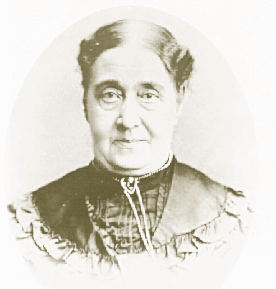
|
THE
HUXLEY
FILE
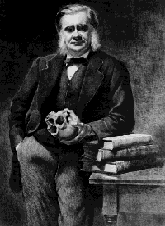
|
| ||||||||||||||||||||||||||||||||||||||||||||||||||||||